
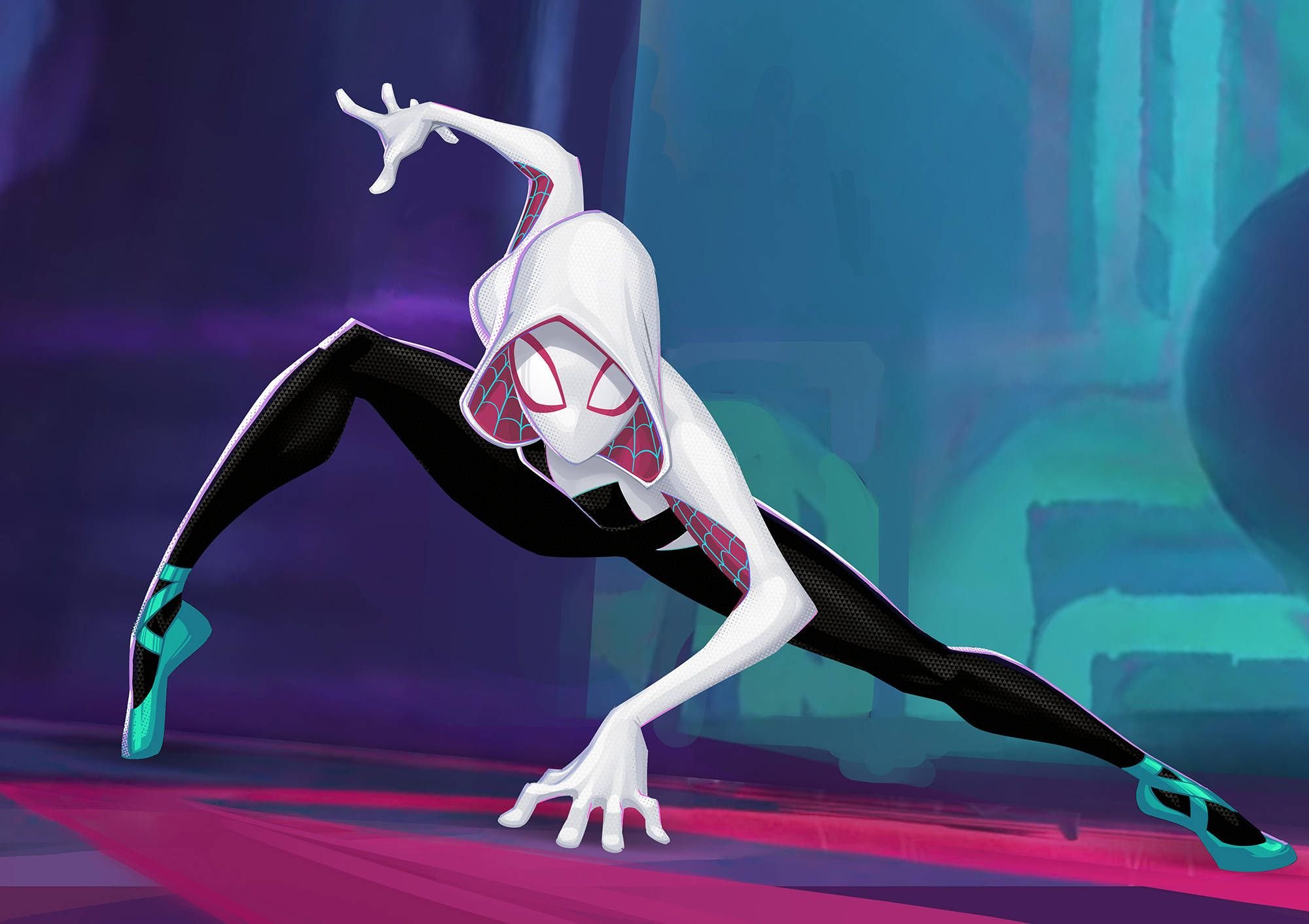
SPIDER-GWEN
The version of Gwen Stacy who lived.
Spider-Gwen — The Complete Comic King Guide
In one universe the radioactive spider bit Peter Parker. In another it bit Gwen Stacy, and Peter is the one who died.
That is the entire premise, and it is why this character works. Gwen Stacy's death is the most famous death in superhero comics. Spider-Gwen is the universe where it went the other way, where Gwen got the powers and the guilt and the double life, and where Peter Parker is the ghost she carries. She was created to fill a single issue of a crossover in 2014. The costume was so good that Marvel announced her own series a month later, and that series went on to be one of the biggest-selling comics of the decade.
She is also one of the more confusing characters on the Marvel wall, and not through anyone's fault. She has had seven first issues in twelve years. She has been called Spider-Woman, Spider-Gwen and Ghost-Spider, sometimes two of those at once, and the name on the cover has often disagreed with the name inside the book. Her first appearance exists in five different printings plus a modern facsimile that is almost impossible to tell from the original at a glance.
This page sorts all of that out. What she is, where to start, which books actually matter, and what to check before you buy one. If you would rather just ask a person, come to the counter at 12915 97 St NW and ask a person. That works too.
Quick Facts
Real Name: Gwen Stacy, of Earth-65
Also Called: Spider-Woman, Spider-Gwen, Ghost-Spider, Gwenom
Created by: Jason Latour and Robbi Rodriguez
First appearance: Edge of Spider-Verse #2, cover-dated November 2014.
First Cover: The same book. First appearance and first cover in one comic, which is rare.
Publisher: Marvel
Series to date: Seven, plus miniseries, annuals and crossovers.
Best starting point: Modern Era Epic Collection volume one, or the compact edition arriving in 2027.
On screen: The Spider-Verse animated films, voiced by Hailee Steinfeld.
Currently publishing: No ongoing series at present. This is a back-issue and collections character right now.
The First Appearance Sold 54,415 Copies. The First Issue Sold 254,074.
Those two numbers explain almost everything about collecting this character, so it is worth sitting with them for a second.
Edge of Spider-Verse #2 came out in September 2014. It was chapter two of a five-issue anthology, a warm-up for a crossover, the kind of book shops order carefully and readers skip. North American comic shops ordered 54,415 copies of it. It was the fortieth best-selling comic in America that month. Nobody knew what was in it.
What was in it was a character design that went off like a flare. Within days people were drawing her. Within weeks they were cosplaying her. Marvel announced an ongoing series at New York Comic Con in October, one month after the issue shipped, on nothing but the reaction.
Spider-Gwen #1 arrived in February 2015. Shops ordered 254,074 copies. It was the third best-selling comic in America that month. Almost five times the debut.
So here is the shape of it. The book that matters is the one nobody bought, and the book everybody bought does not matter much at all. The debut is genuinely scarce for a modern comic because it was ordered like a throwaway. The first issue of her own series is one of the most over-printed Marvel books of its decade, which is why you can hold it in your hand for about what a new comic costs today.
This is the single most useful thing to understand before you spend money on this character, and it is the reason Marvel went back to press on the debut five separate times. By the time the market realised what Edge of Spider-Verse #2 was, the first printing was already gone.
The Run, Era by Era
Seven first issues, three different names on the cover, and a numbering system that only became readable in 2024. Here is the whole thing in order.
The last column names one issue that represents each era, which is also how the gallery above is organised.
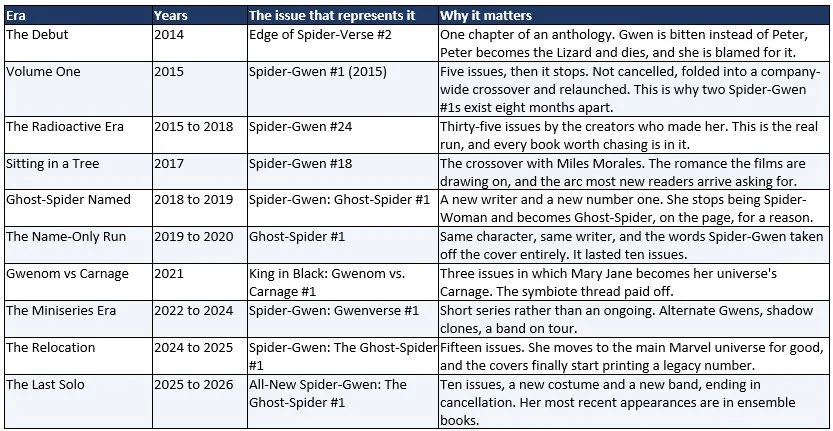
A note on the names, because this trips up more people than anything else on the character. Inside the comics she is called Spider-Woman for the first four years, even while the covers say Spider-Gwen. Spider-Gwen was a marketing name before it was ever her name. Ghost-Spider was coined by Miles Morales during a crossover, when he thought she had died and called her a ghost, and she formally takes it as her own in 2019, partly because the main Marvel universe already had a Spider-Woman in it. From 2022 onward both names live on the cover together. None of this is an error and none of it is a different character.
The Keys — Issues Everyone Hunts
This is a short list, and that is honest rather than lazy. One book carries almost all of the value on this character, a second carries most of the rest, and everything else is a reader.
EDGE OF SPIDER-VERSE #2 is the one that counts. First appearance and first cover in the same comic, which is less common than you would think. Cover-dated November 2014, written by Jason Latour, drawn and covered by Robbi Rodriguez. It is the only Spider-Gwen book that trades in serious money, and it moves steadily rather than sitting, which matters if you are buying one as anything other than a reader.
It also exists in five printings, and the colour matters more than the picture. Marvel went back to press on this book four times after the first printing, and all five use the same Rodriguez cover art, so the picture tells you nothing. What tells you everything is the background colour behind the Marvel logo and the barcode. The first printing has none of the treatments that follow. The second is blue, the third green, the fourth purple, the fifth orange, in that order.
The later printings are worth real but modest money, and here is the part that catches people out. Raw, they line up neatly in printing order, oldest worth most. Graded, they do not. Recent graded sales put the fifth printing above the fourth and both above the third. If you are buying to grade, the fifth printing is the interesting one. If you are buying a slab, do not pay a third-printing premium, because the market does not agree that one exists.
Then there is the facsimile, and the test that does not work on this book. In February 2022 Marvel reprinted Edge of Spider-Verse #2 as a facsimile edition, reproducing the original cover, the original interiors and the original advertising. Facsimiles are normally easy to spot, because the usual trick is to look at the price on the cover. A 1974 comic printed at twenty cents gives itself away instantly when a modern reprint of it says four dollars.
That does not work here, and this is the most important practical thing on this page. The 2014 original was a $3.99 comic. The 2022 facsimile is also a $3.99 comic. The price box reads exactly the same on both. What separates them is the barcode, which is a modern one on the facsimile, and the indicia in the small print inside the front cover, which carries the year of publication. Check those two things, in that order, and ignore the price entirely. If you want the longer version of how to do this on any comic, we wrote a separate guide: https://www.comickingedmonton.com/sell-comics-blog-cluster/how-to-tell-a-first-printing. Edge of Spider-Verse #2 is the worked example of where the quick test breaks down.
SPIDER-GWEN #24 is the first Gwenom, and the book people get wrong. It is the second most significant issue on the character. Gwen bonds with the Venom symbiote on the page in issue twenty-four. Issue twenty-five is titled Gwenom Part One, because it is the first chapter of the arc named after what already happened. Issue twenty-five gets sold as the first appearance constantly. It is not, and the giveaway is that Marvel ordered a second printing of twenty-four specifically because of what happens in it. For most people this is the sensible book to actually own: a genuine first appearance in an affordable band, and it sells often enough that you are not stuck with it.
The variant layer is where the rest of the money is. This is a 2014-onward character, so variant covers are a real part of the picture rather than a footnote. Several store-exclusive and ratio-incentive covers are worth more than any regular-cover issue in the entire run, including covers on issues that are otherwise pocket change. The retailer-incentive cover on the debut, by a different artist entirely, is the most valuable Spider-Gwen item that exists, and it has been climbing while the rest of the character has softened. The rule on this wall is to read the cover, not the issue number.
One sleeper: the second printing of issue zero. Issue zero itself is a reprint of the debut that confusingly shipped after issue one, and it is cheap. Its second printing is a cover homage to the debut, it is worth many times the ordinary version, and it is exactly the sort of thing that sits unnoticed in a cheap box. Check the printing on any issue zero you come across, including one you already own.
And one trap: issue eighteen. It contains two first appearances, the price guides print a strong graded value for it, and copies do move. But there has not been a graded sale of it in over two years, so that printed value is a number without a market behind it. We would rather tell you that than sell you one at a price the market will not give back.
Every Format You Can Buy
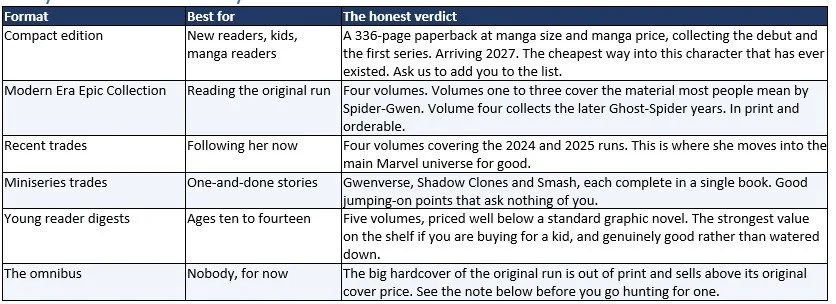
About that omnibus, because it comes up at the counter more than any other question on this character. The Spider-Gwen omnibus collecting the original Latour and Rodriguez run is out of print. It is not being reprinted, and copies now sell for more than they originally cost. If you want that material, the Modern Era Epic Collections cover essentially the same comics across three volumes, they are in print, and we can order them.
There is a second omnibus with a very similar name, and it is not the same book. It collects the later years by a different writer. If someone tells you the Spider-Gwen omnibus is available, this is usually the one they mean. Worth owning if that is the era you want, and worth knowing about before you buy it expecting the original run.
The compact edition is the interesting one. Marvel is launching a line of compact paperbacks printed at the same trim size as manga, at a price that sits closer to a manga volume than a graphic novel, and Spider-Gwen is one of the launch titles. It collects her debut and her first series in a single small book. For anyone who has watched the films and wants to try the comics without committing forty dollars, this is going to be the answer, and it will shelve just as comfortably in our manga section as in Marvel. Ask us to flag it for you when it lands.
On reading age: teen and up for the main run. There is grief in it, a dead Peter Parker, and a symbiote storyline with some real body horror, but nothing explicit. For younger readers the digest volumes and the all-ages collection are the right call, and they are genuinely good rather than watered down.
Screen & Series Status
Updated August 2026: Spider-Gwen is one of the three leads of the Spider-Verse animated films, voiced by Hailee Steinfeld, and those films are the reason most people arrive at this page. The third and final film in that trilogy is in production and scheduled for summer 2027. Beyond that, Sony has confirmed that a Spider-Gwen solo animated film is in active development, with no release date attached.
We will be honest about what that means for buying, because the honest answer is more useful than the exciting one. There is no rush right now. The film is a long way out, no trailer has been released, and her comic series is currently on hiatus after being cancelled. Prices on this character have been soft rather than climbing. If you want the debut, this is a calmer moment to buy it than the one that will arrive when a trailer drops.
One thing worth untangling, because it will cause confusion. A version of Gwen Stacy in costume is also appearing in a Marvel animated series set in a completely different continuity, using the name Ghost-Spider. It is a different character in a different universe with a different voice actor. The comics on this page are not that version. If you have come here after watching that show and something does not match, that is why. She is also a playable card in Marvel Snap, which keeps a low steady hum of interest going regardless of what the films are doing.
None of the above is why this character has lasted. She has lasted because the premise is one sentence long and it lands on anyone who knows anything about Spider-Man. Gwen Stacy is the girlfriend who dies. This is the world where she did not. You can explain that to someone in a comic shop in ten seconds and watch them pick the book up, and that will still work in twenty years.
Collector's Corner — Grading, Care & We Buy
If you are buying, decide first whether you want the debut or you want to read the story, because they are different purchases. If you want to read it, the collections are better than the singles in every way and cost less. If you want the debut, buy the best copy you can afford in one go rather than upgrading through three of them, and check the barcode and the indicia before money changes hands. If you want a first appearance without spending debut money, issue twenty-four is the one: genuine first appearance, sensible price, and it actually trades.
If you are selling to us, bring the whole run rather than the issues you think are the good ones. On this character the value is concentrated in places that are not obvious, and it is often the variant cover on an ordinary issue rather than the issue itself. We check covers and printings individually rather than pricing by the stack. Details on how we buy are here: https://www.comickingedmonton.com/sell-your-comics.
There are three things we check on every copy. One, the barcode and the indicia on any Edge of Spider-Verse #2, because the price on the cover cannot tell a 2014 original from a 2022 facsimile. Two, the printing on any issue zero, because the second printing is worth many times the first. Three, the cover artist on any issue at all, because this character has a variant layer deep enough that the cover matters more than the number.
As for what we tend to have: post-2015 Spider-Gwen is plentiful and cheap, which is the direct consequence of those print runs, so there is usually a good stack of readers in the back issues. Collections are carried on the shelf or special-ordered on request. The debut is a case book when we have one, and we can keep an eye out for a specific issue or printing if you tell us what you are chasing.
FAQ - Straight Answers
What is Spider-Gwen's first appearance?
Edge of Spider-Verse #2, cover-dated November 2014, by Jason Latour and Robbi Rodriguez. It is also her first cover, which is unusual. Be aware that it exists in five printings plus a 2022 facsimile edition, and that the cover price is the same on the original and the facsimile, so the price alone will not tell you which one you are holding. Check the barcode and the small print inside the front cover.
Is Spider-Gwen the same character as Ghost-Spider?
Yes. Same character, different names at different times. She was called Spider-Woman inside the comics for her first four years even though the covers said Spider-Gwen, then took the name Ghost-Spider in 2019, partly because the main Marvel universe already had a Spider-Woman. Since 2022 both names appear on the covers together. Gwenom is a third name, used when she is bonded to a symbiote.
Where should I start reading Spider-Gwen?
The original run by Jason Latour and Robbi Rodriguez, which is collected in the Modern Era Epic Collection volumes one to three. If you would rather try a small cheap book first, a compact paperback collecting her debut and first series arrives in 2027 at roughly manga size and manga price. The big omnibus of the original run is out of print, so do not spend time hunting one at cover price.