
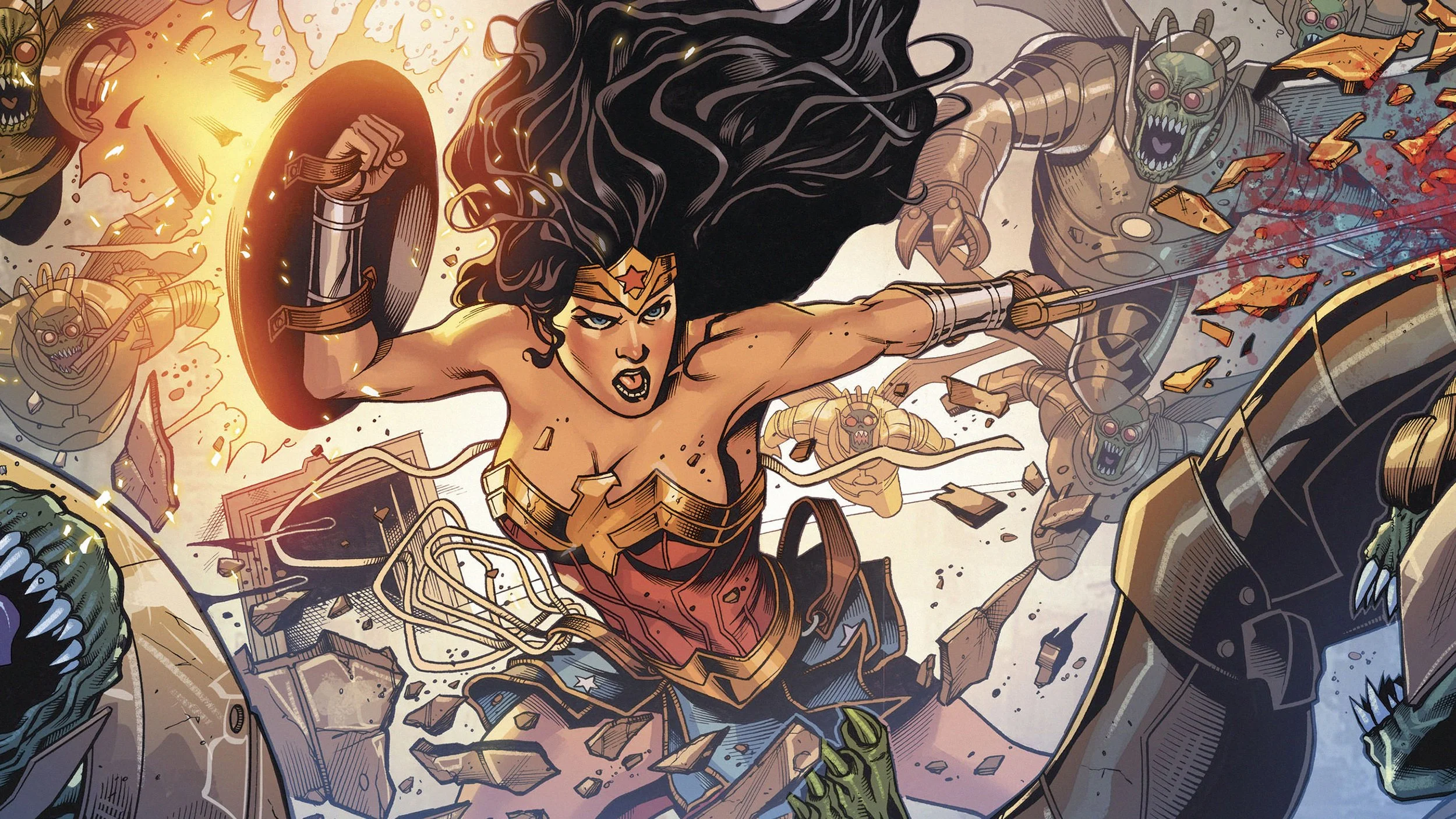
SHE HAS NEVER STOPPED.
Wonder Woman — published continuously since 1941, and the clearest lesson in comic collecting there is · Comic King
Wonder Woman — The Complete Comic King Guide
Wonder Woman has been published continuously since 1941. That sentence is easy to skim past, so here is what it means: of DC's big three, she is the only one who never went away — the superhero genre collapsed in the 1950s and took almost every costumed character with it, and she simply kept coming out. Eighty-five years without a gap makes her the longest-running female lead in comics by a wide margin. She is also, as it happens, the single best example in the entire medium of a collecting distinction that costs people real money when they get it wrong, which is why this page is worth reading properly before you buy anything. Comic King carries Wonder Woman in Edmonton on both ends: this week's new issues, and a back-issue run that is quietly one of the better-value hunts on the wall. If the issue you want isn't on the shelf, we can special-order or source it on request.
Quick Facts
Story: An Amazon from a hidden island who arrives in the wider world and decides to stay and help. Created by a psychologist with unconventional ideas about truth and persuasion.
Length: Published continuously since 1941 — one 329-issue original volume, then six further volumes and a return to legacy numbering.
Status: Ongoing — volume 6 has run since September 2023, with Absolute Wonder Woman running alongside it outside continuity.
Publisher: DC Comics
Age Guide: Broadly all-ages, with a strong dedicated younger-reader line.
Formats: New issues · back issues · graphic novels · omnibus & Absolute editions · facsimile reprints.
At Comic King: New issues weekly, an affordable back-issue run, and we buy DC collections.
First Appearance Is Not the Same Thing as First Cover — and Wonder Woman Is Why
This is the most useful thing on the page, and it is the reason Wonder Woman sits where she does in our homepage gallery. A character's FIRST APPEARANCE is the first comic they appear in at all, anywhere inside it. Their FIRST COVER APPEARANCE is the first comic with them on the front. Those are usually the same book, and when they are not, people lose money. Wonder Woman is the clearest case in comics. She debuts inside ALL STAR COMICS #8, cover-dated December 1941 — as a back-up feature in an anthology, and she is not on that cover at all. Her first cover appearance is SENSATION COMICS #1, from January 1942, where she is front and centre. And her own title, WONDER WOMAN #1, does not arrive until the summer of 1942. Three different books, three different kinds of "first", three different values — and customers mix them up constantly, in both directions. Someone will tell you they own her first appearance and mean Wonder Woman #1. Someone else will pass over an All Star Comics run because there is no Wonder Woman on the cover to tell them what is inside. We check all three, and if you are holding any of them we will tell you exactly which kind of first you have before anyone talks about money.
The Run, Era by Era
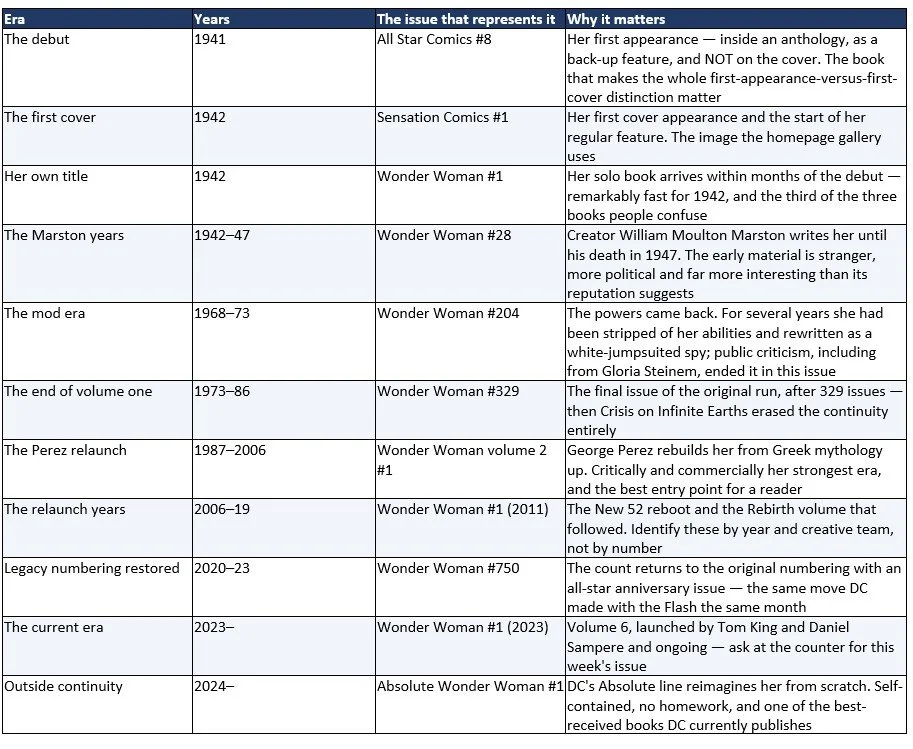
Eighty-five years, organized. Every era of Wonder Woman, the one issue that represents it, and why collectors care:
The Keys — Issues Everyone Hunts
The top of this run is Golden Age heavyweight territory. All Star Comics #8 is her first appearance and a genuinely major book — and it hides, because it is an anthology with no Wonder Woman on the cover and it files under A. Sensation Comics #1 is her first cover appearance and the more visually iconic of the two, and it files under S. Wonder Woman #1 from 1942 is the third leg and the one most people assume is the first appearance. All three need authenticating before any number is discussed, because all three exist as modern facsimiles and older oversized reprints — and the rule across our store is the simple one: if it is oversized, it is a reprint, always. Below the Golden Age, the run gets both cheaper and more interesting. The Marston-era 1940s issues carry real value individually and should never be priced as a lot. The mod era from the late 1960s produced a distinctive, affordable run with a devoted following. Wonder Woman volume 2 #1 from 1987 is a cheap modern key and the single best place for a reader to start. And here is the quiet opportunity worth knowing: her Silver and Bronze Age keys, including her villain first appearances, have historically been picked over far less aggressively than the equivalent Batman or Flash books. The demand for them is steadier than the hype. Key prices move constantly, so we buy and price against live sold comps — ask and we will pull them up on screen together.
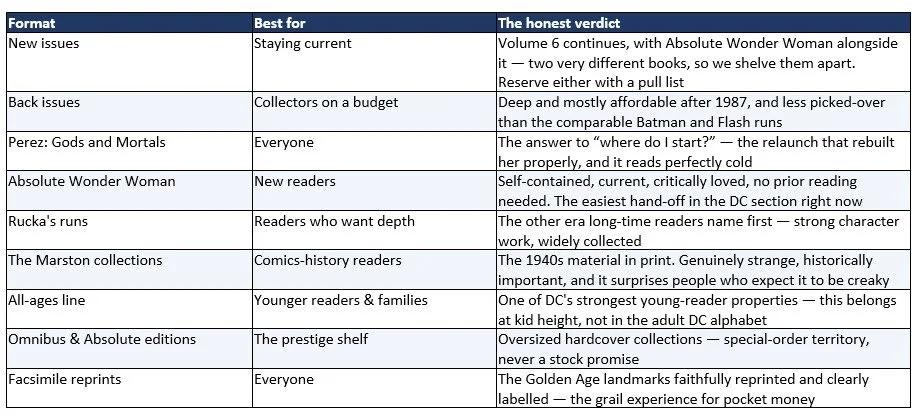
Every Format You Can Buy
Screen & Series Status
Updated August 2026: DC's film universe is being rebuilt around Superman, and Wonder Woman's next screen chapter has not landed yet — which makes this a calm window to build her back-issue wall rather than an expensive one. On the page she is busy: volume 6 continues with a line-wide Wonder Woman event running through the autumn, a guest creative team is handling the monthly while Tom King and Daniel Sampere take a break, and Absolute Wonder Woman continues alongside with its own annual. Exact dates for anything on screen live in the Consolidated Ordering Calendar, not on this page.
Collector's Corner — Grading, Care & We Buy
The habit that matters most on this character is the anthology check, and it is worth stating plainly because it is where the money hides. Wonder Woman's two most important early books do not have her name on the masthead: her first appearance is in ALL STAR COMICS and her first cover is in SENSATION COMICS. A Golden Age collection sorted by title will file both somewhere nobody looking for Wonder Woman will ever check — and a seller can honestly believe they own nothing of hers while holding both. We search both titles in every Golden Age collection we are offered. It is the same discipline the Flash needs for Showcase and Spider-Man needs for Amazing Fantasy, and it is why we ask for the whole box rather than the part with the right name on it. On condition: 1940s newsprint is brittle and most survivors are in low grade. That is entirely normal for the era and those books are still valuable — we grade honestly rather than harshly, and we will explain what we are seeing as we go. We assess keys in front of you with live comps on screen, broker CGC submissions for slab-worthy books, and stock the bags, boards and boxes that keep a collection worth grading in the first place.
FAQ — Straight Answers
What is the difference between a first appearance and a first cover appearance?
A first appearance is the first comic a character appears in at all — anywhere inside it, even as a one-page back-up feature. A first cover appearance is the first comic with that character on the front. Most of the time those are the same book, which is why people assume they always are. Wonder Woman is the clearest example of what happens when they are not: she first appears inside All Star Comics #8, cover-dated December 1941, and she is not on that cover; her first cover appearance is Sensation Comics #1 from January 1942. Both are significant books, both are collected, and they are not interchangeable. It matters practically because a listing that says "first appearance" when it means "first cover" — or the other way round — is describing a different comic at a different price. If you are buying or selling anything from the 1940s, establish which one is meant before money is discussed.
Which Wonder Woman comic is the first one?
It depends what you mean by first, and there are three genuine answers. All Star Comics #8 (December 1941) is her first appearance. Sensation Comics #1 (January 1942) is her first cover appearance and the start of her regular feature. Wonder Woman #1 (Summer 1942) is the first issue of her own title. Collectors chase all three for different reasons and they are valued differently. If someone offers you "the first Wonder Woman", ask which of those three they mean — and if you are the one selling, knowing the difference is worth real money. Bring any of them in and we will identify exactly what you have, check it against reprints and facsimiles, and show you live sold comps on screen.
Why did Wonder Woman lose her powers in the 1970s?
For a few years around the turn of the 1970s, DC stripped her of her abilities and reinvented her as a white-jumpsuited martial-arts spy running a mod boutique. The intention was to modernise her; the effect was to remove the thing that made her Wonder Woman. It drew public criticism — Gloria Steinem was among the most prominent voices — and her powers were restored in issue #204, cover-dated January to February 1973. It is a genuinely strange stretch of comics and it has a devoted following, partly because the art is good and partly because the whole episode is such a clear snapshot of its moment. Those issues are affordable and we usually have some. It is one of our favourite things to hand to a customer who thinks older comics are boring.