
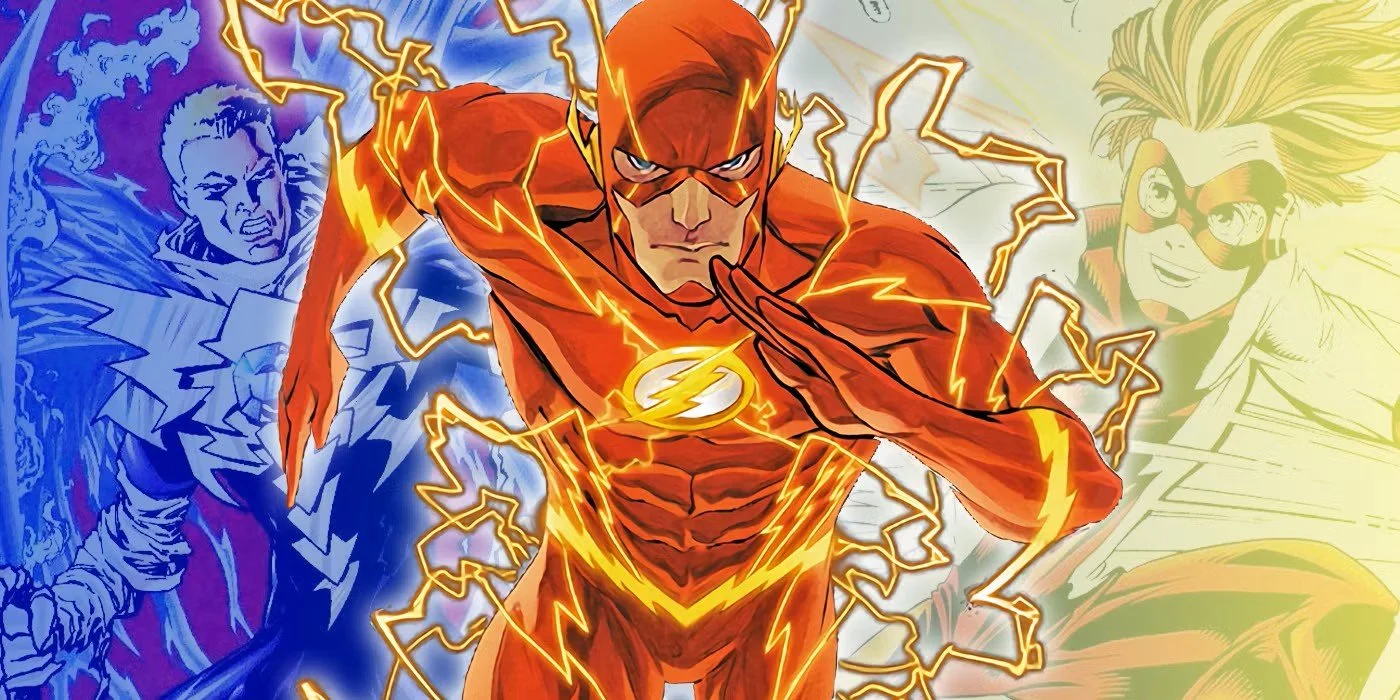
FOUR MEN HAVE BEEN THE FLASH.
The Flash — the character DC restarts the universe with · new issues, back issues and honest valuations · Comic King
The Flash — The Complete Comic King Guide
Most superheroes have a history. The Flash has a job. Three separate times, when DC needed to restart, reorganize or rescue its entire universe, it used this character to do it — and each time the comic that did it became one of the most important books of its decade. That makes the Flash unusually interesting to collect, and unusually confusing to buy, because four different men have worn the costume and the numbering does not behave. Comic King carries the Flash in Edmonton on both ends: this week's new issues, and a back-issue run that is one of the best-value hunts on the DC wall. If the issue you want isn't on the shelf, we can special-order or source it on request.
Quick Facts
Story: A man who can move faster than everything else, and the strange, warm, science-fiction-flavoured world that has grown up around that one idea.
Length: Published since 1940, across two Golden Age-to-modern numbering lines and six volumes — see the era table.
Status: Ongoing — volume 6 has been running since November 2023, with a new creative team from issue #31 in March 2026.
Publisher: DC Comics
Age Guide: Broadly all-ages — one of the most family-friendly characters on the DC wall.
Formats: New issues · back issues · graphic novels · omnibus & Absolute editions · facsimile reprints.
At Comic King: New issues weekly, a deep and affordable back-issue run, and we buy DC collections.
The Flash Is Where DC's History Turns — Three Separate Times
This is the thing worth understanding before you buy anything on this page, and it is the reason a character who is not DC's most famous is one of its most collectible. In 1956 the superhero genre was essentially dead — the war was over, the audience had moved on, and almost every costumed character had been cancelled. DC tried one more time with a new version of the Flash in a try-out comic called Showcase, it worked, and the entire Silver Age of comics followed. Every superhero book published since traces back to that decision, Marvel's included. Five years later, in 1961, the Flash met the older 1940s version of himself in a story called "Flash of Two Worlds", and DC invented the multiverse — the parallel-earth idea that now underpins half of modern blockbuster cinema. And in 1985, when DC wanted to demolish and rebuild its continuity, it killed the Flash to do it, in a death that stuck for twenty years and is still held up as the best in comics. Restarted the genre, invented the multiverse, died to reset the universe. No other character has that record, and it is why the Flash's keys punch above his fame.
The Run, Era by Era
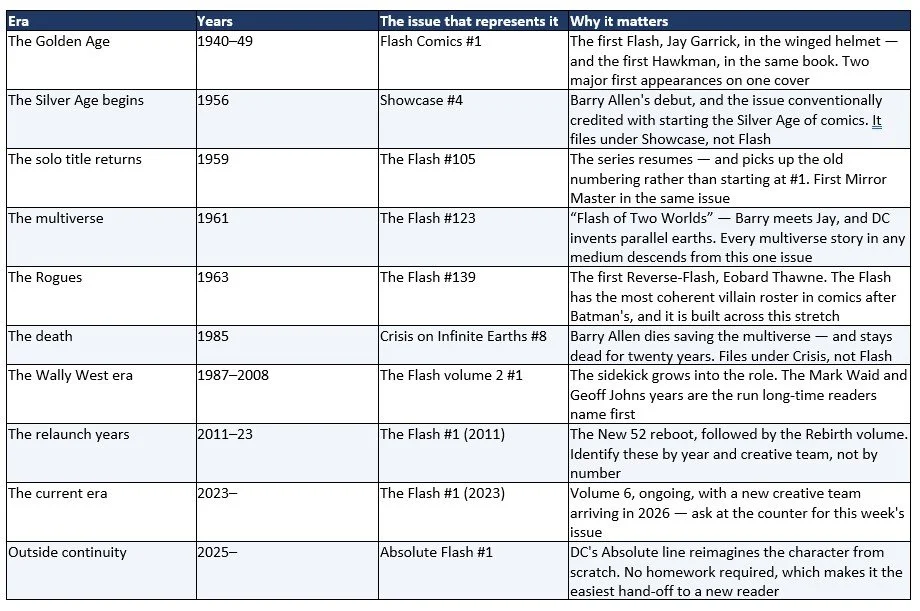
Eighty-six years, organized. Every era of the Flash, the one issue that represents it, and why collectors care:
The Keys — Issues Everyone Hunts
Showcase #4 sits at the top, and it is one of the most important comics of the twentieth century — a six-figure book in strong grade. Here is the practical problem with it: the word Flash does not appear on the masthead. It files under S for Showcase, which means it sits in a completely different part of a collection from where anybody hunting Flash keys will look. We check every Showcase run that comes through the door, and there is a second reason to — Showcase #22 is the first Silver Age Green Lantern, so one modest anthology title contains two enormously valuable DC debuts. Flash Comics #1 is the other heavyweight: the first Jay Garrick and the first Hawkman in the same book, which means it is regularly valued as one key when it is really two. Below those, the run gets interesting fast. The Flash #123 is the multiverse issue and moves every time a parallel-worlds story reaches a screen. The Flash #105 is the first issue of the Silver Age series and the first Mirror Master, and it is frequently mistaken for a first appearance of the Flash himself — it is not, but it is a real key. Then the Rogues cluster: #110 brings Kid Flash and the Weather Wizard, #117 Captain Boomerang, #139 the Reverse-Flash. And Crisis on Infinite Earths #8, the death issue, files under Crisis rather than Flash — another cross-title check we run as a matter of habit. Key prices move constantly, so we buy and price against live sold comps — ask and we will pull them up on screen together.
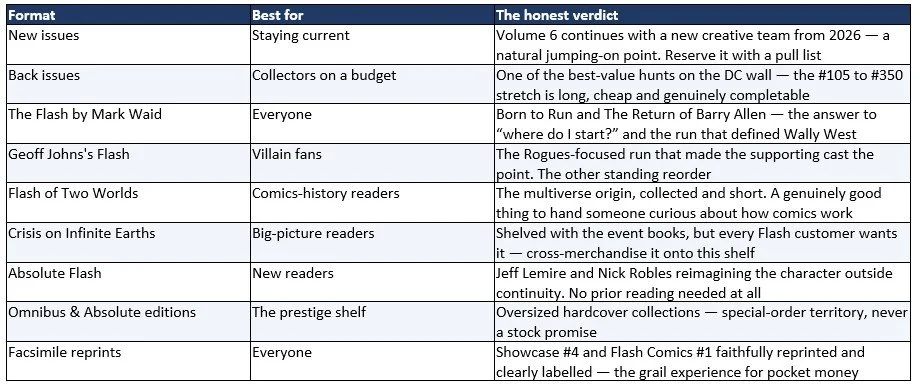
Every Format You Can Buy
Screen & Series Status
Updated August 2026: the long-running Flash television series has finished its run, the standalone film underperformed, and the character's place in DC's rebuilt film universe has not been settled. That is worth saying plainly rather than implying otherwise — and it makes this a calm, cheap window to build a Flash back-issue wall rather than an expensive one. The comic itself is healthy: volume 6 continues with a new creative team from 2026, and Absolute Flash runs alongside it. Exact dates for anything on screen live in the Consolidated Ordering Calendar, not on this page.
Collector's Corner — Grading, Care & We Buy
There is one habit on this franchise that is worth more than all the others, and it is not about the Flash at all — it is about Showcase. The two most valuable DC debuts of the Silver Age, Barry Allen's Flash and Hal Jordan's Green Lantern, both appeared in the same unassuming anthology title, and neither cover carries the character's name on the masthead. That means a seller can honestly say they have no Flash comics while owning one, and a collection sorted by title will file the most valuable book in it under the wrong letter. We search every Showcase run in every collection we are offered, twice. The same logic applies to Crisis on Infinite Earths #8 — the death of the Flash is not filed under Flash. On authentication: both Showcase #4 and Flash Comics #1 exist as modern facsimiles and as older oversized reprints, and the rule is the simple one we apply across the store — if it is oversized, it is a reprint, always. We assess keys in front of you with live comps on screen, grade honestly, broker CGC submissions for slab-worthy books, and stock the bags, boards and boxes that keep a collection worth grading in the first place.
FAQ - Straight Answers
How many different Flashes are there, and how do I tell which one I have?
Four men have carried the name in the main comics. Jay Garrick is the original, from 1940 — you will know him by the silver winged helmet, which looks nothing like the modern costume. Barry Allen arrived in 1956 and is the classic version most people picture: the full red suit with the lightning bolt. Wally West started as Kid Flash and took over the role in 1987 after Barry died, wearing essentially the same costume. Bart Allen has held it briefly too. On a cover, the helmet is the fastest tell — if you can see it, you are holding Golden Age material or a story about Jay specifically, and that is a completely different collecting lane. If you are not sure, bring the book in; the costume and the cover date together answer it in seconds.
Why does The Flash start at issue #105 instead of #1?
Because it did not start — it resumed. The Golden Age title was called Flash Comics and it ran 104 issues before being cancelled in 1949. When DC brought the character back in 1959 with a new solo series, it picked up where the old numbering had left off rather than starting fresh, largely because keeping an existing numbering line was cheaper under the postal permit rules of the time. That is the same reason several Marvel titles resume at odd numbers a decade later. The practical upshot for a collector is that there is no issue #1 of the Silver Age Flash to hunt for — the first issue of that run is #105, and the actual first appearance of Barry Allen is in a different title altogether.
Which is worth more — Flash Comics #1 or Showcase #4?
Both are serious books and the honest answer depends on grade, but they are valuable for different reasons and it is worth knowing which you are being offered. Flash Comics #1, from 1940, is a Golden Age heavyweight and carries two major first appearances — the first Flash and the first Hawkman — in one comic. Showcase #4, from 1956, is the book credited with starting the Silver Age of comics, which gives it a historical significance that very few issues can claim, and it is one of the most sought-after DC books of its era. What we can tell you for certain is that both need authenticating before any number is discussed, because both exist as modern facsimiles and as oversized 1970s reprints. Bring either one in and we will look at it properly and show you live sold comps on screen.