

Sin City
Seven books, always in print. And one anthology issue that does not say Sin City anywhere on the front.
Sin City — The Complete Comic King Guide
Frank Miller’s Sin City is seven books of crime stories set in a city where nobody is clean, drawn in stark black and white with one colour used at a time. It is one of the most visually distinctive things ever published in comics, it produced a landmark film in 2005, and it is permanently in print.
It is also a franchise where almost everything people believe about the comics is slightly off. The first appearance is in a book that does not say Sin City on the front. The famous serialised run has dates that are wrong in most places you will read them. And the one issue worth real money exists in two printings that nobody — not the price guides, not the grading companies, not the sellers — actually tells apart.
Two things before anything else. This is adults-only material, genuinely, and we will not pretend otherwise further down. And no new Sin City comic has been published since the year 2000. There have been announcements. There have not been comics.
Quick Facts
Story: Crime stories set in Basin City, told in stark black and white with one colour used at a time. Separate self-contained yarns rather than one continuing plot.
Length: Seven volumes. ⚠ No new Sin City comic has been published since 2000 — twenty-six years.
Status: Nothing on the new-comics rack. The books are permanently in print and that is the whole business here.
Publisher: Dark Horse, and only Dark Horse. Frank Miller Presents announced new Sin City work in 2022 but never published any of it.
Age guide: ⚠ ADULTS ONLY, and we mean it. Graphic violence, full nudity and sexual content throughout. This is the easiest book in the shop to hand to the wrong person. Ask, describe it plainly, and let the adult decide.
Formats: Seven collected volumes at the standard tier · deluxe slipcased hardcovers · original 1990s single issues, which are a genuine hunt.
At Comic King: The books faced out on the crime and literary shelves, all seven kept in stock, and honest answers about what the old issues are actually worth.
The Only Sin City Book Worth Money Doesn’t Say Sin City on the Cover
In April 1991 Dark Horse published a fat black-and-white anthology called the Dark Horse Presents Fifth Anniversary Special. It cost nine dollars ninety-five, ran a hundred and twelve pages, and collected work from most of the company’s features. Inside it, for the first time anywhere, was an eight-page strip called Sin City, and a man called Marv.
Frank Miller drew the cover. But he did not draw Sin City on it. The cover shows Martha Washington from Give Me Liberty, leaping across rocks with a knife in one hand, with an alien claw reaching in from the corner. Down the right-hand side is a list of the features inside, in white capitals. Sin City is the last name on that list, at the bottom.
That is why this book hides. It files under Dark Horse Presents, it looks like a generic early-nineties anthology, and the only clue on the front is one line of small text in a stack of eleven. It gets bulk-priced constantly. It is the first appearance of an entire franchise.
Now the part that is genuinely unusual, and the reason this section exists at all.
That book was printed twice. There is a first printing from April 1991 and a later printing from the same year, and both carry the identical nine ninety-five cover price. The price box, which is the normal way to spot a reprint, tells you nothing. And here is the strange bit: none of the usual authorities separate them. The main online price guide lists one entry covering both. The largest grading company gives the book a single census line and puts no printing information on its slab labels at all — even though that same company routinely does break printings out separately, including for other Dark Horse books and for a later Sin City issue. And the sellers do not help either: across thirty recent sales of this book we checked, exactly one mentioned which printing it was.
The consequence is worth understanding. The market is not paying a premium for the first printing, because the market cannot see which copies are first printings. Every price you will read for this book is a blind average of both.
For a customer that is a caution: if you are buying this as the first appearance, the printing matters and the listing almost certainly will not tell you. For us it is simply how we do the job — we check the small print inside the front cover before we buy one and before we sell one, and we tell you which you are holding. That is not a clever trick. It is just the one piece of information nobody else on this book is bothering to look up.
And it is worth saying what the books are actually like, because "adults-only crime comic" undersells them. Miller is doing something formally strange here: pages that are almost pure white shapes on black, rain drawn as white scratches, a character rendered as nothing but a silhouette and a pair of eyes. Whole sequences run without dialogue. The one colour — Goldie’s hair, the yellow of the villain in the fourth book, a woman’s red dress — is used maybe once a chapter and lands like a gunshot. It is the most confident-looking comic on the shelf, and that is why it sells face-out to people who have never bought a comic in their lives.
The stories themselves are pulp, deliberately and unapologetically: a man avenging a woman he knew for one night, a private detective in over his head, a cop protecting a girl from a senator’s son. They are short, they are brutal, and they are told with total conviction. You will either take to that in about ten pages or you will not, which is another reason we would rather you flipped through one here than ordered it blind.
The Run, Era by Era
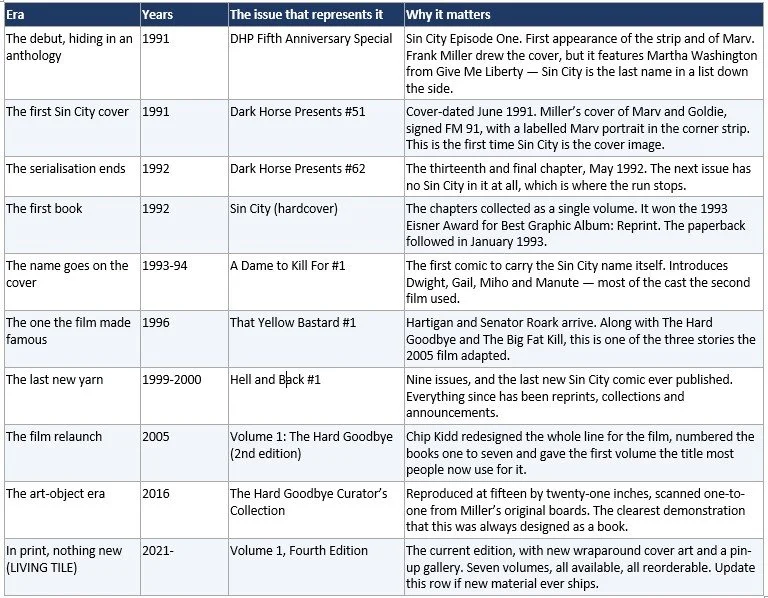
Sin City started as a back-feature in an anthology, ran thirteen chapters, and then became a series of self-contained books.
There is no reading order to get right, which makes it unusually easy to recommend.
The Keys — Issues Everyone Hunts
The Dark Horse Presents Fifth Anniversary Special, April 1991, nine ninety-five. First appearance of Sin City and of Marv, as covered above. One thing to be straight about: it is important, but it is not rare. Well over two hundred copies have been professionally graded and more than half of those came back near-mint or better, which tells you it was a squarebound book that people looked after. It sells briskly and it is affordable. Buy it because it is the first appearance, not because it is scarce, because it is not.
Dark Horse Presents #51, cover-dated June 1991. The first Sin City front cover — Miller’s image of Marv in a bullet-holed trench coat with Goldie on his arm, signed FM 91, with a small labelled portrait of Marv in the corner strip. Note the date: you will see this issue listed as May 1991 in several places, and there does not appear to have been a May 1991 issue at all. The anniversary special sat in that slot.
Dark Horse Presents #52 through #62 carry the remaining chapters, finishing in May 1992. Issue #63 has no Sin City in it, which is a useful thing to know when you are working through a run. These are affordable, they are a satisfying want list, and they are the only real hunt this franchise offers.
Here is the number that justifies searching every Dark Horse Presents run that comes through the door. Take the Sin City chapters and the surrounding issues from the same title, same years, same format. The Sin City issues have been sent for professional grading roughly seven times as often. Between two consecutive issues the gap is starker still: the last Sin City chapter has been graded more than twenty-five times as often as the issue that followed it. Nobody grades an ordinary anthology. They grade these.
A Dame to Kill For #1, 1993 — the first comic to carry the Sin City name on its own cover, and the first appearance of Dwight, Gail, Miho and Manute. Many sellers assume this is the franchise’s first appearance. It is not, and it is priced accordingly, which makes it a genuinely good honest entry point for someone who wants a meaningful first issue without chasing the anthology.
That Yellow Bastard #1, 1996, introduces Hartigan and Senator Roark. Worth separating two characters that constantly get confused: Cardinal Roark, the villain of The Hard Goodbye, and Senator Roark, who arrives here, are different men.
And one correction that comes up often. Nancy Callahan is routinely credited to That Yellow Bastard, because that is her starring role and the one the film made famous. She actually first appears back in The Hard Goodbye, as the dancer at Kadie’s — and she is the only character who appears in all seven volumes.
Hell and Back, 1999 to 2000, nine issues. The last new Sin City comic ever published.
One practical note for anyone building the Dark Horse Presents run. These were thin anthologies that got read hard, so genuinely clean copies of #51 to #62 are less common than the era would suggest — early nineties books are usually easy to find in high grade and these are the exception. The anniversary special is the opposite: it was squarebound, more like a paperback than a comic, and it survived well. So the cheap chapters are the harder ones to find nice, and the expensive one is the easy one. That is worth knowing before you pay a premium for a sharp copy of the wrong book.
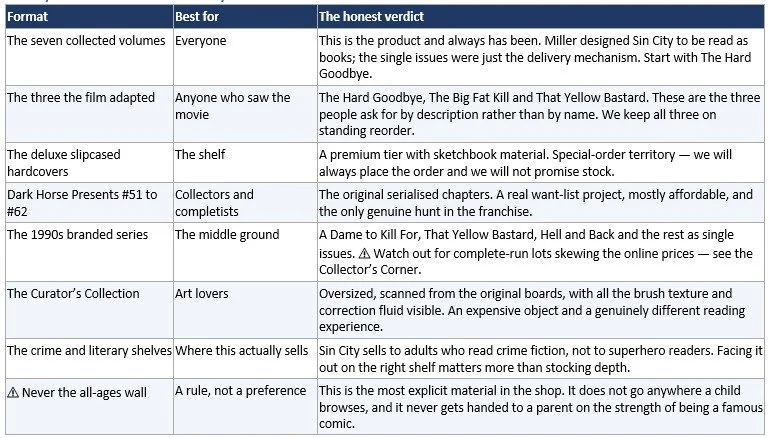
The collected editions carry no collector premium at all, because they have never gone out of print. That is not a criticism — they are the product. They are simply not the chase.
Every Format You Can Buy
Screen & Series Status
Updated August 2026: nothing is in production, and this franchise generates more announcements than output. The useful skill here is telling the two apart.
Sin City reached cinemas on 1 April 2005, co-directed by Robert Rodriguez and Frank Miller, and it reproduced the panels almost literally. It was a genuine hit and it changed how comics were adapted for a decade. The sequel, A Dame to Kill For, arrived nine years later in August 2014 and failed badly — it took less worldwide than it cost to make before a penny of marketing, and it grossed under a fifth of what the original did domestically. A third film had been discussed publicly the same year. It was cancelled.
A television series was announced in November 2019, when Legendary acquired the rights with Robert Rodriguez and Frank Miller in talks to produce, and both live-action and animated versions were mentioned. Since that announcement there has been no casting, no order, no platform and no update of any kind — coming up on seven years. It has not been cancelled either. Treat it as announced and dormant, and please do not let anyone tell you it is coming.
On the comics side, Frank Miller launched his own publishing company in 2022 and announced two new Sin City projects: a colour one-shot with the Italian artist Milo Manara, and a western set in the same city’s past. Neither has ever been solicited or shipped. The company itself stopped putting out new solicitations in 2024, its publisher departed, and its collected editions moved to another publisher entirely. So these are not books running late. They are announcements from a company that has largely stopped publishing.
Miller himself is busy — there is a memoir out this year and a new science-fiction series that launched at Comic-Con in July 2026, and notably that series came out through Dark Horse, who have said more Miller projects are coming. That is worth watching. It is not Sin City news yet.
What actually sells this franchise needs no news at all: the 2005 film keeps finding new viewers, and every one of them who liked it is a customer for The Hard Goodbye. That has been true for twenty-one years.
One last piece of context that explains the whole shape of this franchise. Miller designed Sin City to be read as books from the very beginning — the anthology chapters were a delivery mechanism, not the intended form. That is unusual for comics of that era and it is why the collected volumes have never gone out of print in thirty years, why there is no continuity to keep up with, and why a franchise with no new material since 2000 is still perfectly healthy on a shelf. Most comics need momentum. This one does not.
Collector's Corner — Grading, Care & We Buy
Three practical things, and the first two will save money.
The printing check on the Fifth Anniversary Special, as described further up. Two printings, one cover price, no help from the guides. Read the small print inside the front cover. This is the single most valuable habit on this franchise and it takes ten seconds.
The second is about online prices on the 1990s series, and it is a trap we would rather you knew about. The published market prices for single issues of A Dame to Kill For, That Yellow Bastard and Hell and Back are badly inflated, because a large share of the recorded sales feeding them are not single issues at all — they are complete-run lots and collected editions that happen to have the issue number in the listing title. On one of those books, more than half the recent sales used to set the price were bundles. Strip those out and single copies trade for a small fraction of the quoted figure. If you are selling, do not be surprised when a real offer is well below what a price guide app shows you; if you are buying, do not pay the app price. We work from actual single-copy sales and we will show you them.
The third is a genuine market observation on the key book, and it points in a useful direction. Over the past year, ordinary readable copies of the Fifth Anniversary Special have risen noticeably, while top-graded slabbed copies have fallen and now sit well below where they were three years ago. More people are buying the book to have it; fewer are paying a premium for a perfect one. If you want this comic, the affordable copy is the one the market is actually moving toward.
On condition generally: early-nineties Dark Horse anthologies were thin and were read hard, so clean high-grade Dark Horse Presents is less common than the era suggests. The exception is the anniversary special itself, which was squarebound and survived well.
We buy Sin City, with one note on language. When someone offers us a Sin City collection they almost always mean the trade paperbacks, which are in print and carry no premium. When someone offers us a box of old Dark Horse Presents, they may unknowingly be offering the real key. We ask about both, every time — and if you are clearing out either, bring them and we will tell you honestly what is there.
One last thing, on displaying it. Some of this material is explicit. We think carefully about what is visible at child height, and we would ask the same of anyone reselling it.
FAQ — Straight Answers
Where do I start?
The Hard Goodbye, always. It is the first story, it is self-contained, and it is the one the film opens with. After that, The Big Fat Kill and That Yellow Bastard are the other two the film adapted. There is no reading order to worry about beyond starting there.
Is it suitable for a teenager?
We will describe it plainly and let you decide, because that is the only honest answer. It contains graphic violence, full nudity and sexual content throughout, and it is considerably more extreme than the film. It is not a book we would recommend for a young reader, and we would rather have that conversation with you than have you find out at home.
Is there any new Sin City coming?
No. Two projects were announced in 2022 and neither has ever been solicited or shipped, and the company that announced them has largely stopped publishing. A television series was announced in 2019 and has been silent since. No new Sin City comic has been published since 2000. If you read a headline saying otherwise, it is almost certainly an announcement rather than a release.
Are my old Sin City comics worth anything?
Possibly, but probably not the ones you think. The trade paperbacks are permanently in print and carry no premium regardless of age. The 1990s single issues are modest, and their online prices are inflated by bundle sales. The book that matters is the Dark Horse Presents Fifth Anniversary Special from 1991 — and if you have one, we will check which printing it is before either of us talks about price.
Do I need to read them in order?
No. Each volume is a self-contained story and they can be read in almost any order — a few characters recur and there is a loose chronology, but nothing depends on it. Start with The Hard Goodbye because it is the strongest opening and it establishes the city, then follow whichever cover appeals. It is one of the easiest recommendations in the shop for exactly that reason.
Why does the first appearance not say Sin City on it?
Because Sin City began as a back-feature in an anthology. It was one strip among eleven, listed last on the cover, in a book named after the anthology rather than the story. It was a back-feature before it was a franchise, and that single fact is what finds it in a collection.