
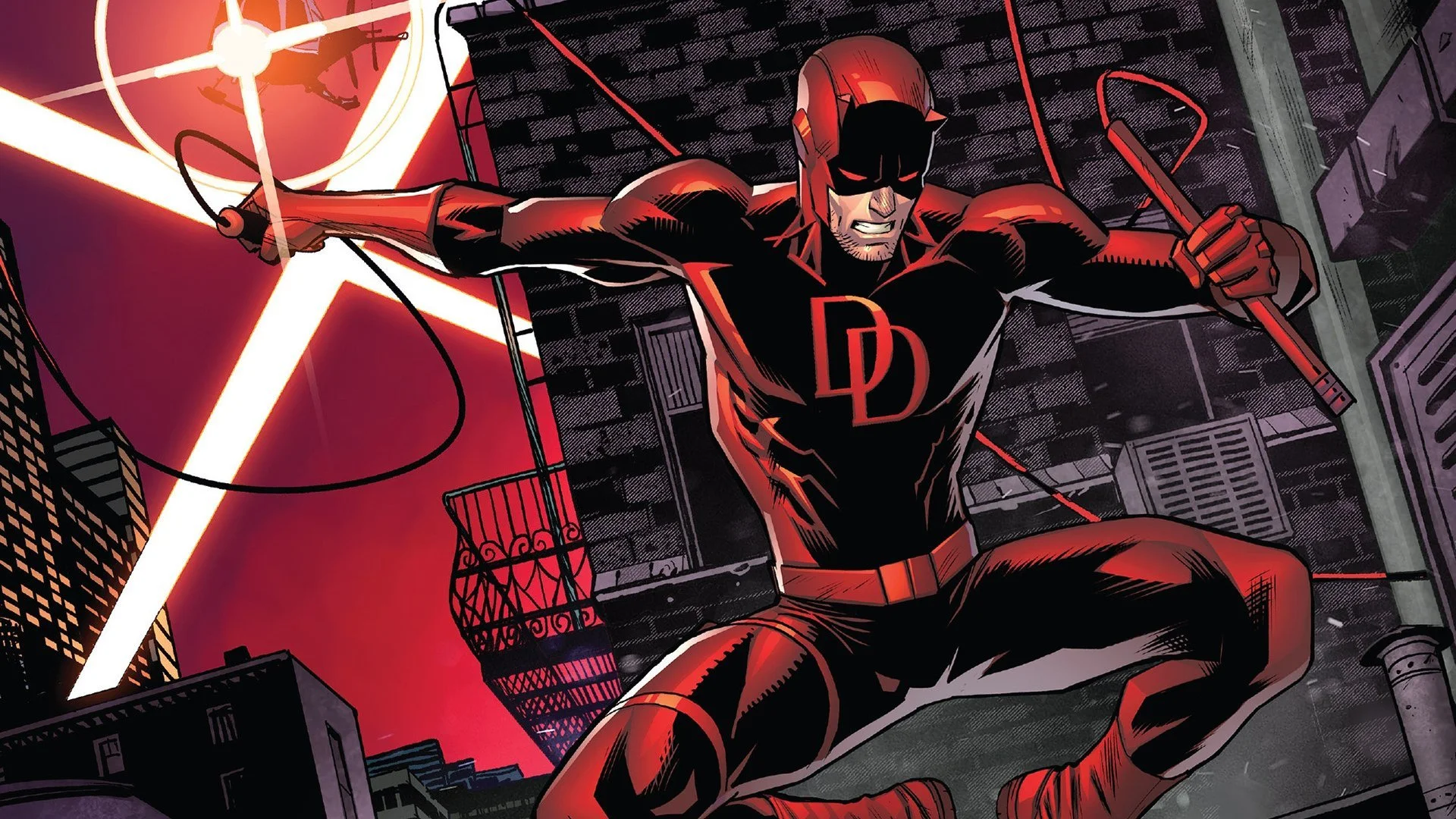
YELLOW BEFORE RED.
Daredevil — the yellow issues, the Miller run the show is built on, and the one comic that dates itself across a room · Comic King
Daredevil — The Complete Comic King Guide
For fifteen years Daredevil was a perfectly decent comic that nobody would have called important. A blind lawyer with heightened senses, well drawn, reliably published, quietly mid-list. Then in 1979 a young artist called Frank Miller took over the art, then the writing, and turned it into one of the most respected runs in American comics — ninjas, the Hand, Elektra, a New York that felt genuinely dangerous, and eventually Born Again, which a lot of people will tell you is the best superhero story ever published. Every screen version you have seen descends from that, not from 1964. It is the clearest case in comics of one creator rescuing a character outright. There is also a detail on this page that will save you time in a long box: HE WAS YELLOW FIRST. The costume on Daredevil #1 is yellow and black, and the red suit everybody pictures does not arrive until issue seven — which means you can date a Daredevil comic from across a room, and the earliest and most valuable issues identify themselves. Comic King carries Daredevil in Edmonton across all of it — the Miller and Born Again collections that people actually want, a searched Silver and Bronze wall, and honest routing for anybody who arrived from the television series. If the book you want is not on the shelf, we can special-order or source it on request.
Quick Facts
Story: Matt Murdock: blinded as a child by the accident that sharpened every other sense, a defence lawyer by day and something considerably less lawful at night, Catholic about all of it, and never once allowed to be happy for long.
Length: Since April 1964 — volume one ran to #380, then a run of relaunched volumes through to a new one in March 2026. Ask which ERA rather than which volume: the value and the demand are concentrated in one stretch.
Status: Current on both fronts, which is rare. A new comic volume launched in March 2026, and the television series is confirmed for a third season.
Publisher: Marvel Comics
Age guide: ⚠ Adult in tone despite being a superhero — violence, addiction, Catholic guilt and some genuinely bleak stretches. Born Again in particular is not a children's book. We will ask before recommending it for a young reader.
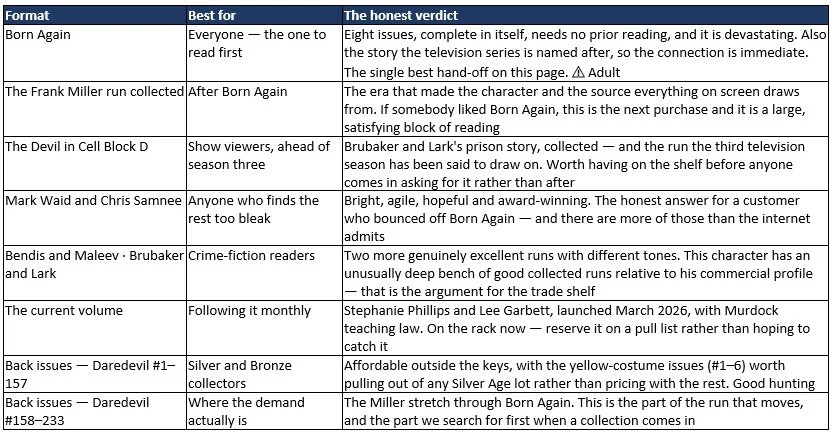
Formats: An unusually strong trade shelf — five or six genuinely great collected runs · Silver and Bronze back issues · the current monthly · Omnibus and Epic Collections by special order.
At Comic King: Born Again and the Miller collections face-out, the yellow-costume issues pulled out of Silver Age lots rather than bulked, and staff who will not start a show viewer at issue one.
Yellow Before Red, and the Run That Changed Everything
Two things to know before you buy or sell anything on this page, and the first one is the most useful sorting rule on our Marvel wall. THE COSTUME DATES THE COMIC. Daredevil's original suit, from his debut in April 1964, is YELLOW AND BLACK. Wally Wood redesigned it into the all-red version everybody knows in DAREDEVIL #7, only six issues later — and that red design has lasted more than sixty years unchanged. So yellow means issues one to six, the earliest and most valuable stretch of the run, and you can see it from the other side of the shop. It is also the fastest authentication cue there is: if the cover is red, it is not issue one. The second thing is the story of the whole franchise. For fifteen years and roughly a hundred and fifty issues, Daredevil was a solid mid-tier book — Gene Colan's art on it is genuinely admired, and Marv Wolfman's mid-1970s run introduced BULLSEYE in DAREDEVIL #131, who became the character's defining opponent. Then FRANK MILLER arrived as artist on #158 in 1979, took over the writing shortly after, and rebuilt the book from the ground up: ninja clans, organised crime, a genuinely frightening Kingpin, and in DAREDEVIL #168 a character called ELEKTRA who has outlived the run that created her. Miller's first stretch ran to #191, and he came back in 1986 with artist David Mazzucchelli for BORN AGAIN, in which Karen Page sells Matt's secret identity for a fix and the Kingpin methodically dismantles his life. That eight-issue story is why the television series is called what it is called. Which leads to the single most useful thing we can tell you at the counter: IF YOU CAME FROM THE SHOW, YOU DO NOT WANT DAREDEVIL #1. You want Miller, and you want Born Again — the 1964 comic is a completely different book, and starting there is how people decide comics are not for them.
The Run, Era by Era
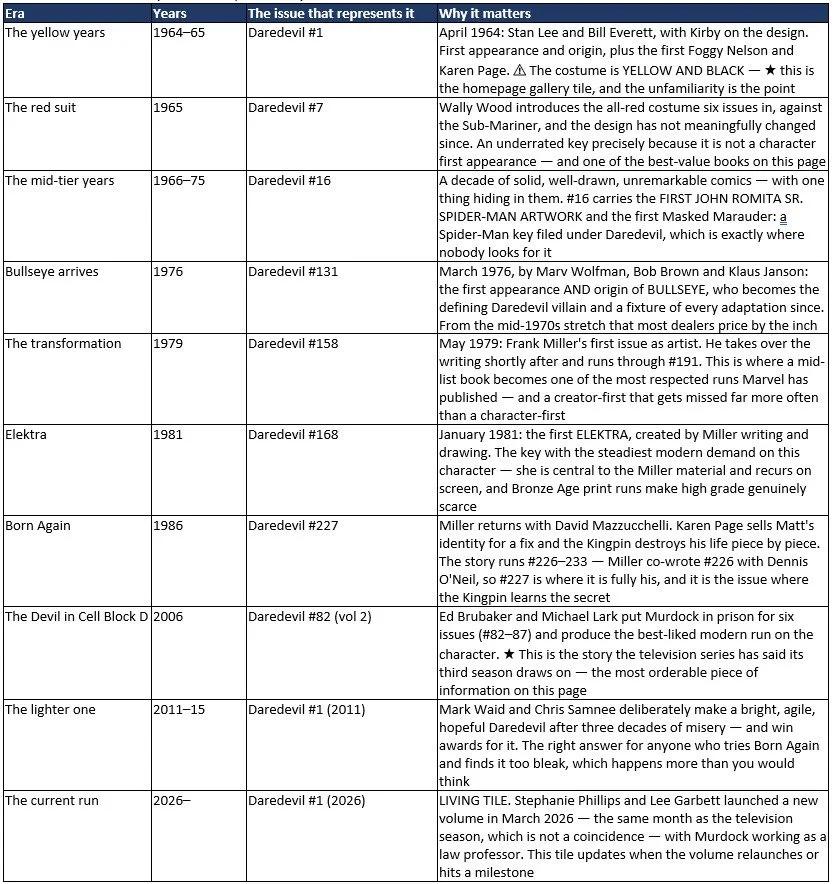
Sixty-two years, one costume change and one creator who changed everything, organized. Every era of Daredevil, the one issue that represents it, and why collectors care:
The Keys — Issues Everyone Hunts
DAREDEVIL #1 is the franchise key and it is a serious Silver Age Marvel book: four figures raw, five figures through the upper grades, and it trades a couple of times a week, so there is no excuse for a guessed price. The yellow costume on the cover is the authentication cue and the reason it is hard to get wrong. DAREDEVIL #7 is the one more people should be buying — the first red costume, by Wally Wood, at a little over a hundred dollars raw with three sales a week and a price that has been moving up. It gets overlooked purely because it is a design first rather than a character first, and design firsts are consistently the cheapest way into an expensive run. DAREDEVIL #16 is the surprise on this page: the first John Romita Sr. Spider-Man artwork, sitting in a Daredevil comic, at a similar price and selling roughly once a day nationally. Spider-Man collectors do not search Daredevil runs and Daredevil collectors do not know what they have, so it slips through both. DAREDEVIL #131 is the first Bullseye and his origin in one issue, from a mid-1970s stretch dealers routinely bulk-price. DAREDEVIL #168 is the first Elektra and the key with the most consistent demand here — around a hundred and fifty raw, trading weekly in the middle grades, and it climbs steeply at the top because Bronze Age print runs mean high grade is genuinely scarce. DAREDEVIL #158 is Miller's first issue and a creator-first worth pulling rather than bulking, as is the whole stretch behind it. And BORN AGAIN is the bargain: the individual issues run about the price of two new comics each, the complete eight-part story is realistically completable in an afternoon, and it is the best thing on the shelf. Two warnings: Daredevil #1 exists in facsimile and in oversized reprint collections, and oversized always means reprint; and post-1990 Daredevil is plentiful and cheap despite how good several of those runs are — the reading demand is real, the collectible demand is not, and we will say so. Key prices move constantly, so we buy and price against live sold comps — ask and we will pull them up on screen together.
Every Format You Can Buy
Screen & Series Status
Updated August 2026: Daredevil has the most useful screen position of any character on this site, and the reason is not the size of the show but its RHYTHM. Born Again's second season aired from late March 2026, a third season is confirmed and was filming through the first half of this year, and the pattern so far points to another spring arrival. A returning series on a predictable cadence is worth more to a shop than a one-off film, because you can plan for it instead of guessing — we treat March as a Daredevil month the way early November is a war-comics month. Two things make the planning specific rather than vague. First, the adaptation draws on one era: the television material is built on Frank Miller and on Born Again, so a customer arriving from the show wants the 1980s comics, not 1964. Second, the third season has been described by its own producers as drawing on THE DEVIL IN CELL BLOCK D — the Brubaker and Lark story in which Murdock ends up in prison — which tells us exactly which collection to have in stock before anyone asks for it. On the comics side a new volume launched in March 2026 by Stephanie Phillips and Lee Garbett, deliberately timed to the season. As always, the character keys move with the characters: when Elektra, Bullseye or the Kingpin feature heavily, their first appearances follow. Exact release dates for anything upcoming live in our ordering calendar, not on this page.
Collector's Corner — Grading, Care & We Buy
Four habits govern this character at our counter. THE COSTUME CHECK is the fastest sort on the Marvel wall and the one we teach first: yellow and black means issues one to six, the earliest and most valuable stretch; red means seven onward. You can date a Daredevil comic across a room, which is not true of most characters, and it means the good ones announce themselves. THE MILLER STRETCH IS WHERE THE MONEY MOVES — #158 through Born Again, and #168 specifically. Dealers who sort a collection by decade rather than by creator walk straight past it, so when a Daredevil run comes in we pull that stretch before anything is bulk-priced. THE TWO HIDDEN KEYS get checked every time, because both sit in the parts of the run people skim: #131 for the first Bullseye, in the mid-1970s stretch, and #16 for the first Romita Spider-Man artwork, which is a Spider-Man collectible filed under a completely different character. And THE MODERN REALITY, which we will always be straight about: post-2000 Daredevil is plentiful and cheap even though several of those runs are genuinely excellent. The reading demand is real and the collectible demand is not, so when a modern collection comes in we buy the trades rather than the singles and we tell the seller why. Beyond those: Daredevil #1 has a facsimile edition and appears in oversized reprints, so we authenticate before quoting; grade does heavy work on the Silver Age material and we grade conservatively and broker the serious books rather than shelf-pricing them. Bring the whole box — on this character the valuable issues are the ones that look least like the version you know.
FAQ - Straight Answers
Why is Daredevil yellow on the first issue?
Because that was the original costume, and it only lasted six issues. Daredevil debuted in April 1964 in a yellow-and-black suit designed by Bill Everett, and Wally Wood redesigned it into the all-red version in DAREDEVIL #7 in 1965. The red design has been essentially unchanged for sixty years, which is why the yellow one looks so wrong to anybody who knows the character from television. Two useful consequences. First, it is the fastest way to date a Daredevil comic — yellow means issues one to six, and those are the earliest and most valuable of the run, so the good ones identify themselves from a distance. Second, it is the fastest authentication cue there is: if somebody offers you a "Daredevil #1" with a red costume on the cover, it is not Daredevil #1. Issue seven is worth knowing about in its own right, incidentally — the first red costume is a genuine key and it costs a fraction of the first issue.
I watched the show — which comics should I actually read?
Born Again, and then the Frank Miller run. This is the single most useful thing we can tell a new Daredevil customer, because the obvious answer is wrong. The television series is built almost entirely on the 1980s comics: Frank Miller took the book over in 1979 and rebuilt it, and Born Again — an eight-issue story from 1986 by Miller and David Mazzucchelli, which the show takes its name from — is the source of the tone, the Kingpin and most of what people recognise. Daredevil #1 from 1964 is a perfectly good comic and a completely different experience, and starting a show viewer there is how you lose them. Born Again is the right first purchase for almost everybody: it is short, it needs nothing read before it, and it is widely rated among the best superhero stories published. After that, the Miller run collected. If it all turns out to be too bleak — which is a normal reaction — the Mark Waid run is bright and hopeful and just as good.
Which Daredevil issues are actually worth money?
Fewer than people expect, and not always the obvious ones, so here is the honest map. DAREDEVIL #1 from 1964 is the big one and it is a four-figure comic even in modest shape. DAREDEVIL #168 from 1981 is the first appearance of Elektra and has the steadiest demand of anything on this character — it is the one we most want to see walk in. DAREDEVIL #131 is the first Bullseye and his origin, and it sits in a mid-1970s stretch that gets bulk-priced constantly. DAREDEVIL #7 is the first red costume and is genuinely undervalued. And DAREDEVIL #16 is the odd one — it contains the first Spider-Man artwork by John Romita Sr., which makes it a Spider-Man collectible hiding in a Daredevil comic, and almost nobody on either side of that goes looking for it. Everything else is more modest: the Miller stretch from #158 is worth pulling out and comping properly, Born Again issues are cheap and lovely, and most post-1990 Daredevil is common regardless of how good it is. Bring the box in and we will go through it with you against live sold results rather than a guide.