
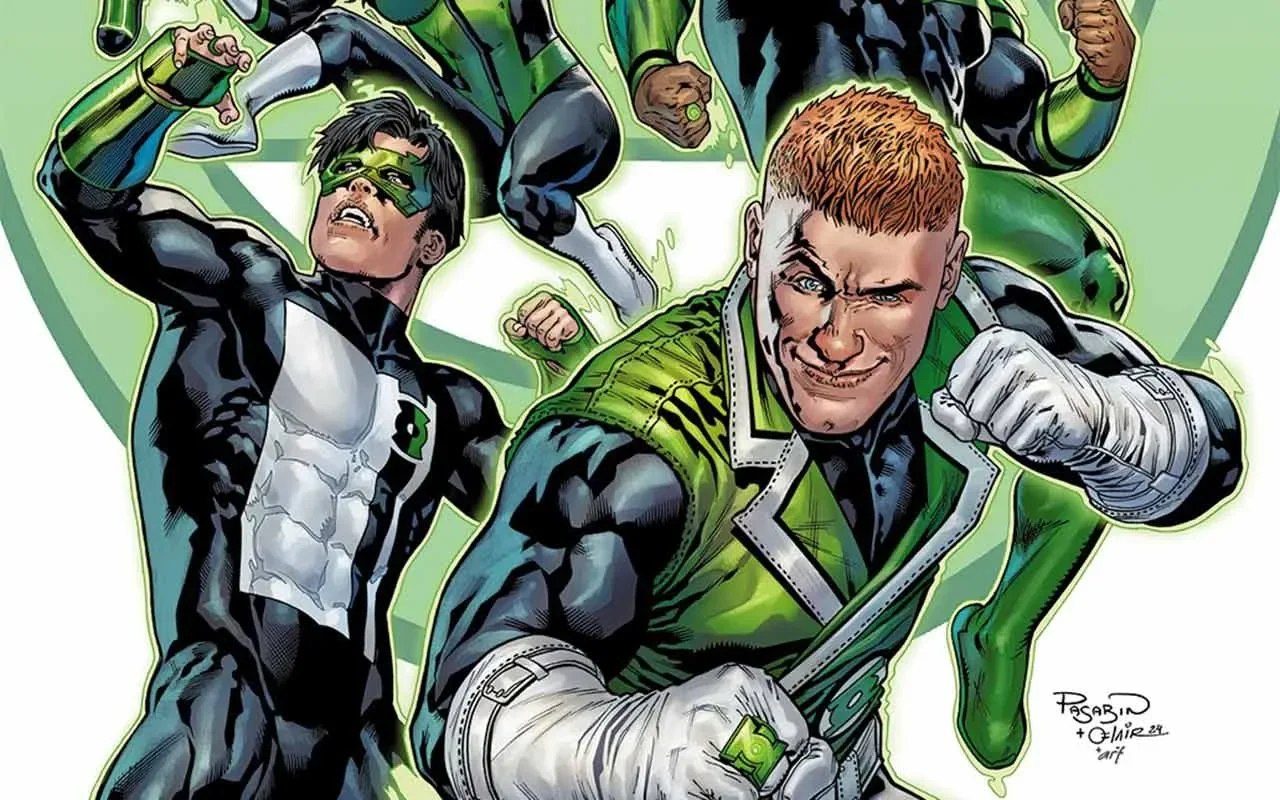
GREEN LANTERN IS A JOB, NOT A MAN.
Five people have carried the ring · new issues, back issues and honest valuations · Comic King
Green Lantern — The Complete Comic King Guide
Green Lantern is the one DC franchise that is genuinely science fiction. Not a man in a cape in a city — an intergalactic police force of thousands, one officer per sector of space, powered by willpower and a ring that makes whatever you can imagine. It is also the franchise most likely to cause confusion at a comics counter, because "Green Lantern" is not a person. It is a job, and five different men have held it. Getting that straight is the difference between buying the right comic and the wrong one, and it is where this page starts. Comic King carries Green Lantern in Edmonton on both ends: this week's new issues, and a Bronze Age back-issue wall that is deep, affordable and more historically important than most people realise. If the issue you want isn't on the shelf, we can special-order or source it on request.
Quick Facts
Story: A ring that turns willpower into anything you can imagine, and a police force of thousands who carry them.
Length: Published since 1940 across seven volumes and several parallel titles — see the era table.
Status: Ongoing — volume 7 has run since May 2023, and reached an anniversary issue numbered #600 in March 2026.
Publisher: DC Comics
Age Guide: Broadly all-ages — and the Corps concept, thousands of space police with one per sector, is an unusually easy sell to younger readers.
Formats: New issues · back issues · graphic novels · omnibus & Absolute editions · facsimile reprints.
At Comic King: New issues weekly, a deep and affordable Bronze run, and we buy DC collections.
Green Lantern Is a Job, Not a Man — and Five People Have Had It
This is the first thing to establish and it saves everybody time. ALAN SCOTT is the original, from 1940 — a railway engineer with a magic lantern, no space police, no Corps, and an origin with nothing at all to do with the version most people know. HAL JORDAN arrived in 1959, a test pilot chosen by a dying alien, and he is the classic Green Lantern: the ring, the Corps, the Guardians, the whole cosmic apparatus. JOHN STEWART came in 1971, an architect recruited as a substitute, and he has since become one of the most prominent Lanterns of all. GUY GARDNER is the abrasive one people either love or cannot stand. KYLE RAYNER took over in 1994 when the franchise was rebuilt from scratch, and you can spot his era instantly by the crab-mask helmet. Five men, one name, one ring, and completely different collecting lanes — their first appearances are in different decades and different titles, and the values are nothing like each other. So when someone tells us they are after Green Lantern comics, our first question is always the same: which one? It is not pedantry. It is the difference between handing you a five-dollar book and a five-figure one.
The Run, Era by Era
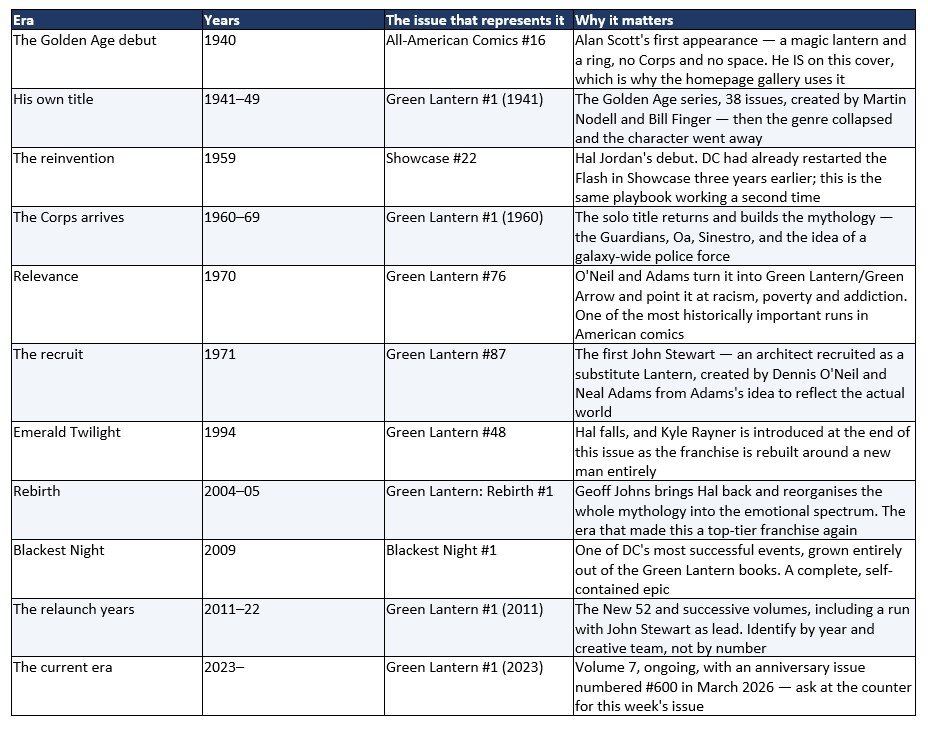
Eighty-six years, organized. Every era of Green Lantern, the one issue that represents it, and why collectors care:
The Keys — Issues Everyone Hunts
Two books sit at the top and they are separated by nineteen years. Showcase #22, from October 1959, is Hal Jordan's first appearance and a major Silver Age key — and it hides, because the masthead says Showcase, not Green Lantern. It files under S. Worth knowing: Showcase #4 is the first Silver Age Flash, so one unassuming anthology title contains two enormously valuable DC debuts, neither of them named on the cover. We search every Showcase run that comes in, twice. All-American Comics #16, from July 1940, is Alan Scott's first appearance and a Golden Age heavyweight — and unlike some Golden Age debuts, he genuinely is on the cover, which we have verified. It files under A. Below those, the run gets both cheaper and more interesting. Green Lantern #76 from 1970 is bought for its historical weight and its Neal Adams cover, and it is a permanent fixture on every "most important comics" list. Green Lantern #87 is the first John Stewart and is the book on this page we would most encourage you to look at properly — see the next section. The early volume two run carries Sinestro's debut, the franchise's defining villain. Green Lantern #48 to #50 is Emerald Twilight and the arrival of Kyle Rayner, though 1990s print runs mean grade discipline applies hard. And Green Lantern: Rebirth and Blackest Night are modern, plentiful, and valued on reputation rather than scarcity. Key prices move constantly, so we buy and price against live sold comps — ask and we will pull them up on screen together.
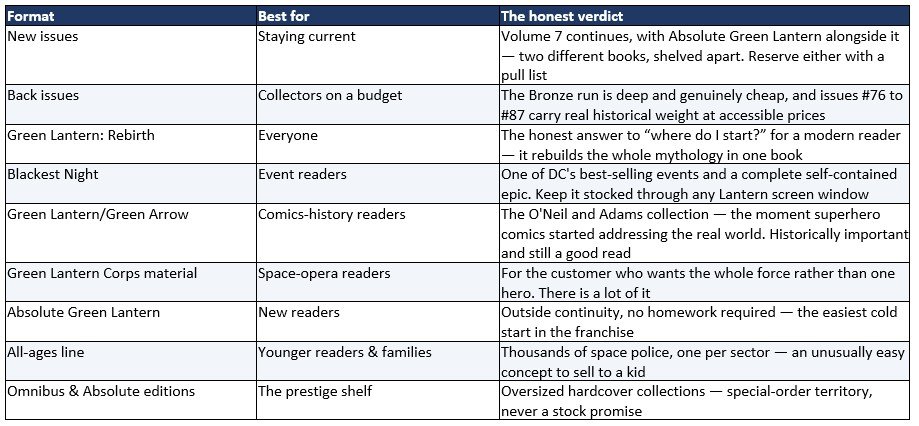
Every Format You Can Buy
Screen & Series Status
Updated August 2026: LANTERNS arrives on HBO Max on 16 August 2026, releasing weekly across eight episodes through to 4 October. Aaron Pierre plays JOHN STEWART and Kyle Chandler plays Hal Jordan, with Nathan Fillion appearing as Guy Gardner, connecting it to DC's wider rebuilt film universe. It is being made as a grounded crime story rather than a space opera — two intergalactic officers investigating a murder in small-town America. What that means for readers: John Stewart is about to become the Green Lantern a very large number of people meet first, and his first appearance is Green Lantern #87, from December 1971. If you have ever thought about that book, this is the season to ask us about it. On the page, volume 7 continues and Absolute Green Lantern runs alongside it outside continuity.
Collector's Corner — Grading, Care & We Buy
The habit that matters most here is the Showcase check, and it is worth doing twice on every collection. Showcase #4 is the Silver Age Flash and Showcase #22 is the Silver Age Green Lantern — one modest anthology title, two of the most valuable DC books of the era, and neither cover carries the character's name on the masthead. A seller sorting by title will file both under S and never think to mention them. We search every Showcase run that comes through the door. The second habit is specific to this franchise and it is about sorting: a "Green Lantern collection" might be built around any of five different characters, and the keys for each are in different decades and different titles. We sort by which Lantern before we price anything, because getting that wrong in either direction is expensive. On the 1990s material: Emerald Twilight-era books were printed in boom quantities, so only genuinely high grade carries a premium and the rest is honest bin material — we will tell you that plainly rather than let you find out later. And on authentication, the standing rule applies: Showcase #22 and All-American Comics #16 both exist as facsimiles and oversized reprints, and if it is oversized, it is a reprint, always. We assess keys in front of you with live comps on screen, broker CGC submissions for slab-worthy books, and stock the bags, boards and boxes that keep a collection worth grading.
FAQ - Straight Answers
Which Green Lantern is which?
Five men have carried the ring in the main comics, and telling them apart is the single most useful thing to know about this franchise. Alan Scott is the 1940 original — a magic lantern, no Corps, and a costume that looks nothing like the modern one. Hal Jordan arrived in 1959 and is the classic version: test pilot, green and black uniform, the whole space-police mythology. John Stewart came in 1971, an architect recruited as a substitute, and he is now one of the most prominent Lanterns there is. Guy Gardner is the loud one. Kyle Rayner took over in 1994 and is instantly identifiable by the crab-mask helmet and the very 1990s costume design. Their first appearances are decades and titles apart, and the values are nothing like each other — so if you are buying, selling or just asking, start by telling us which one you mean, and if you are not sure, bring the book in and the costume will tell us in seconds.
Which comic has the first appearance of John Stewart?
Green Lantern volume 2, issue #87, cover-dated December 1971 to January 1972. He was created by writer Dennis O'Neil and artist Neal Adams, from Adams's idea that the Green Lantern Corps ought to reflect the actual world it was policing — John Stewart is an architect recruited as a substitute Lantern when Guy Gardner is injured. It is a significant issue for reasons well beyond collecting, and it has historically been priced below what its importance would suggest, partly because it sits in the middle of a long Bronze Age run that gets sorted quickly. We look for it specifically in every Green Lantern run we buy, and we are always interested in a clean copy. Ask us what we have.
What is Blackest Night, and do I need to read anything before it?
Blackest Night is a DC-wide event from 2009 that grew entirely out of the Green Lantern books, and it is one of the best-selling and best-liked events the publisher has produced. The short version: the emotional spectrum that Geoff Johns built into the Green Lantern mythology gets a black end of it, and the dead come back. You do not strictly need to read anything first — it is written to be followable — but it lands considerably harder if you read Green Lantern: Rebirth beforehand, because that is the book that sets up the whole system it depends on. That is our standard recommendation for anyone starting Green Lantern from scratch: Rebirth, then Blackest Night. Both are permanently in print, we keep them stocked, and between them they are the most satisfying entry into this franchise there is.