
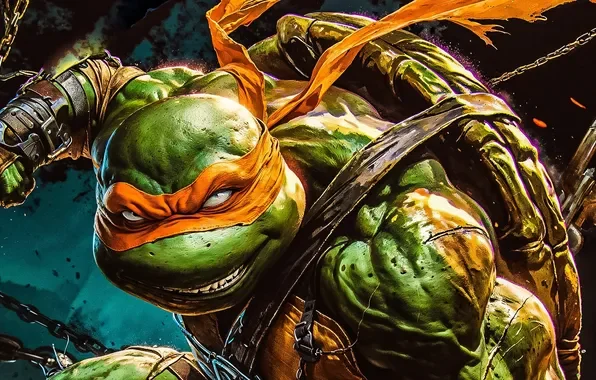
ONE OF THESE IS FROM 1984.
Teenage Mutant Ninja Turtles — six printings, one counterfeit, and the right Turtles book for every age · Comic King
Teenage Mutant Ninja Turtles — The Complete Comic King Guide
Two friends in Massachusetts drew a black-and-white parody of the comics they liked, ordered three thousand copies with a tax refund and a loan from an uncle, and got three thousand two hundred and seventy-five back because the printer overran the job. They sold them out of a table at a small convention in New Hampshire in May 1984. That comic is now one of the most valuable books published in the last fifty years, and the characters in it have been a cartoon, a film series, a video game and a toy aisle for four decades running.
It is the best story in independent comics, and it has produced the most confusing back-issue situation of any franchise we handle. There is no single continuous run — five different publishers have put out a TMNT comic, each with its own issue one. The most famous characters from the cartoon are not in the original comic at all. And the first issue itself was printed six separate times across eight years, with the difference between the first printing and the fourth being roughly the difference between a house deposit and a nice dinner.
So this page is organised around one question we ask before any other, and we ask it kindly and every single time: WHICH ONE HAVE YOU ACTUALLY GOT? Get that right and everything else is easy.
Quick Facts
Story: Four mutant turtles trained as ninja by a mutant rat, in a book that started as a deadpan parody of gritty 1980s comics and accidentally became a global brand.
Creators: Kevin Eastman and Peter Laird, self-published through their own Mirage Studios.
The Original: May 1984, black and white, oversized magazine format. Three thousand ordered, three thousand two hundred and seventy-five actually delivered
Publishers: FIVE, each with its own issue one — Mirage, Archie, Image, Dreamwave, and IDW since 2011. Always ask which publisher and what year before quoting anything.
Printings of issue one: SIX, between 1984 and 1992 — plus a known counterfeit and, from 26 August 2026, an official facsimile.
Where to start: Depends entirely on age and taste, which is why we ask. The original in collected form, the cartoon-era Archie books, the modern IDW run, or The Last Ronin for adults.
Age guide: THE WIDEST RANGE IN THE SHOP. Genuine all-ages books at one end, and The Last Ronin — which the creators themselves describe as R-rated — at the other. Same name, three different shelves, and we will not mix them up.
The one thing to check: The inside front cover. On issue one it is where the printing is declared, and it is worth more than the cover, the grade or the seller's description.
Six Printings, One Counterfeit, and a Facsimile Landing This Month
TMNT ISSUE ONE WAS PRINTED SIX TIMES: May 1984, June 1984, February 1985, September 1985, 1988 and 1992. Only the first is the book people mean when they talk about the grail. The gap between them is not a premium, it is a category difference — a second printing is worth something like a fifth of a first, a third printing around a thirteenth, and the fourth and fifth printings roughly a hundredth. Same cover art on the first three. That is why this page exists.
★ THE FIRST TEST IS THE INSIDE FRONT COVER, and it is delightfully simple: the second and third printings SAY SO, in plain type, just under the artist credit. The first printing says nothing at all. The fourth printing has a completely different full-colour cover and announces itself as a reprint. The fifth adds an extra story. The sixth is squarebound with an introduction by Harlan Ellison and is unmistakable.
★★ AND HERE IS THE THING THAT CHANGES ON 26 AUGUST 2026. For forty years the confirming test has been the inside BACK cover: a genuine first printing carries an advertisement for a small Mirage comic called Gobbledygook, and the later printings replace it with an iron-on transfer ad. Every guide online tells you to check for it. IDW'S NEW FACSIMILE EDITION, SHIPPING THIS MONTH, REPRODUCES THAT ADVERTISEMENT — and reproduces the original oversized dimensions too. From the end of August, 'it has the Gobbledygook ad' proves nothing on its own. We would rather tell you that now than have you find out from a seller.
What still works, and what we actually use: the facsimile is forty-four pages against the original's forty, it carries a modern cover price and a modern barcode, and its indicia says IDW and 2026 rather than Mirage and Dover, New Hampshire. The 1984 book is printed on cheap off-white newsprint that has aged; nothing new feels like it. And there are production artefacts unique to the first printing — a misspelled name on page fifteen that was corrected from the second printing onward, and stray lines outside the art on several pages.
⚠ THERE IS ALSO A GENUINE COUNTERFEIT, and it is old enough and good enough that the grading companies slab it with a note saying so. The tells are on the back cover: the fine crosshatching in Shredder's shadow is missing and printed as solid black, the red reads pink rather than deep red, and there is often a pale scrape across the middle. Separately, people bleach the printing line off second and third printings to pass them as firsts — which is exactly why we check the back cover and the paper, not just the front.
None of this is a reason to be nervous about buying one. It is a reason to buy one from somebody who will put the two books side by side and show you. Bring yours in and we will do that whether or not you are selling it, because most people who own a TMNT issue one have no idea which one they have, and finding out is genuinely fun.
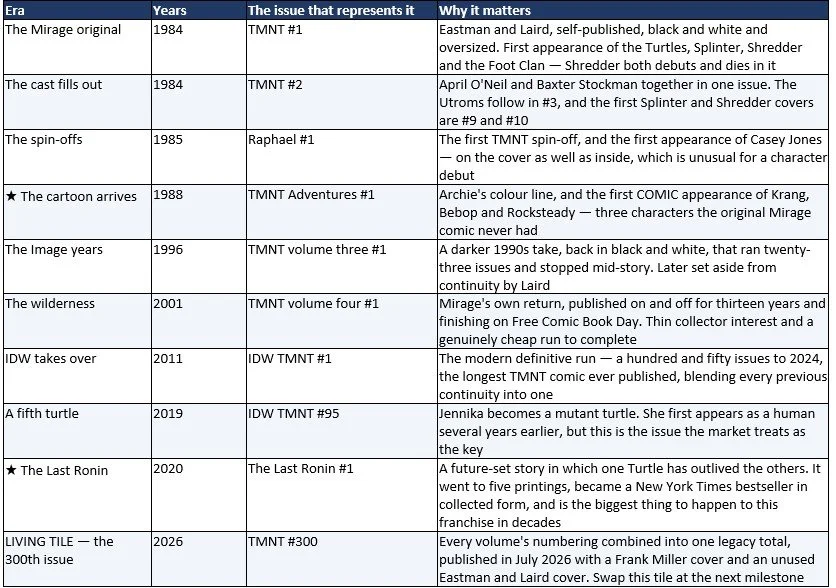
The Run, Era by Era
Four decades, five publishers, and no continuous numbering anywhere. Every era, the one issue that represents it, and why collectors care. Note how many of the famous characters arrive in somebody else's comic.
The Keys — Issues Everyone Hunts
TMNT ISSUE ONE, FIRST PRINTING, IS THE GRAIL and it is a five-figure comic in any collectable grade. It is also, and this surprises everybody, THE HARDEST BOOK IN THE FRANCHISE TO ACTUALLY BUY OR SELL. There have been a handful of genuine public sales in three years and they range across a spread of roughly three to one, which means there is no reliable market price — only a series of individual events. A certified top-grade copy has not changed hands publicly in over two years.
★ THE COUNTERINTUITIVE FACT WORTH SAYING OUT LOUD: the THIRD printing trades roughly twenty times as often as the first. If you want a 1980s Mirage issue one on your shelf that you can also sell again one day, the third printing is a far more sensible object to own, and it costs something like a thirteenth of the price. We would rather sell you that and tell you why than let you believe a first printing is a liquid asset. It is a trophy, and trophies are fine — just buy one knowing what it is.
★★ THE BUY-ON-SIGHT RECOMMENDATION ON THIS PAGE IS TMNT ADVENTURES ISSUE ONE, from Archie in 1988, and it is the strongest one we have made anywhere on this site. It is the first comic appearance of KRANG, BEBOP AND ROCKSTEADY — the three characters everybody who watched the cartoon can name — and it costs about a third of what a Last Ronin first printing costs and roughly a fifteenth of a Mirage third printing. It is also THE MOST ACTIVELY TRADED VINTAGE TURTLES COMIC THERE IS: raw copies change hands about once a day, and even top-grade certified copies trade weekly. Important, cheap and liquid almost never appear together. Here they do.
⚠ ONE WARNING ON IT, because the mistake is easy and common: there are TWO Archie comics called TMNT Adventures number one. The 1988 three-issue miniseries is the key. The 1989 ongoing series that followed also starts at number one, is worth roughly half as much, and gets listed by careless sellers as the Krang first appearance. Check the year.
★ THE CHEAP TIER IS THE BEST THING ON THIS PAGE FOR AN ORDINARY CUSTOMER, and we sell it as a set: the first comic Krang, Bebop and Rocksteady, the first Shredder cover, the first Splinter cover, the Fugitoid, Slash, and Jennika as a mutant turtle. Six comics, every one a character somebody can name from a screen, and the whole group costs about what a single mid-grade Raphael number one costs. Every book in it trades at least twice a month, so none of them is a book you get stuck with. If somebody wants to start collecting rather than reading, we start them here.
RAPHAEL NUMBER ONE, from 1985, is the first Casey Jones and the first TMNT spin-off, and it is a properly good key — raw copies trade a couple of times a week at a very reasonable price. ⚠ Be careful at the top of its ladder though: a certified top-grade copy is more than ten times the raw price and trades about TWICE A YEAR. Buy this one raw or in a middling slab unless you are genuinely collecting rather than investing.
THE EARLY MIRAGE RUN NEEDS ITS REPUTATION CORRECTING, and correcting it saves customers money. Issue two is a genuine four-figure book in high grade — April O'Neil and Baxter Stockman together. Issues three through six are solid three-figure books certified and very affordable raw. But issues SEVEN THROUGH ELEVEN are ordinary comics — most of them cost less raw than a couple of new releases, and anyone quoting you a hundred dollars for a raw one is well above market. Issue ten is the exception worth grading, because the first Shredder cover carries a real premium at the top.
THE LAST RONIN ISSUE ONE, from 2020, is the modern key and behaves like one — first printings trade twice a week and top-grade certified copies trade weekly, which is better liquidity than almost anything vintage here. ⚠ It went to five printings and the later ones are inexpensive, so the printing question applies to the modern shelf too. Its fifth printing in particular trades about three times a YEAR and should be priced accordingly.
⚠ AND TWO WE WILL TALK YOU OUT OF GRADING. The first Metalhead appearance from 2014 has never had a single certified sale recorded, so any graded price you see quoted for it is a computer's guess rather than a market. TMNT three hundred, from last month, is trading briskly in raw copies and has no certified sales at all yet. Both are fine comics to own. Neither has a graded market to sell into.
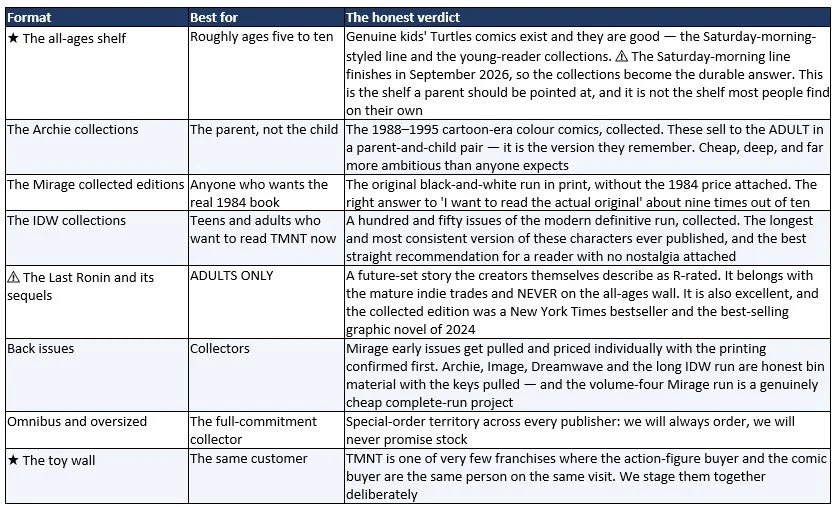
Every Format You Can Buy
Screen & Series Status
Updated August 2026, and there is a lot moving.
★ THE GENERATIONAL PATTERN IS THE MOST USEFUL THING TO UNDERSTAND HERE, and it does not expire: TMNT gets remade for every new generation of children, and each remake brings a fresh age cohort to the same characters while the previous cohort grows into the collector market. That is why this franchise never has an off year, and why we keep three separate shelves rather than one.
★★ AND IT MATTERS COMMERCIALLY WHICH KIND OF ANNOUNCEMENT ARRIVES. A new cartoon sells KIDS' BOOKS AND TOYS. An adult-skewing project sells COLLECTOR SINGLES AND KEYS. Read which one it is before ordering anything — this is the single most practical rule on the page.
RIGHT NOW BOTH ENGINES ARE RUNNING AT ONCE, which is unusual. On the children's side, a new preschool series launched in July 2026 and an animated film sequel arrives in summer 2027; a major new toy licensee also takes over next year. On the adult side, the Last Ronin story concludes in a final chapter dated for summer 2027, a video game based on it is back in development with a new studio, and a live-action film is dated for late 2028. The older streaming series was cancelled at the end of 2025.
ON THE COMICS SIDE the flagship is very much alive: it passed a legacy three hundredth issue in July 2026, which was the best-selling comic of that month outside Marvel and DC. A new creative team takes over the ongoing series in January 2027, and the current writer's run finishes shortly before that.
⚠ ONE NOTE ON THAT MILESTONE ISSUE, because we would rather be straight with you than sell you a story: its enormous order number was driven substantially by a sealed random-cover programme, which means the copies exist in quantity. It is a lovely comic and a real event. It is not a scarce book and we will not price it as one.
THE EVERGREEN PLAYBOOK: ahead of any TMNT screen event, stage the matching wall. A family film means the all-ages and Archie collections face out at child height with the toys beside them. An adult project means The Last Ronin and the Mirage keys in the case. And keep the entry volumes in standing reorder year-round rather than chasing each announcement, because on this franchise there is always another announcement.
Collector's Corner — Grading, Care & We Buy
Four habits govern this franchise at our counter, and the first one is worth more than the other three put together.
THE PRINTING QUESTION COMES BEFORE THE PRICE QUESTION, EVERY TIME. 'Let me check which printing this is first' is the most valuable sentence in this shop. We open the inside front cover, we check the inside back cover, we look at the paper, and we do it in front of you. Getting this wrong costs four figures in one direction or the other, and from the end of August 2026 it takes one more step than it used to, because the new facsimile reproduces the tell everyone relies on.
WE CHECK EVERY BLACK-AND-WHITE INDEPENDENT STACK THAT COMES THROUGH THE DOOR. Self-published 1980s black-and-white comics get bulk-priced by dealers in a hurry, and this is precisely the stack a Mirage first printing hides in. It costs us a few minutes and it has to be done on every single collection.
WE ASK WHICH PUBLISHER AND WHAT YEAR BEFORE WE SAY A NUMBER. Five publishers, five different issue ones, and two different Archie comics both numbered one. A thirty-second identification: oversized black and white means Mirage 1984 and we stop and check the printing; bright cartoon-style colour means Archie; glossy nineties black and white means Image; anything modern with an IDW logo is 2011 or later; a grim future-set book with an aged Turtle is the Last Ronin line and belongs on the adult shelf.
WE ARE HONEST ABOUT GRADING ON MODERN AND MID-TIER BOOKS. Certification earns its cost at the very top of this franchise and almost nowhere else — we will tell you when a book is worth submitting, and for most Turtles comics the answer is no. Storing them: bag and board, boards behind the comic, upright and out of sunlight. The 1984 printing in particular was newsprint with a glossy cover and it shows handling badly, which is why a genuinely sharp copy is scarcer than the print run alone suggests.
On the buy counter: Mirage early issues are graded and comped individually with the printing confirmed first. Archie arrives in bulk, reads beautifully, and we buy it cheap and price it cheap so it does volume on the all-ages wall. The Image, Dreamwave and long IDW runs are bins with the keys pulled. And this is a sentimental franchise — the collections that walk in are usually here because somebody loved them, and we handle those conversations accordingly.
FAQ — Straight Answers
How do I know which printing of TMNT issue one I have?
Open the inside front cover. The second and third printings say so in plain type under the artist credit; a first printing says nothing. The fourth printing has an entirely different full-colour cover, the fifth adds an extra story, and the sixth is a thick squarebound edition with an introduction by Harlan Ellison. Then check the inside back cover and the paper stock. One important update: an official facsimile edition arriving in late August 2026 reproduces the inside-back-cover advertisement that people have used as the confirming test for forty years, so that check alone no longer settles it. Bring it in and we will go through it with you — no charge, and no obligation to sell.
Is a second or third printing worth anything?
Yes, genuinely — just not first-printing money. Think of a second printing as roughly a fifth of a first and a third printing as roughly a thirteenth, with the fourth and fifth printings a good deal further down again. Here is the part most people find surprising: the third printing changes hands far more often than the first does. If you want a real 1980s Mirage issue one that you could also sell again one day, it is a much more practical thing to own.
Where do Krang, Bebop and Rocksteady first appear?
Not in the original comic — this is the most common misunderstanding we hear. Krang was created for the 1987 cartoon, although his design was borrowed from an alien race that does appear in the early Mirage issues. Bebop and Rocksteady were designed by Peter Laird during the toy negotiations and then named and given their personalities for the cartoon. All three make their first COMIC appearance in Archie's TMNT Adventures issue one from 1988, which is a wonderful comic and costs a fraction of what people expect. Ask for the 1988 miniseries, not the 1989 series that also starts at number one.
My kid loves the Turtles — what should I buy them?
Please ask us, because this is the shelf where the wrong choice matters most. There are proper all-ages Turtles comics and they are excellent, and there is also The Last Ronin, which the creators themselves describe as R-rated and which should never end up in a nine-year-old's hands. Same characters, same name on the cover, completely different books. Tell us the age and we will put the right one in your hands — and quite often the Archie-era collections are the one the PARENT ends up buying for themselves.