
TWO SHELVES. ASK WHICH SHOW THEY WATCHED.
Teen Titans — 1964 to now, where Nightwing and Deathstroke actually start, and the right book for the right reader · Comic King
Teen Titans — The Complete Comic King Guide
The Teen Titans started in 1964 as a novelty — somebody's idea to put the sidekicks in a book of their own, without the adults. Robin, Kid Flash and Aqualad, and no Batman anywhere. It should have been a one-off. Instead it became the book where Dick Grayson stopped being Robin and became Nightwing, where Deathstroke first appeared, and where Cyborg, Starfire and Raven came from — and for a stretch in the early 1980s it outsold nearly everything else DC published. There are two things worth knowing before you buy anything here. The first is that almost every key on this page is filed under a title that does not say Teen Titans. The second is that two completely different products share this name, one of them made for eight-year-olds and one of them containing betrayal, addiction and death, and we would rather ask you a question than hand you the wrong one.
Quick Facts
Story: The sidekicks, without the adults. Started in 1964 as Robin, Kid Flash and Aqualad; became the book where Dick Grayson grew up and stopped being Robin.
Length: Since 1964, across many relaunches — and it has been one of DC's biggest sellers at least once.
Status: Currently publishing, and there is a brand-new first issue on the way — see Screen & Series Status.
Publisher: DC Comics
Age guide: ⚠ THE SPLIT ON THIS SHELF IS THE WIDEST IN THE SHOP. The all-ages Go! material is genuinely for small children. The 1980s run and most modern Titans books are teen-and-up with death, addiction and betrayal in them. Please ask us — handing over the wrong one is the easiest mistake on this shelf.
Formats: Graphic novels and collections · all-ages line · back issues · current series · deluxe tier by special order.
At Comic King: Two clearly separated shelves, the 1980s collections faced out, and staff who will ask which show you watched before recommending anything.
Three Titles That Don't Say Titans — and One That Changed Its Name
If you are hunting Teen Titans keys by looking for the word Titans on a masthead, you will miss almost all of them. Here is where they actually are.
THE DEBUT IS IN BRAVE AND THE BOLD. Issue #54, mid-1964: Robin, Kid Flash and Aqualad take on a weather-controlling villain, and it is the first time the three of them work as a team. They do not have a name yet. The name arrives a year later in the same title, in issue #60, which is also the first appearance of Wonder Girl. So the two founding keys of this franchise are both filed under B, in an anthology named after nothing in particular.
★ AND BRAVE AND THE BOLD IS DOING THIS TWICE. Issue #28 is the debut of the JUSTICE LEAGUE. Issue #54 is the debut of the TEEN TITANS. One try-out anthology holding two of the biggest team debuts in DC history, and the masthead names neither of them. If you check one title in every collection that comes through the door, check this one.
THEN THERE IS A SHOWCASE APPEARANCE TOO. Before they got their own comic, the Titans had a try-out in Showcase #59 at the end of 1965 — which means this franchise touches BOTH of DC's great anthology titles. For us that is the fourth entry on a list we already use daily: Showcase #4 is the Silver Age Flash, #22 is Green Lantern, #30 to #33 are Aquaman's solo try-out, and #59 is the Teen Titans.
★★ AND THE BIGGEST HIDDEN KEY OF ALL IS IN A SUPERMAN COMIC. In late 1980, DC previewed a relaunched Teen Titans in an insert inside DC Comics Presents #26 — a Superman team-up book. That preview is the first appearance of CYBORG, RAVEN and STARFIRE, three characters a very large number of people know from television. The Titans are not on the cover of that comic. Superman and Green Lantern are. So it gets filed under Superman, priced as a common Bronze Age team-up, and walked straight past by anyone valuing a Superman run by the inch. It is, for our money, the clearest single example of this problem anywhere in comics, and it is one of the most actively traded books on this page.
★ AND THEN THE ONE THAT CHANGED ITS NAME, which is the nastiest trap here. The New Teen Titans ran from 1980 as issues #1 to #40. In 1984 that same series was RENAMED Tales of the Teen Titans and carried straight on with its numbering from #41 — while at the same time DC launched a SECOND series also called The New Teen Titans, starting over at #1. Two books with almost the same name running at once. This matters because Dick Grayson becomes NIGHTWING in Tales of the Teen Titans #44, and somebody hunting for that moment under New Teen Titans #44 will end up holding entirely the wrong comic. Read the masthead, not the number.
The practical version: search every Brave and the Bold, every Showcase, every DC Comics Presents, and read the masthead carefully on anything from 1984. Do that and this franchise stops hiding.
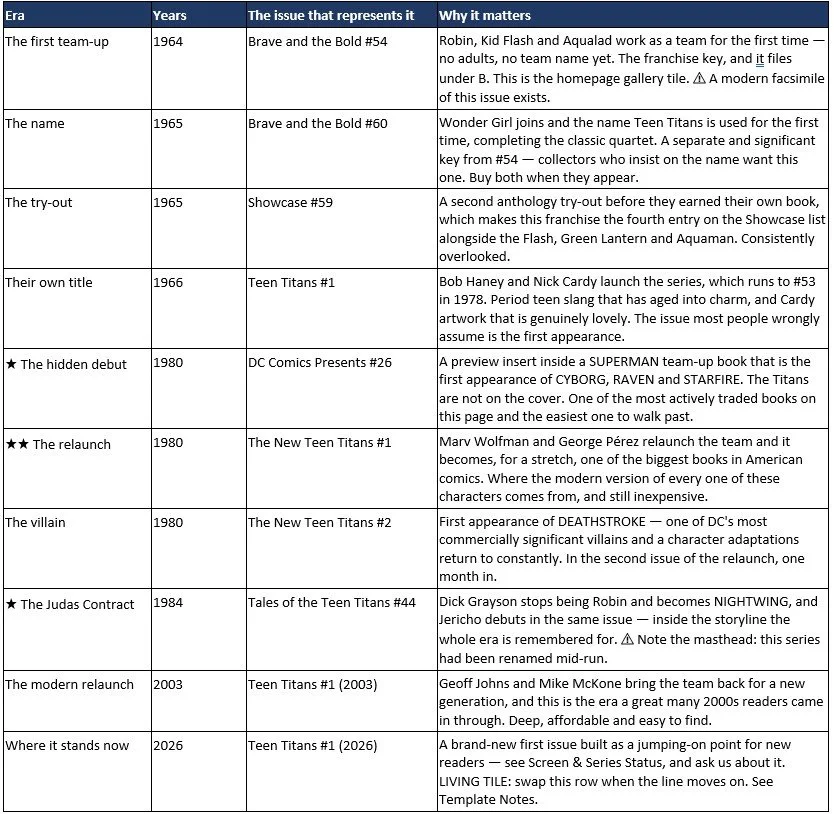
The Run, Era by Era
Sixty years, organised. Every era, the one issue that represents it, and why collectors care. Note how many of these are comics that do not say Teen Titans on the front:
The Keys — Issues Everyone Hunts
BRAVE AND THE BOLD #54 IS THE FRANCHISE KEY. Mid-1964, the first appearance of the team, and it sits in the low hundreds raw while trading about once a week. It climbs very steeply through the grades — a high-grade copy is a different order of money entirely — so the grade conversation matters more here than on most Silver Age books. ⚠ AND THERE IS A FACSIMILE. DC has reissued this comic in a modern facsimile edition, so before anyone talks about money, check the indicia and the cover price. Oversized or a modern price means a reprint, every time, no exceptions.
BRAVE AND THE BOLD #60 is the other half of the pair — first Wonder Girl and the first use of the name — and it is a genuine second key rather than a follow-up appearance. Some collectors argue the franchise really starts here, because you cannot have a Teen Titans first appearance before anybody says Teen Titans. We think #54 is the debut, but the argument is a fair one and we will happily have it with you across the counter.
★★ THE 1980–84 CLUSTER IS THE STORY OF THIS PAGE, AND IT IS EXTRAORDINARY VALUE. Five books published inside four years hold the first appearances of SIX characters that a very large number of people know by sight — Cyborg, Raven, Starfire, Deathstroke, Nightwing and Jericho. Every one of those books is cheap. Every one of them trades between several times a week and once a DAY, which makes this the most liquid stretch of back issues on our DC wall by a wide margin. You could own all six first appearances for less than one mid-grade copy of the 1964 debut. We do not think there is a better-value cluster of screen-relevant keys anywhere in the shop.
WITHIN THAT CLUSTER, HERE IS HOW WE RANK THEM. DC COMICS PRESENTS #26 gives you three first appearances in one comic for the price of a decent lunch, and it sells about once a day — the best keys-per-dollar book on the page. TALES OF THE TEEN TITANS #44 is the one we would tell you to buy if you are only buying one: it is the cheapest book in the cluster, it also sells about once a day, and it holds the first Nightwing, which is one of the most consequential single moments in DC's history and a character with his own long-running series ever since. THE NEW TEEN TITANS #2 is the first Deathstroke and the most expensive of the group, which is exactly what you would expect from the most famous villain in the set. THE NEW TEEN TITANS #1 is the cheapest entry point of all and still sells daily.
TEEN TITANS #1 FROM 1966 is a solid Silver Age key in its own right and the issue most people assume is the first appearance. The rest of that original run, through to 1978, is affordable throughout and worth searching for the Nick Cardy covers, which are the real reason to own it.
THE JUDAS CONTRACT ISSUES beyond #44 are cheap, celebrated and make a genuinely satisfying short want-list — the kind of thing a customer can start and actually finish. And a general note on the modern material and the all-ages line: it arrives in volume, it is reading stock rather than collectible, and we price it to move and are cheerful about it. There is no shame in a comic being for reading.
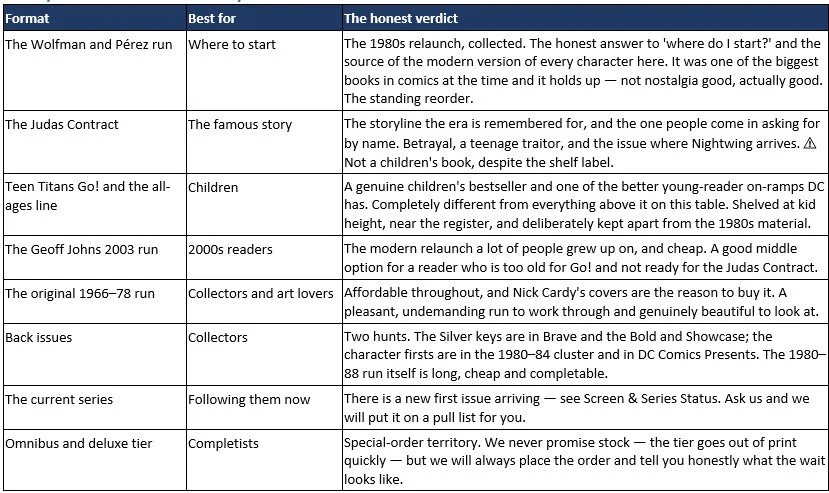
Every Format You Can Buy
Screen & Series Status
Updated August 2026: there is a lot moving here, and one item has a date on it.
★ ON THE PAGE — A BRAND-NEW TEEN TITANS FIRST ISSUE IS ARRIVING IN EARLY SEPTEMBER 2026. It is deliberately built as a jumping-on point for new readers, set in main continuity, with a new young line-up and Red Hood alongside them. It ships in three cover tiers — a standard cover, a card stock variant and a foil variant — and two other new reader-friendly first issues launch the same day. If you have been waiting for a sensible place to start with this franchise, that is a real one, and pre-ordering is the way to be sure of the variant you want. Talk to us before the end of August.
Separately, the team's ongoing adult book relaunched earlier in 2026 with a new title, new creative team and an expanded roster, continuing its numbering rather than restarting. Two different Titans books, two different audiences, which by now is the running theme of this entire page.
ON SCREEN: this franchise has had unusually broad screen presence — a long-running children's animated series, a darker live-action series, and the earlier animation that raised a whole generation. Their place in DC's rebuilding film universe is not settled. That is a calm window, and calm windows are when back-issue walls get built cheaply.
THE EVERGREEN PLAYBOOK, which does not expire: on this franchise the MEMBER first appearances move independently of the team ones. When Cyborg, Raven, Starfire, Deathstroke or Nightwing turns up in anything on screen, their individual first appearance moves — and all of those sit in the cheap, liquid 1980 to 1984 cluster described above. Ahead of ANY Titans screen window, stage the Wolfman and Pérez collections and The Judas Contract face-out, keep the children's material clearly separate, and have the member firsts pulled and in the case before the announcement rather than after it.
Collector's Corner — Grading, Care & We Buy
Four habits govern this franchise at our counter, and the first one is worth more than the other three combined.
WE SEARCH BRAVE AND THE BOLD FOR TWO TEAMS. Issue #28 is the Justice League, #54 and #60 are the Teen Titans. One anthology, filed under B, holding two of the biggest team debuts in DC history. After Showcase, this is the single most valuable search habit on our DC wall — and this franchise is on the Showcase list as well, at #59.
WE RUN EVERY DC COMICS PRESENTS STACK BEFORE PRICING A SUPERMAN COLLECTION. Issue #26 is the first Cyborg, Raven and Starfire, it is a Superman team-up book, and the Titans are not even on the cover. It is the easiest genuinely valuable comic in the store to bulk-price by accident, and we would rather find it and tell you than have you learn about it later from somebody else.
WE READ THE MASTHEAD ON ANYTHING FROM 1984. The New Teen Titans was renamed Tales of the Teen Titans mid-run while a second series with almost the same name started over at #1. The first Nightwing is in Tales of the Teen Titans #44. Getting this wrong in either direction — buying or selling — costs real money, and it is an easy mistake to make.
AND WE CHECK FOR THE FACSIMILE on Brave and the Bold #54. A modern reissue exists. Indicia and cover price before a number is spoken, the same discipline we apply to every facsimile in the shop.
On pricing generally: Brave and the Bold #54 and #60 get comped individually and facsimile-verified. Teen Titans #1 from 1966 gets comped. DC Comics Presents #26 gets comped individually. The 1980 to 1984 run gets the member-first issues pulled and the rest priced as the deep, affordable, enjoyable run that it is. Modern and all-ages material is reading stock, priced to move, and we are cheerful about it — a large amount of it arrives from families clearing out children's books, and that is a perfectly good reason for a comic to exist.
Grading is a service, not a sales pitch — we will tell you honestly when a book is worth submitting and, more often, when it is not. Storing them: bag and board, boards behind the comic, upright in a proper box, off concrete floors and away from exterior walls. Edmonton basements swing hard on humidity between February and July and that swing does the damage, not age. Selling: bring them in, or send a list first if it is a large collection, at https://www.comickingedmonton.com/sell-your-comics.
FAQ — Straight Answers
What is the first appearance of the Teen Titans?
Brave and the Bold #54, from mid-1964 — Robin, Kid Flash and Aqualad working as a team for the first time, with no adults and no team name yet. The name arrives a year later in Brave and the Bold #60, which also introduces Wonder Girl, and some collectors argue that issue is the true starting point on the reasonable grounds that you cannot have a Teen Titans appearance before anyone says Teen Titans. Both are real keys and we would buy either. Two practical notes: both are filed under Brave and the Bold rather than anything with Titans on the cover, so they hide from anyone sorting by character — and a modern facsimile edition of #54 exists, so check the indicia and cover price before anyone talks about money.
Where do Nightwing, Deathstroke, Cyborg, Raven and Starfire first appear?
All of them within about four years of each other, and all in books that are cheaper than you would expect. Cyborg, Raven and Starfire all debut together in DC Comics Presents #26 from 1980 — which is a Superman team-up comic, and they are not on the cover of it. Deathstroke first appears one month later in the second issue of the 1980 relaunch. And Dick Grayson becomes Nightwing in Tales of the Teen Titans #44 from 1984, in the same issue Jericho debuts, inside the Judas Contract storyline. ⚠ Be careful with that last one: that series had been renamed mid-run while a different series with almost the same name was also being published, so read the masthead rather than trusting the issue number. All five books are in the shop or findable, and together they are one of the best-value groups of first appearances we can point you at.
My kid loves Teen Titans Go! — what should I buy them?
Ask us, and please do ask, because this is the one shelf where the wrong choice really matters. Teen Titans Go! is a children's property with its own excellent all-ages comics line, and that is what you want — it is bright, funny, genuinely good for young readers, and we keep it at kid height. What you do not want is the 1980s material or most modern Titans books, which share the name and the characters but contain betrayal, addiction and death, and are written for teenagers and adults. They sit on completely different shelves in our shop for exactly this reason. If your child is a bit older and ready for something with more weight, there is a middle path we can point you at instead. Just tell us their age and which show they watched and we will get it right.