
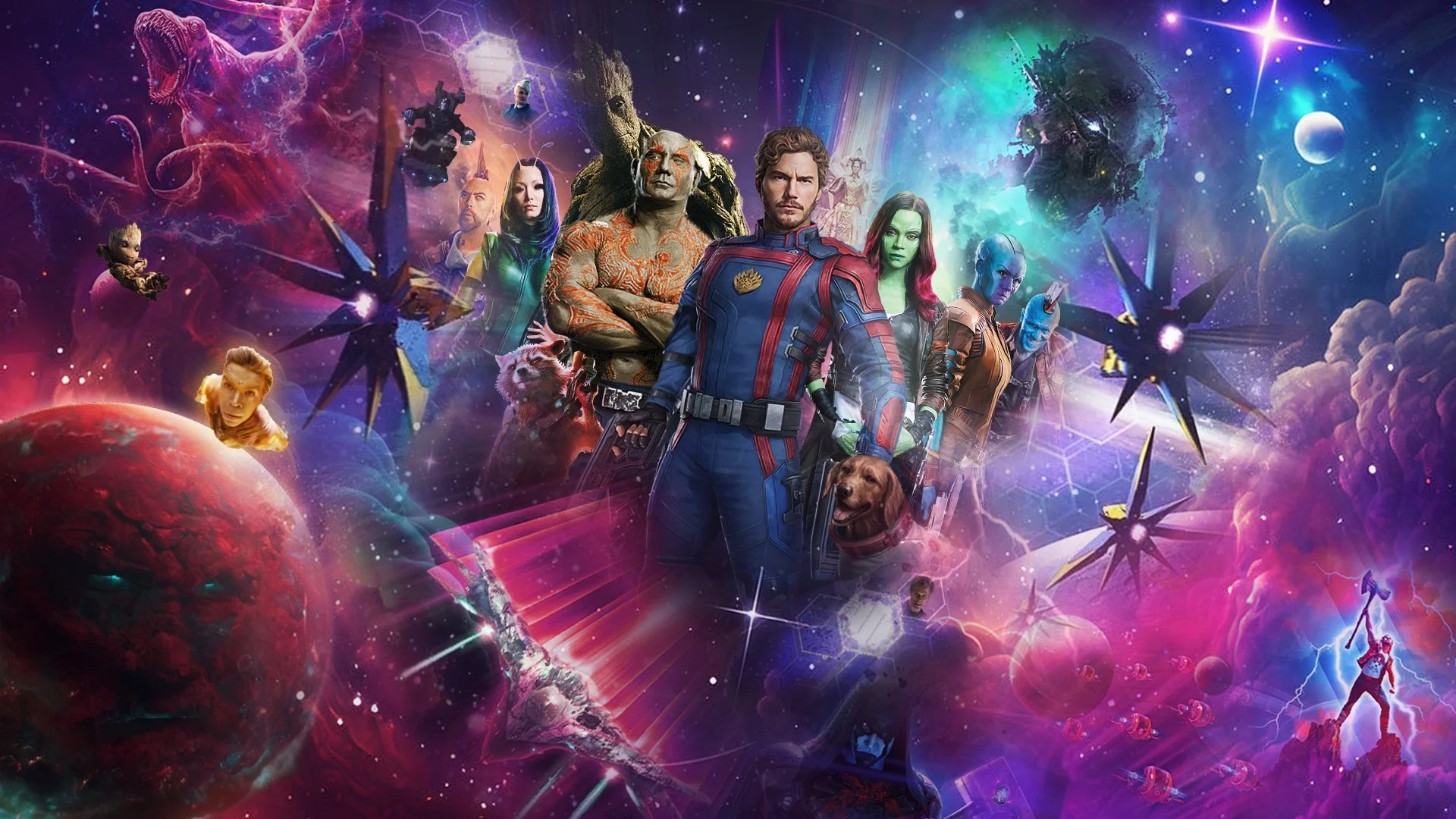
NONE OF THEM STARTED IN A GUARDIANS COMIC.
Star-Lord and Rocket debut in a black-and-white magazine, Drax shares an issue with Thanos,
and Groot is a 1960 monster · Comic King
Guardians of the Galaxy — The Complete Comic King Guide
In 2008 two writers called Dan Abnett and Andy Lanning built a team out of characters who had nothing whatsoever to do with each other: a space adventurer from a 1976 black-and-white magazine, a talking raccoon from the same magazine line, an Iron Man villain, a Jim Starlin assassin, a monster from a 1960 horror comic, and a golden man who first turned up in Fantastic Four without a name. Six years later a film made them globally famous. That history has one enormous practical consequence, and it is the reason this page exists: NOT ONE OF THE GUARDIANS FIRST APPEARED IN A GUARDIANS COMIC. Their key issues are scattered across five other titles and five decades, which means a "Guardians collection" is almost never where the money is — the money is somewhere else in the same box, filed under a completely different character. There is also a second team entirely: the ORIGINAL Guardians of the Galaxy, from 1969, a thirty-first-century group with only one member in common with the version you know. Comic King carries the Guardians in Edmonton across all of it, and we sort by CHARACTER rather than by team, because that is the only way to find anything. If the book you want is not on the shelf, we can special-order or source it on request.
Quick Facts
Story: A man makes a deal with something he does not understand, and it costs him control of his own body every night. The specifics change with each rider; the bargain never does.
Length: Two unrelated teams sharing one name: the original from January 1969, and the modern line-up assembled in 2008. Only YONDU appears in both lineages. Always establish which team first.
Status: Currently publishing, but read the small print — the 2026 book is a five-issue series rather than an ongoing, and its roster is not the team from the films.
Publisher: Marvel Comics
Age guide: Broadly fine for teenage readers — action and some violence, nothing graphic. More approachable than most of the Marvel wall,
and one of the easier recommendations for a family.
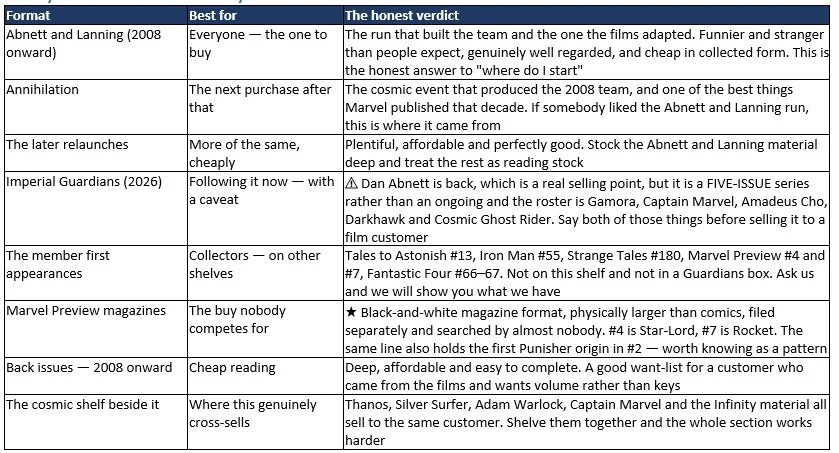
Formats: The Abnett and Lanning collections above all · the Annihilation event that produced them · a deep and cheap modern back-issue run · the member first appearances, which live on other shelves entirely.
At Comic King: The Abnett and Lanning trades face-out, the member keys identified and labelled by their ACTUAL titles, and every magazine box searched — because two Guardians debut in one.
None of Them First Appeared in a Guardians Comic
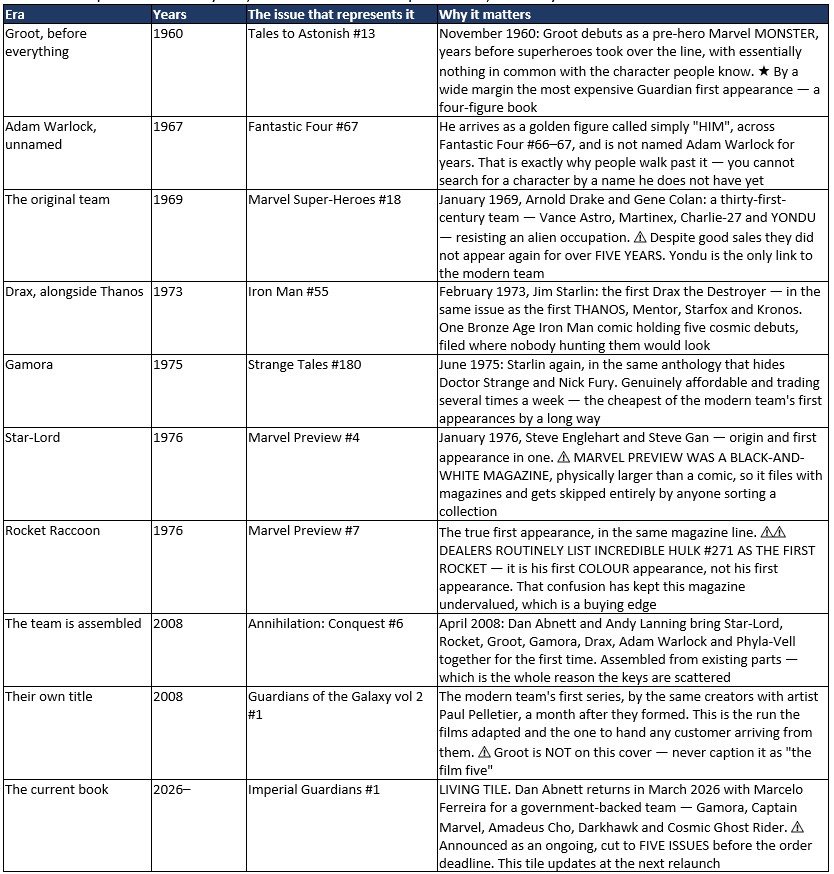
This is the most scattered franchise on our wall and it is worth understanding properly, because it changes where you look. The modern Guardians were ASSEMBLED in 2008, not created — Dan Abnett and Andy Lanning took characters who already existed in unrelated corners of Marvel and put them in a room together. So every single one of their first appearances is in somebody else's comic. GROOT is the oldest and the most expensive by a distance: he first appears in TALES TO ASTONISH #13 from November 1960, as a pre-hero Marvel monster with almost nothing in common with the character in the films, and that comic runs to four figures. ADAM WARLOCK debuts in FANTASTIC FOUR as a golden figure called simply "Him", which is precisely why people miss him. DRAX THE DESTROYER arrives in IRON MAN #55 from February 1973 — the same issue as Thanos, which makes one Bronze Age Iron Man comic the single densest cosmic key in Marvel. GAMORA turns up in STRANGE TALES #180 in June 1975. And then the two that matter most for the buy counter: STAR-LORD first appears in MARVEL PREVIEW #4 and ROCKET RACCOON in MARVEL PREVIEW #7, both from 1976 — and MARVEL PREVIEW WAS A BLACK-AND-WHITE MAGAZINE. It is physically larger than a comic, so it gets filed with magazines, and magazines are the one format that almost nobody sorts through. Two of the most recognisable characters in modern Marvel have their first appearances sitting in a format collectors skip. ONE CORRECTION WORTH MONEY: dealers routinely list INCREDIBLE HULK #271 as the first Rocket Raccoon. It is not — it is his first COLOUR appearance. The first appearance is Marvel Preview #7, and because that mistake is so common the magazine has historically been undervalued relative to what it is. Knowing the difference is a genuine buying edge, and we will always describe it accurately on resale.
The Run, Era by Era
This franchise has no single run to walk through — so instead, here is where each piece actually came from, in the order it was published.
Every era, the one issue that represents it, and why collectors care:
The Keys — Issues Everyone Hunts
The keys on this page are not on this shelf, and that sentence is the single most useful thing we can tell you. TALES TO ASTONISH #13 is the first Groot and it is a four-figure book — a 1960 pre-hero monster comic that most people would not glance at twice, and the most valuable single Guardian first appearance by a wide margin. It moves slowly and it is comped individually every time. MARVEL PREVIEW #7 is the first Rocket Raccoon and MARVEL PREVIEW #4 is the first Star-Lord — both in the low three figures, both trading weekly, and both in a BLACK-AND-WHITE MAGAZINE format that gets filed away from comics and skipped in almost every collection we see. If you have a box of old magazines in a basement, those two issue numbers are the reason to bring it in. IRON MAN #55 is the first Drax and the first Thanos in one issue, comped on our Iron Man page and worth several hundred dollars. STRANGE TALES #180 is the first Gamora and is the bargain of the group at well under a hundred dollars raw, selling about three times a week — a major screen-facing character for less than the price of a modern omnibus. FANTASTIC FOUR #66 and #67 hold Adam Warlock's debut as "Him". And MARVEL SUPER-HEROES #18 is the original 1969 team, which trades around the price of a nice dinner raw and climbs steeply in grade — it carries the first Yondu, which is most of why anyone wants it now. The modern material is the opposite picture and we will be straight about it: Annihilation: Conquest #6, Guardians of the Galaxy vol 2 #1 and everything since were printed in modern quantities and are valued on story and film association rather than on scarcity. They are excellent comics and they are cheap, which is a good combination for a reader and a poor one for an investor. The practical instruction that follows from all of this: SORT BY CHARACTER, NEVER BY TEAM. A collection with Guardians interest almost always has its value filed under Iron Man, Strange Tales, Fantastic Four or in a magazine box. Key prices move constantly, so we buy and price against live sold comps — ask and we will pull them up on screen together.
Every Format You Can Buy
Screen & Series Status
Updated August 2026: nothing on the screen side changes what we stock today, and the permanently useful fact is bigger than any announcement anyway — the film trilogy took a modest cosmic comic and made it globally famous, and it did so using the 2008 line-up. That dictates every routing decision here: a customer arriving from the films wants Abnett and Lanning, not 1969. On the comics side there is a live ordering nuance worth knowing. The current book, Imperial Guardians, launched in March 2026 written by Dan Abnett — the man who assembled the modern team in the first place, which is a genuine reason to be interested — but it was announced as an ongoing series and then cut to five issues before retailers placed their orders, and its line-up is not the team from the films. We will tell you both of those things rather than let you find out at issue five. The pattern worth watching on this franchise is unusual and it is about INDIVIDUALS rather than the team: because every member's first appearance is in a different title, a screen story that features one Guardian heavily moves that character's own key and nothing else. Watch character news, not team news. Exact release dates for anything upcoming live in our ordering calendar, not on this page.
Collector's Corner — Grading, Care & We Buy
Three habits govern this franchise, and the first one is unusual enough to be worth stating twice. WE SORT BY CHARACTER, NEVER BY TEAM. There is no meaningful Guardians back-issue key — every one of them is filed under a different title, so when anything Guardians-related comes through the door we go looking in Iron Man, Strange Tales, Fantastic Four, Tales to Astonish and the magazine boxes. A collection can be full of Guardians comics and have all of its value somewhere else entirely. THE MAGAZINE CHECK is the highest-value single habit here: Marvel Preview was a black-and-white magazine, physically larger than a comic, so it lives in a different box and gets skipped by almost everyone sorting a collection — including a lot of dealers. Number four is Star-Lord, number seven is Rocket Raccoon, and number two is the first Punisher origin, so that one magazine line is worth searching for three separate reasons. If you have magazines in a basement, bring them. AND THE ROCKET RACCOON CORRECTION, which we apply in both directions: Incredible Hulk #271 is frequently sold as the first Rocket Raccoon and it is not — it is his first colour appearance. We will pay you correctly for whichever one you actually have, and we describe it accurately when we sell it. Being right about that distinction is worth more to us over time than any single transaction. Beyond those: the pre-1980 material is where grade does real work and we grade conservatively; the modern runs are common, cheap and excellent reading, and we will say so rather than let anyone imagine otherwise. Bring the whole box — on this franchise more than any other, the valuable thing is the one that does not look related.
FAQ - Straight Answers
Where do the Guardians of the Galaxy first appear?
It depends entirely on which Guardians you mean, and that is not a pedantic answer — there are two unrelated teams. THE ORIGINAL team debuts in MARVEL SUPER-HEROES #18, January 1969: a thirty-first-century group of Vance Astro, Martinex, Charlie-27 and Yondu. They were popular enough on debut and then Marvel did nothing with them for over five years. THE MODERN TEAM — the one from the films — was assembled in 2008 in Annihilation: Conquest #6 and got its own title a month later. Only Yondu appears in both lineages. And here is the part that catches everyone: not one member of the modern team first appeared in a Guardians comic. Groot is a monster from Tales to Astonish #13 in 1960, Drax is in Iron Man #55 alongside Thanos, Gamora is in Strange Tales #180, Adam Warlock turns up in Fantastic Four as an unnamed character called "Him", and Star-Lord and Rocket Raccoon both debut in a black-and-white magazine called Marvel Preview. If you are hunting keys, you are hunting in five different titles.
Is Incredible Hulk #271 the first Rocket Raccoon?
No — and this one comes up constantly, because a great many dealers list it that way. Hulk #271 from 1982 is Rocket's first COLOUR appearance, which is a genuine and collectable thing, but his actual first appearance is MARVEL PREVIEW #7 from 1976. The reason for the confusion is format: Marvel Preview was a black-and-white magazine rather than a comic, so it sits in a different box, it is physically bigger, and it simply does not get searched the way comics do. The practical effect is that Marvel Preview #7 has been undervalued for years relative to what it actually is. If you own either book we will tell you exactly which one it is and pay you accordingly — and if you are buying, we will describe it the same honest way rather than using the label that gets the higher price. Worth checking the same magazine line while you are at it: issue four is the first Star-Lord, and issue two contains the first Punisher origin.
Which Guardians comics should I read after the films?
The Dan Abnett and Andy Lanning run from 2008, without hesitation. That is the team you know, written by the people who put it together, and the films drew on it directly — the tone, the line-up and a good deal of the humour all come from there. After that, read ANNIHILATION, the cosmic event that produced the team in the first place and one of the best things Marvel published in that decade. Both are collected and both are inexpensive. What we would NOT do is start you on the 1969 team: they are a genuine curiosity and a legitimate collector purchase, but they are a completely different group of characters and reading them will not give you what you came for. One caution about the current rack: the 2026 book is written by Abnett, which is a real recommendation, but it is a short series rather than an ongoing and its line-up is mostly not the film team. Ask us and we will show you what is actually on the shelf.