
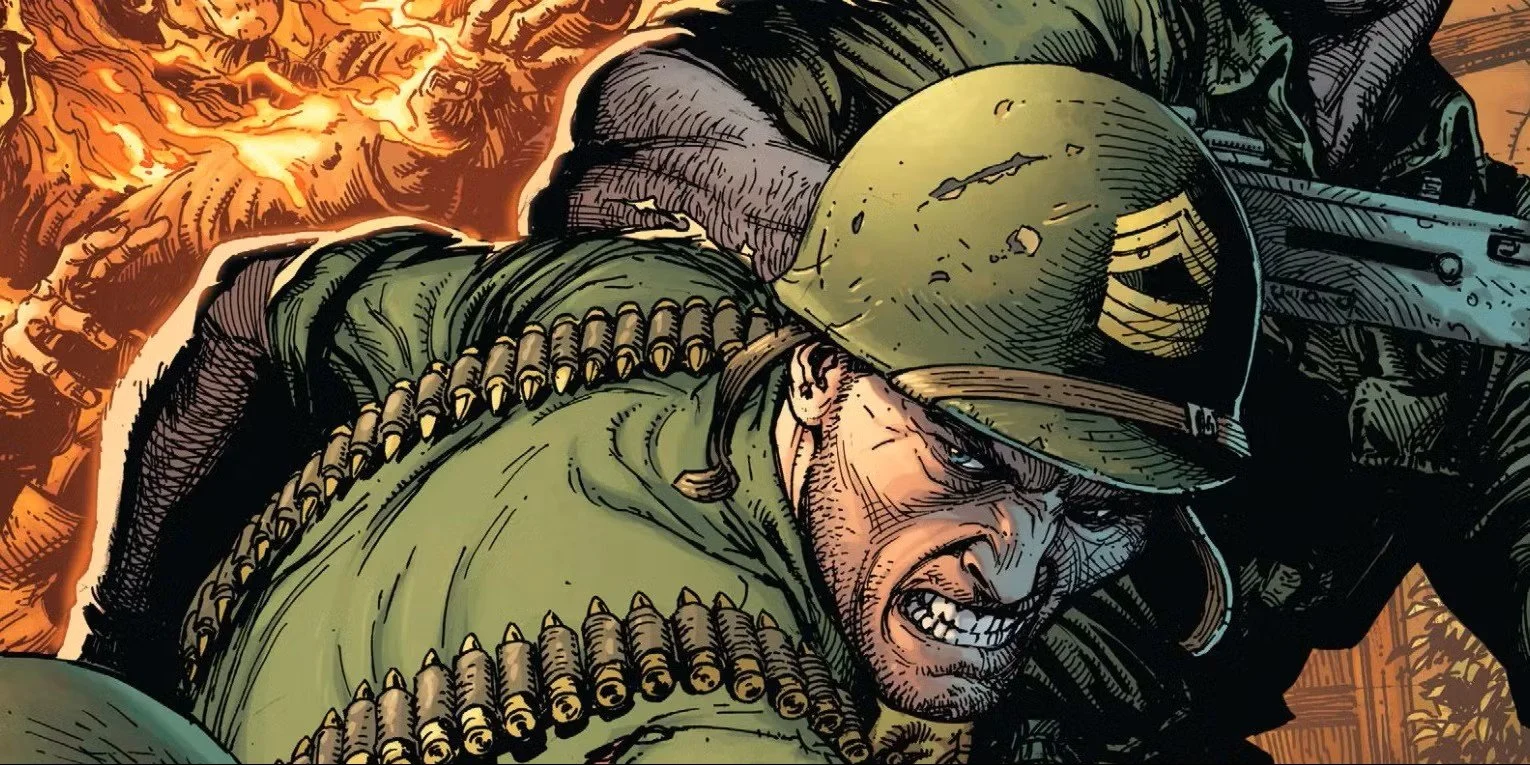
THE FIRST APPEARANCE IS STILL AN ARGUMENT.
Sgt. Rock and DC's war comics — Our Army at War, Easy Company, and the keys most shops price as filler · Comic King
Sgt. Rock — The Complete Comic King Guide
In 1959 a DC anthology called Our Army at War was eighty issues into a run with no continuing lead, and Robert Kanigher and Joe Kubert put a sergeant in it who did not enjoy any of it. Frank Rock, Easy Company, a comic where people stayed dead — which was not how comics worked at the time, and is why people who read them still talk about them. He carried that title for the next eighteen years, at which point DC gave up and simply renamed the comic after him without changing the numbering, so the first issue of Sgt. Rock is number 302. He is the biggest character in a category almost nobody stocks: DC's war line, where the keys are genuinely scarce, the reading is better than anyone expects, and a 1959 issue in poor condition is a four-figure comic that gets thrown into dollar bins by people who assume old army comics are filler. Comic King carries Sgt. Rock in Edmonton across the whole run — the reprint volumes that hold the earliest stories, an affordable Kubert wall, and honest identification of anything from the 1950s and 60s that comes through the door. If what you want is not on the shelf, we can special-order or source it on request.
Quick Facts
Story: Sergeant Frank Rock and Easy Company, fighting through Europe in the Second World War. No powers, no costume, no winning — a war comic written as an anti-war comic long before that was a safe thing to publish.
Length: Since 1959, across two titles and one continuous numbering run: Our Army at War #81–301, then Sgt. Rock #302–422 to July 1988. Roughly 340 issues of him in all.
Status: No current ongoing series. This is a back-issue and reprint character — and DC has been putting the early material back into print, which is the best thing to happen to this shelf in years.
Publisher: DC Comics
Age Guide: ⚠ War violence, handled seriously rather than gratuitously — people die and it is not made to look good. Fine for most teenage readers and genuinely educational; we will talk it through with a parent rather than guess. The 2022 horror crossover is an adult book and a different thing entirely.
Formats: Reprint collections · back issues under two different mastheads · a handful of modern miniseries and graphic novels · the wider DC war shelf beside it.
At Comic King: The volume that answers "where do I start", a searched — never bulk-priced — war back-issue section, and someone at the counter who knows why #83 is not #81.
The First Appearance Is Still an Argument
Most characters have one first appearance. Sgt. Rock has three candidates inside three months, and the gap between them is worth thousands of dollars, so it is worth getting straight before you buy or sell anything on this page. G.I. COMBAT #68, from January 1959, contains a story called simply "The Rock" — a prototype, in a different title, four months early. OUR ARMY AT WAR #81, April 1959, has a sergeant called "Sgt. Rocky" leading Easy Company, written by Bob Haney and drawn by Ross Andru and Mike Esposito. OUR ARMY AT WAR #82, May 1959, is generally logged as the cameo. And OUR ARMY AT WAR #83, June 1959, is the first full appearance of the character as everyone knows him, written by Robert Kanigher and drawn by Joe Kubert. The argument is not about the order — nobody disputes that — it is about identity: is Haney's Rocky the same man, or a trial run with a different name and a different art team? Kanigher said he rewrote most of Haney's script. Haney said he wrote the first story that contained the character. Both are on the record and neither has been settled. DC itself once landed on #81, reprinting it as the first appearance in its Millennium Editions programme in 2000. The market has landed decisively on #83, which is a four-figure comic even in low grade — and that is the number that sets prices, so it is the number we quote. Plenty of serious collectors split the difference and buy all three. Here is the part that makes this page useful rather than academic: as of 2026 you can read the entire argument for less than the price of a mid-grade back issue. DC's big reprint volume collects G.I. Combat #68 and Our Army at War #81 through #122 in a single book, so the prototype, the Rocky story, the cameo and the debut all sit side by side and you can decide for yourself which one is Sgt. Rock.
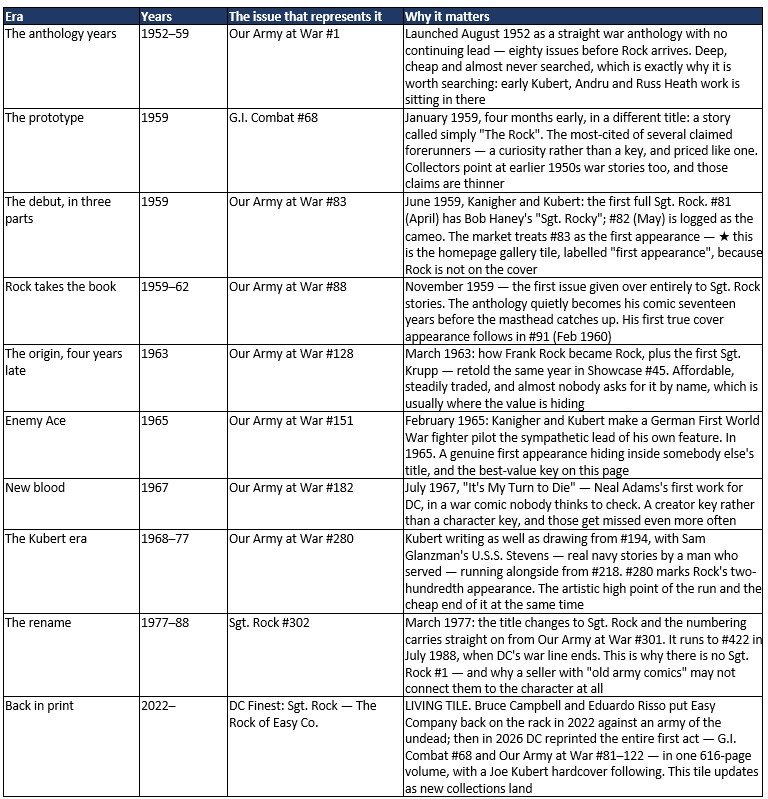
The Run, Era by Era
Two mastheads, one unbroken numbering run and sixty-seven years of Sgt. Rock, organized. Every era, the one issue that represents it, and why collectors care:
The Keys — Issues Everyone Hunts
OUR ARMY AT WAR #83 is the book, and the thing to understand about it is the expectation gap: it is a 1959 war comic that goes four figures in grades most people would describe as beaten up, and it keeps going — mid grades run into five figures. Fewer than a few hundred copies have ever been formally graded. Nobody expects that from a war title, which is precisely why copies still surface in collections priced as filler. We comp it individually, every time, and we will show you the sold results on screen rather than asking you to take our word for it. OUR ARMY AT WAR #81 is the interesting one: it is earlier, it is genuinely scarce, DC itself once called it the first appearance — and it trades at a fraction of #83, in the low hundreds raw, with copies changing hands roughly monthly. If one turns up, it is worth owning. What it is not is a book you describe to a buyer as "the first Sgt. Rock", because the market says otherwise, and being scrupulous about that distinction is the whole difference between a dealer people come back to and one they don't. #82 sits between them as the cameo and gets forgotten by almost everyone. Then there are the two keys nobody files under Sgt. Rock at all. OUR ARMY AT WAR #151 is the first appearance of ENEMY ACE, and it is the best-value key on this page by a distance — raw copies run a few tens of dollars and sell about once a week nationally, which for a genuine Silver Age first appearance is remarkable. OUR ARMY AT WAR #182 is Neal Adams's first DC work and costs less again. Both are hiding inside a title collectors search by character rather than by masthead. OUR ARMY AT WAR #128 holds the origin and is similarly cheap. Below all of that, the run itself — #1 to #80 before Rock, the whole Kubert stretch, and everything after the rename — is deep, affordable and realistic to complete, which very few Silver Age runs still are. One warning made of money: this material has been reprinted repeatedly, from DC's 2000 Millennium Editions through today's collections. Check the indicia. A reprint is clearly labelled, and oversized always means reprint.
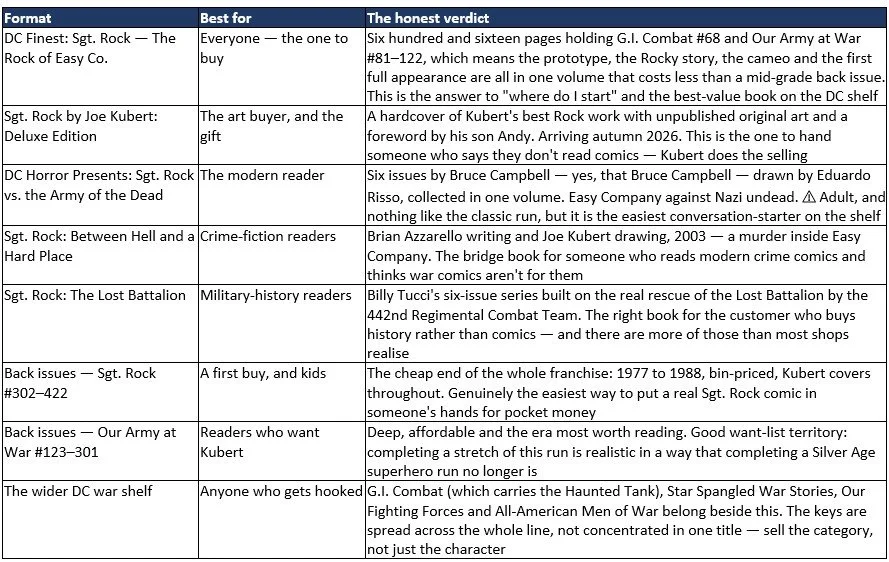
Every Format You Can Buy
Screen & Series Status
Updated August 2026: there is no Sgt. Rock series on the rack and no film in production, and we would rather say that plainly than imply something is coming. The film in particular has been almost-made for forty years — Arnold Schwarzenegger was attached in the 1980s, Bruce Willis later, and the most recent attempt got closer than any of them: a director in place, a lead cast, pre-production running in England, and then the studio scrapped it in the spring of 2025 weeks before shooting. Treat any new announcement as news rather than a plan, and know that if one ever does get made, Our Army at War #81 and #83 will move quickly and quietly before most shops notice. What is actually happening is more useful than any of that: DC has started putting this material back into print properly. A 616-page collection of the earliest run arrived in 2026, and a Joe Kubert hardcover follows in September 2026 — the first time in a long while that a customer can walk in and buy the good stuff new. That is the state of things, and it is a better state than it sounds. Exact release dates for anything upcoming live in our ordering calendar, not on this page.
Collector's Corner — Grading, Care & We Buy
Four habits govern this shelf at our counter, and the first one is the most valuable thing on this entire page. WE SEARCH EVERY WAR STACK BEFORE ANYTHING IS PRICED. Most dealers, and almost every seller, treat 1950s and 60s DC war comics as worthless filler — and one of them is a four-figure comic in poor condition, with two more genuine first appearances hiding in the same run. Nothing that comes through our door gets bulk-priced without being looked at issue by issue, and if you are selling, that habit is worth money to you rather than to us. The second is THE TITLE QUESTION. This run is called Our Army at War for its first three hundred and one issues and Sgt. Rock for the last hundred and twenty-one, so somebody bringing in "some old army comics" often has no idea the character is involved at all — we ask about both names, and we will happily walk through a box with you. The third is HOW WE DESCRIBE #81. We buy it enthusiastically and we sell it honestly: it is the earlier book, DC once called it the first appearance, and the market treats #83 as the real one. Anybody who tells you otherwise while selling you #81 is telling you what you want to hear. Fourth, CONDITION DOES MORE WORK HERE THAN ALMOST ANYWHERE. War comics were read by children and thrown out by parents, and nobody speculated on them for decades, so they were never protected the way superhero keys were. High grade is genuinely rare, prices climb steeply through the middle grades, and that makes accurate grading the whole ballgame — we grade conservatively, we broker the serious books to the specialist market rather than shelf-pricing them, and we say plainly when something is common. Outside the identified keys most of this run is affordable and always will be, and we will tell you that too. Bring the whole box: the reason people call us when something from 1959 turns up in an estate is that we were straight with them about the dollar comics first.
FAQ — Straight Answers
What is the first appearance of Sgt. Rock?
The short answer is Our Army at War #83, June 1959, by Robert Kanigher and Joe Kubert — that is the book the market recognises and prices as the first appearance, and it is a four-figure comic even in rough shape. The longer answer is that it is genuinely contested, and the detail matters if you are buying or selling. Our Army at War #81, from April 1959, is two months earlier and features a sergeant called "Sgt. Rocky" leading Easy Company, written by Bob Haney with different artists; #82 is logged as a cameo; and there is a story called "The Rock" in G.I. Combat #68 from January 1959 that predates all of them. DC itself treated #81 as the first appearance when it reprinted the issue in 2000. The disagreement is about whether Haney's Rocky is the same character or a trial run, and the two writers contradicted each other on the record about who created what. So: #83 is the answer to give, #81 is the smarter thing to buy if you can find one, and a lot of serious collectors simply own all three. If you just want to read them, the current DC Finest collection has G.I. Combat #68 and Our Army at War #81 through #122 in one book and you can judge for yourself.
Why do Sgt. Rock comics start at #302 — is there a Sgt. Rock #1?
There isn't one, and this trips up more sellers than any other fact on this page. Sgt. Rock ran inside an anthology called Our Army at War from 1959 onwards, and by the mid-seventies he so thoroughly was the comic that DC simply renamed the title after him — at issue #302, in March 1977, carrying the numbering straight across from Our Army at War #301. It ran on to #422 in July 1988. So the first issue of a comic called Sgt. Rock is number three hundred and two, and it is a cheap common comic rather than a key. Marvel does the same thing in three places, which is why we can spot it quickly: the Hulk's series restarts at #102, Captain America's at #100 and Thor's at #126, each carrying on from a cancelled anthology. Two things to watch for. There IS a Sgt. Rock Special #1 from 1988, and it is a reprint title, not a first issue. And if a listing offers you "Sgt. Rock #1", it is either a reprint, a mislabelled book or a different comic entirely — bring it in and we will tell you which in about a minute.
I have a box of old war comics — is there anything in there?
Quite possibly, and this is the category where the answer surprises people most often. DC war comics get treated as filler by almost everyone, and yet Our Army at War #83 is a four-figure book in low grade, the first appearance of Enemy Ace is sitting in issue #151 of the same title, and Neal Adams's first DC work is in #182 — none of which look like anything on a shelf, because they are war covers with no recognisable character on the front. Here is what to do: don't sort them, don't clean them, don't tape anything, and bring the whole box rather than the ones you think are good, because the valuable issues in this category are the ones that look least remarkable. Check for the Our Army at War masthead with a 1959 or 1960 date especially. It is also worth bringing anything from the rest of the DC war line — G.I. Combat, Star Spangled War Stories, Our Fighting Forces, All-American Men of War — because the keys are spread across all of them. We will go through it with you, tell you honestly which ones are common, and price against live sold results rather than a guide. Full details on how we buy are on our sell page.