
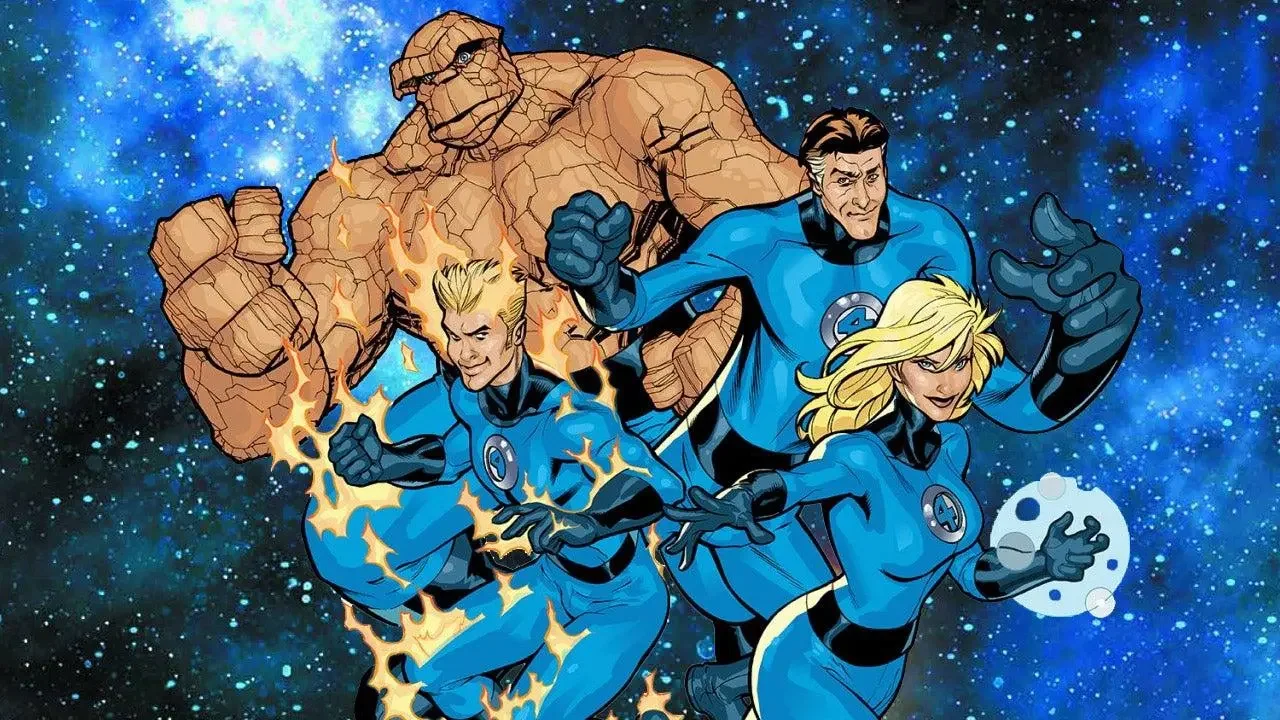
WHERE MARVEL BEGAN
Fantastic Four — the first family, the biggest debuts in comics, and the run we keep deep · Comic King
Fantastic Four — The Complete Comic King Guide
In 1961 Marvel Comics published a book about a family who got superpowers and did not much enjoy it, and the modern comics industry started there. The Fantastic Four is the title everything else at Marvel was built on top of — and along the way it introduced more famous characters than any other run in comics. Comic King carries the Fantastic Four in Edmonton on both ends: this week’s new issues, and a back-issue run with genuine depth. If the issue you want isn’t on the shelf, we can special-order or source it on request.
Quick Facts
Story: Four people, one accident, and a family that argues its way through cosmic catastrophe — Marvel’s first family, literally and historically.
Length: Publishing since 1961 — one long original volume, then several relaunches (see the era table).
Status: Ongoing — the current volume relaunched in 2025 and counts past issue 726 under legacy numbering.
Publisher: Marvel Comics.
Age guide: All-ages friendly — the most family-appropriate of the classic Marvel runs.
Formats: New issues · back issues · Epic Collections · omnibus & Masterworks · facsimile editions.
At Comic King: New issues weekly and a genuine back-issue run — special orders and issue-sourcing on request.
The Book That Started Marvel — and the Densest Key Run in Comics
Here is the thing worth understanding before you buy a single issue. Almost every long-running comic has a handful of famous first appearances scattered across decades. The Fantastic Four has them stacked on top of each other. Doctor Doom, the Skrulls, the Inhumans, the Silver Surfer, Galactus, the Black Panther, Adam Warlock, Annihilus and Franklin Richards all debut in this one title, most of them inside a single ten-year stretch by Stan Lee and Jack Kirby. Nothing else in comics comes close for concentration. It has two practical consequences. First, a Fantastic Four run is worth checking carefully rather than pricing by the inch — the money is spread across many issues, not just issue one. Second, this is the title to read if you want to understand where the rest of the Marvel wall came from, because most of it walked out of these pages.
The Run, Era by Era
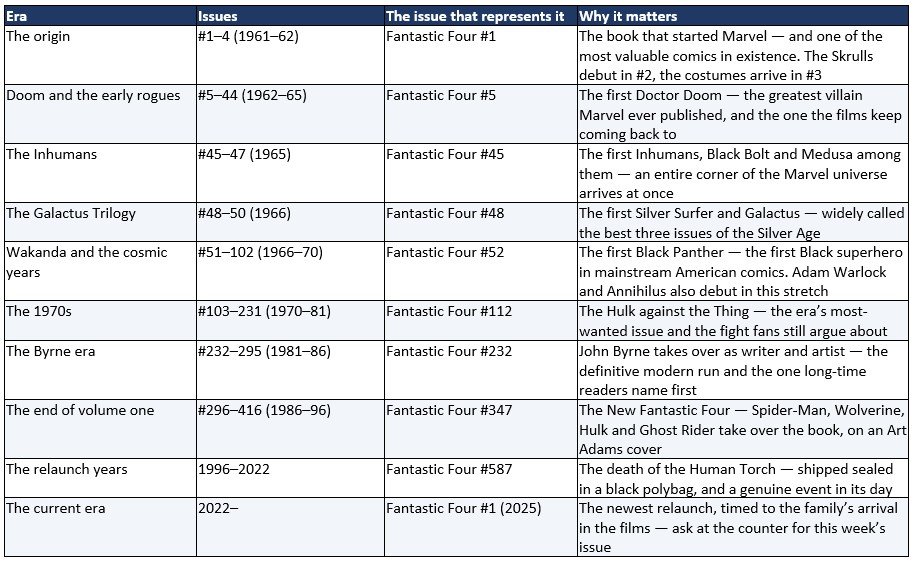
Sixty-plus years, organized. Every era of the Fantastic Four, the one issue that represents it, and why collectors care:
The Keys — Issues Everyone Hunts
Fantastic Four #1 sits at the top, and it is genuinely rare air: a high-grade copy sold at auction in 2024 for more than two million dollars. But the interesting thing about this run is how much lives below it. Issue #5 is the first Doctor Doom and moves on every piece of casting news. Issue #48 is the first Silver Surfer and Galactus. Issue #52 is the first Black Panther, which is culturally the most significant single issue in the run and behaves accordingly whenever that character is on screen. Issue #45 brings the Inhumans, #2 the Skrulls, #18 the Super-Skrull, and #66–67 the character who would become Adam Warlock. And then there is the one that gets missed: Annual #6 contains the first appearance of both Annihilus and Franklin Richards, and because it is an annual it routinely ends up bulk-priced with the ordinary issues. We check every annual. Key prices move constantly, so we buy and price against live sold comps — ask and we will pull them up on screen together.
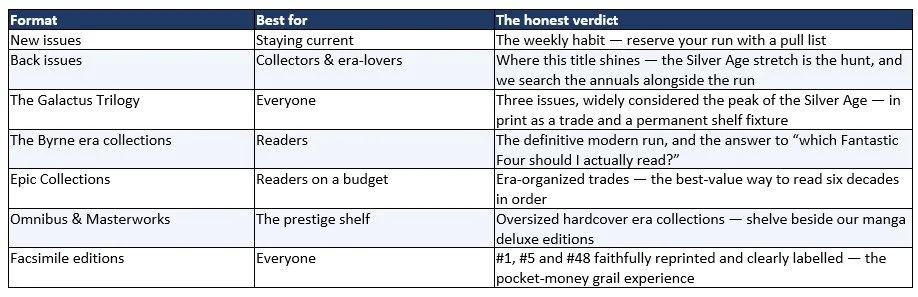
Every Format You Can Buy
Screen & Series Status
Updated August 2026: the Fantastic Four have joined Marvel’s film universe properly, the comic relaunched alongside that arrival, and Doctor Doom is being positioned as the villain driving the films forward — which is why issue #5 has been the one to watch. On the page, the current volume continues; ask at the counter for the newest jump-on issue.
Collector's Corner — Grading, Care & We Buy
There are two habits that make a real difference to what a Fantastic Four collection is worth, and most sellers know neither. The first is the annuals: Annual #6 carries two first appearances and looks, to the untrained eye, like an ordinary oversized comic. We check every annual in every collection. The second is authentication — the famous keys exist as modern facsimile editions and older reprints, and on a run where the top book has sold for seven figures, provenance matters before any number is discussed. We assess keys in front of you with live comps on screen, we grade honestly, and we broker CGC submissions for slab-worthy books. We also stock the bags, boards and boxes that keep a collection worth grading in the first place. Bring the whole run in — including the annuals.
FAQ - Straight Answers
Why are the Fantastic Four called Marvel’s first family?
Two reasons, and both are literally true. They were the first characters of the modern Marvel age — their 1961 debut is the book that launched everything that followed, from Spider-Man to the X-Men. And unlike almost every other superhero team, they actually are a family: two brothers-in-law, a sister, and a best friend who bicker their way through cosmic disasters. That domestic quality is the reason the book still reads differently from everything around it.
Which Fantastic Four issue has the first Black Panther?
Fantastic Four #52, from 1966 — the first appearance of the Black Panther and of Wakanda, and the first Black superhero in mainstream American comics. It is one of the most historically significant single issues in the medium, and its value reflects that. We stock it when we can find it, and we are always interested in buying one. Ask and we will show you where it sits in the run.
Do Fantastic Four annuals matter, or are they just extras?
They matter, and this is the single most useful thing to know about collecting this title. Annual #6 contains the first appearance of Annihilus and the first appearance of Franklin Richards — two significant characters in one book. Because annuals get filed and sold as extras, that issue is one of the most commonly overlooked keys in comics. If you are selling us a Fantastic Four collection, bring the annuals; if you are buying, do not skip the oversized ones.