
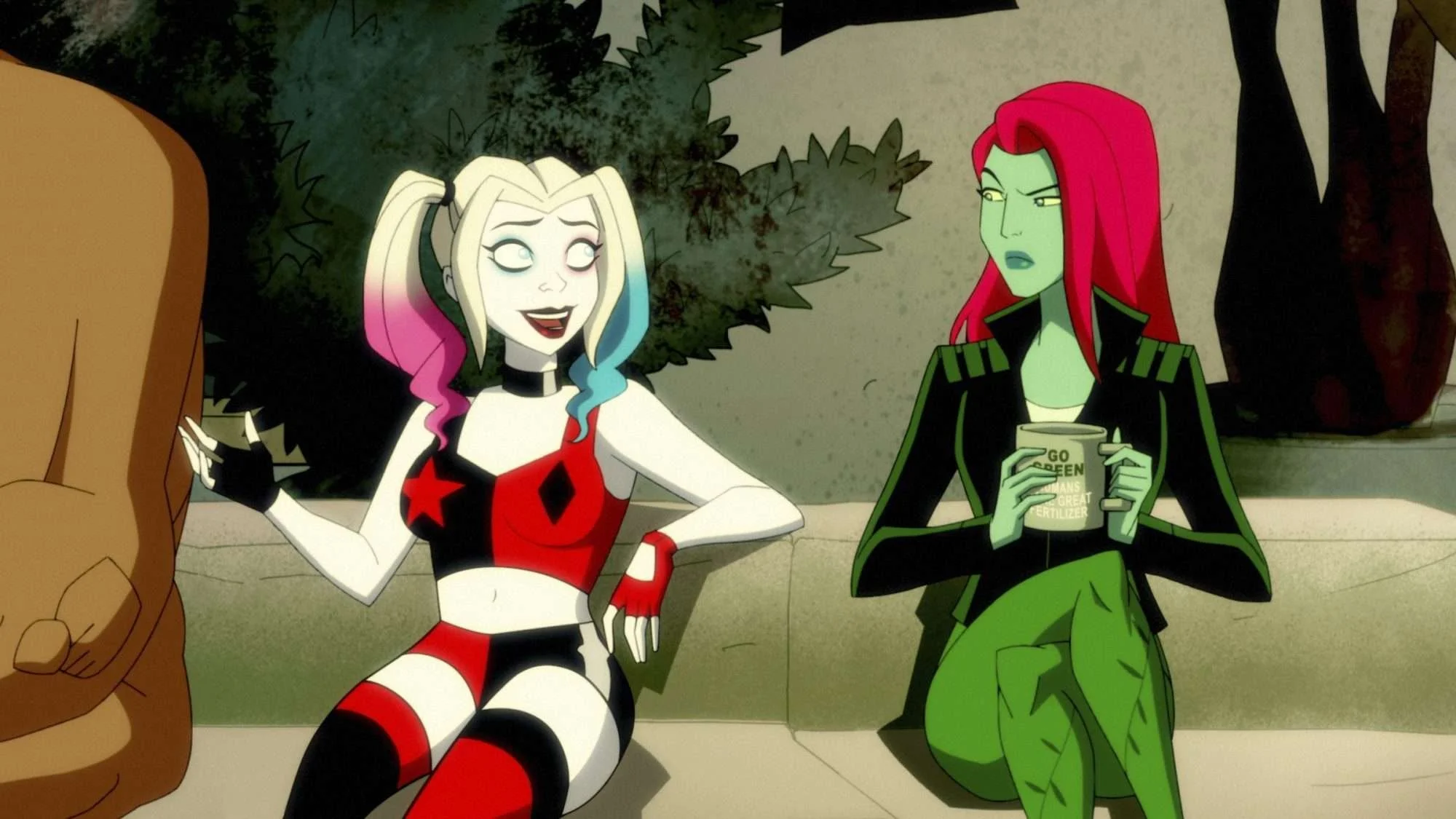
SHE WAS WRITTEN FOR ONE EPISODE.
Harley Quinn — the cartoon henchwoman who took over DC · new issues, back issues and honest valuations · Comic King
Harley Quinn — The Complete Comic King Guide
Every other character on this wall was invented in a comic. Harley Quinn was not. She was written for a single episode of a Saturday-morning cartoon in 1992, as a henchwoman with no backstory who was never meant to appear again — and the audience liked her so much that the comics had to go back and invent her properly. Thirty-four years later she is one of DC's most valuable characters, and the comic she first appeared in is a children's cartoon tie-in that dealers bulk-priced for the better part of a decade. That is a genuinely great story, and it is also the single most useful thing to know if you are buying or selling comics in Edmonton. Comic King carries Harley Quinn on both ends: this week's new issues, and back issues from every era of a character who has more of them than you would think. If the issue you want isn't on the shelf, we can special-order or source it on request.
Quick Facts
Story: A brilliant Arkham psychiatrist falls for her most dangerous patient and never quite recovers. Funny, chaotic, and considerably darker underneath than the costume suggests.
Length: In comics since 1993 — several series across three decades, plus a permanent presence in Batman and Suicide Squad books.
Status: Ongoing — the current volume has run since 2021.
Publisher: DC Comics
Age Guide: ⚠ SPLIT — the animated-series material is genuinely all-ages; several modern runs and the adult cartoon are firmly adult.
Two very different Harleys share a shelf, so ask before recommending.
Formats: New issues · back issues · graphic novels · omnibus editions.
At Comic King: New issues weekly, back issues across every era, and we check every box of kids comics that comes through the door.
The Only Character on This Wall Whose First Appearance Is a Cartoon Episode
On 11 September 1992, the twenty-second episode of Batman: The Animated Series aired. It was called "Joker's Favor", and Paul Dini and Bruce Timm needed a henchwoman for the Joker to order about for a scene. They gave her a jester costume, a Brooklyn accent and no history whatsoever, and she was not intended to come back. She came back. The response was strong enough that she became a regular, and then strong enough that DC had to bring her into the comics — which happened a full year later, in September 1993, in THE BATMAN ADVENTURES #12, a tie-in book aimed at the children watching the show. Here is why that matters practically. For years, everybody involved in comics retail treated the animated tie-in line as disposable: kids' books, licensed material, not real continuity, priced by the handful. Meanwhile the character in issue #12 became one of DC's four or five biggest names, and that issue became a four-figure comic in high grade. It is still filed with the all-ages material. It still arrives in boxes labelled "my kid's old comics". We search every one of those boxes, every time, and if you have a stack of Batman Adventures somewhere, it is worth ten minutes of your afternoon to go through them.
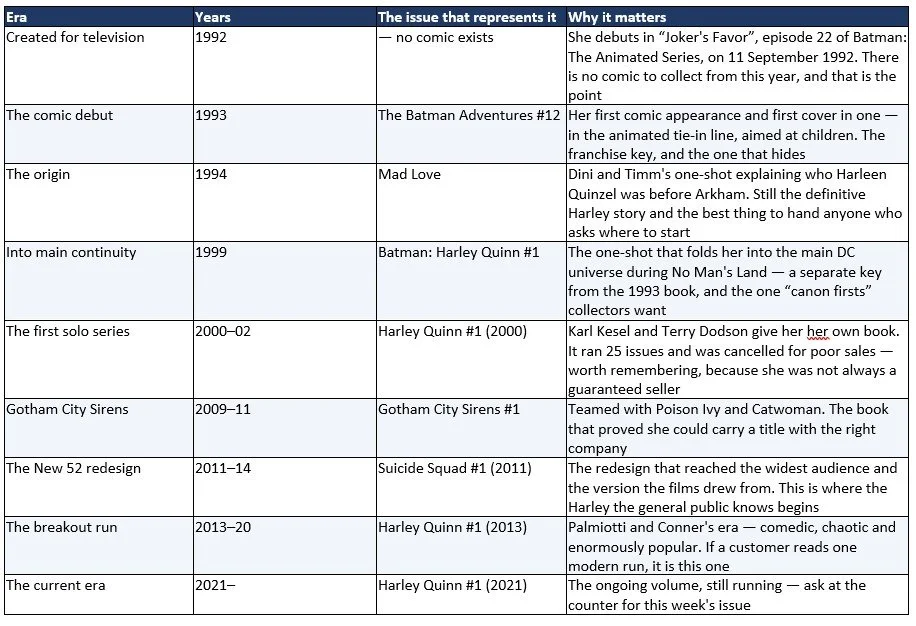
The Run, Era by Era
Thirty-four years, organized. Every era of Harley Quinn, the one issue that represents it, and why collectors care:
The Keys — Issues Everyone Hunts
The Batman Adventures #12 is the book, and it is one of the great modern sleeper stories in comics — a children's cartoon tie-in that now trades in four figures in high grade. There is a catch, and it is the most important sentence on this page: BECAUSE DEMAND EXPLODED, DC HAS REPRINTED IT. There is a clearly-labelled Dollar Comics reprint edition and other later printings in circulation, and they sit in exactly the same stacks as the original. The cover art is the same. Check the indicia and the cover price before anybody discusses money — this is the same discipline that Teenage Mutant Ninja Turtles #1 and Walking Dead #1 demand, and for the same reason. Below that, the run has real depth. Mad Love from 1994 is a genuine key with reader demand as well as collector demand, and it is considerably more affordable than #12. Batman: Harley Quinn from October 1999 is her first mainstream-continuity appearance and a distinct key that collectors chasing canonical firsts specifically want. Harley Quinn #1 from December 2000 is the first solo series and a nice, cheap entry point. And then there is the modern reality: Harley is one of the most variant-covered characters in comics, so on anything after 2013 the COVER usually matters more than the issue number. We price by cover, not by number. Key prices move constantly, so we buy and price against live sold comps — ask and we will pull them up on screen together.
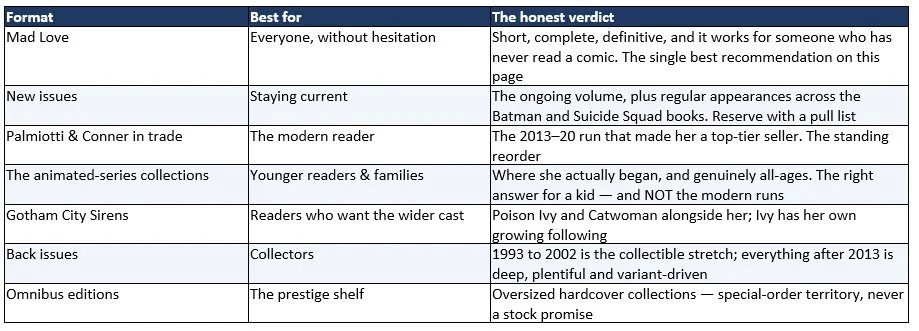
Every Format You Can Buy
Screen & Series Status
Updated August 2026: Harley is one of the very few comic characters whose screen presence has essentially never lapsed since 1992 — animation, film and a long-running adult animated series, which has run five seasons to date. DC's film universe is being rebuilt and her place in it has not been settled yet. On the page, the current volume continues and has been putting her through a significant costume-and-status change this year. As always, ask at the counter for the newest issue. Exact dates for anything on screen live in the Consolidated Ordering Calendar, not on this page.
Collector's Corner — Grading, Care & We Buy
There is one habit here worth more than every other piece of advice on this page: we search every box of all-ages, cartoon-line and Batman Adventures comics that comes through the door, before anything gets bulk-priced. Sellers bring those in as "my kid's old comics" and genuinely do not know what is in them, because for a decade nobody in the industry treated that line as worth anything. That is exactly why the opportunity still exists. If you are clearing out a collection, please do not sort the children's comics into a separate pile to save us time — that pile is the one we most want to see. The second habit is verification, and it applies whichever side of the counter you are on: The Batman Adventures #12 has been reprinted, the reprints are labelled, and they look identical at a glance in a stack. We read the indicia and check the cover price on every copy before a number is spoken, and we will do that in front of you. On modern material: Harley variants can be worth multiples of the standard cover, so we check covers rather than assuming, which is one of the few franchises where that effort genuinely pays. We assess keys with live comps on screen, grade honestly, broker CGC submissions for slab-worthy books, and stock the bags, boards and boxes that keep a collection worth grading.
FAQ - Straight Answers
Was Harley Quinn created for the comics or the cartoon?
The cartoon — and she is the only major DC character of whom that is true. Paul Dini and Bruce Timm wrote her for a single episode of Batman: The Animated Series, "Joker's Favor", which aired on 11 September 1992. She was a one-scene henchwoman with no backstory and no plan for her to return. The audience response changed that: she became a recurring character, then a fixture, and DC brought her into the comics a year later. Her first comic appearance is The Batman Adventures #12, cover-dated September 1993. It is a genuinely unusual route into comics, and it is why her first appearance sits in a place nobody thinks to look.
Is The Batman Adventures #12 valuable, and how do I know if mine is a reprint?
An original 1993 first printing in strong condition is one of the most valuable modern comics there is, which is remarkable for what was marketed as a children's tie-in book. But DC has reprinted it — including a clearly-labelled Dollar Comics edition and other later printings — and those are common, inexpensive, and easy to mistake for the original because the cover art is the same. The way to tell is the indicia on the inside front and the cover price; the reprints say so if you look. Do not judge from the cover, and be cautious of any online listing that shows only the front. Bring yours in and we will check it properly in front of you and show you live sold comps on screen, whichever way it turns out.
Which Harley Quinn comic should I start with — and is she suitable for a younger reader?
Start with Mad Love. It is a single self-contained book from 1994 by the two people who created her, it explains exactly who she is and how she ended up with the Joker, and it works perfectly for someone who has never read a comic before. After that, the Palmiotti and Conner run from 2013 onwards is the funny modern one most people mean. On the age question — and this one matters, because the costume and the cartoon make people assume: it depends entirely which Harley. The animated-series tie-in collections are genuinely all-ages and are a great recommendation for a child. Several of the modern runs, and the adult animated series she is currently best known for, are firmly adult in language and content. They sit near each other on a shelf and look similar from a distance. Ask us and we will point you at the right one — it takes ten seconds and it saves an awkward conversation later.