
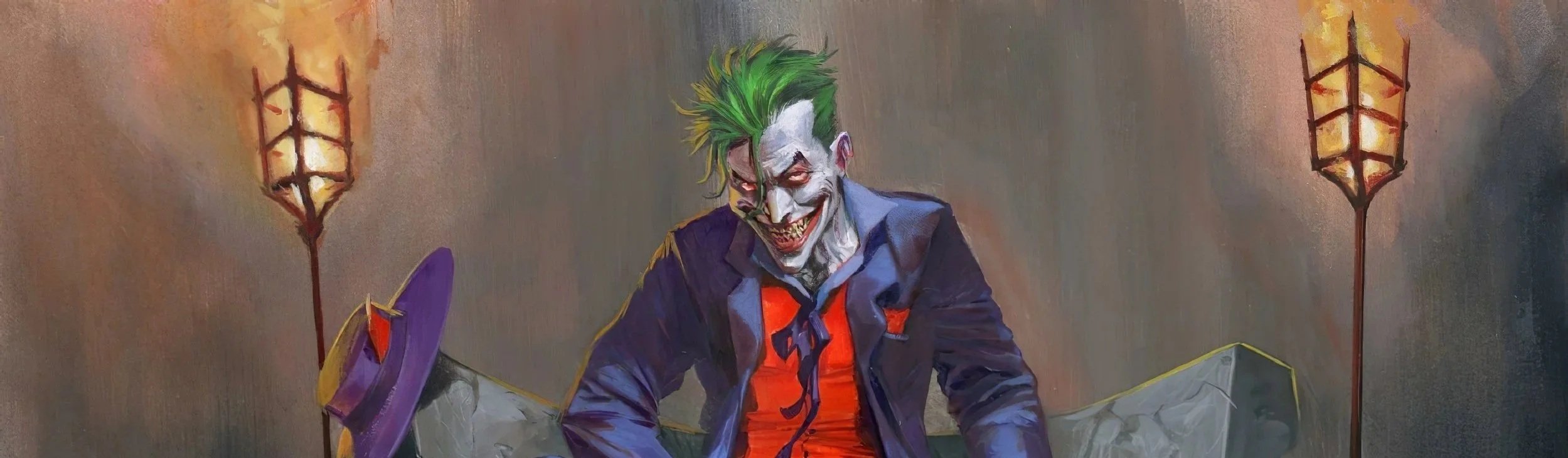
HIS FIRST COVER IS A COMIC HE ISN'T IN.
The Joker — 1940 to now, and the four stories that are really being asked for · Comic King
The Joker — The Complete Comic King Guide
In April 1940 three men — Bill Finger, Bob Kane and Jerry Robinson — put a murderous playing-card clown into the first issue of Batman's own comic, and then wrote him to die in it. He was stabbed in the heart on the last page. An editor named Whitney Ellsworth read it, overruled the decision, and had a panel hastily drawn in showing that the Joker had survived. Eighty-six years later he is the most valuable villain in comics, the only one with two Academy Award-winning performances behind him, and the reason a great many people who have never opened a comic still walk into shops like ours. What almost nobody knows is how strange his publishing history actually is: he has hardly ever had a comic of his own, his origin didn't arrive until eleven years after his debut, and his first cover appearance is on a comic he isn't in. Comic King carries the Joker in Edmonton across all of it — the collections that hold the famous stories, an affordable Bronze and modern wall, and honest identification of anything Golden Age that comes through the door. If the book you want isn't on the shelf, we can special-order or source it on request.
Quick Facts
Story: Batman's opposite number — a killer with no origin he tells the same way twice, written for eighty-six years as the argument that the Batman is the thing that created him.
Length: Since April 1940 — but almost never in a title of his own; he lives in Batman and Detective Comics.
Status: Permanently in print, no standalone ongoing on the rack at the moment — he is a constant across the Batman line rather than a series you follow.
Publisher: DC Comics
Age Guide: ⚠ The modern Joker is genuinely graphic — The Killing Joke and A Death in the Family are adult books and we will say so before selling one to a parent. The all-ages Batman line covers him harmlessly and is a different product entirely.
Formats: Graphic novels and collections · back issues · prestige one-offs · Batman-line crossovers · the 1975 solo series.
At Comic King: The four stories people actually mean, faced out and easy to find — plus proper authentication on anything from the 1940s, where the money is serious.
His First Cover Is a Comic He Isn't In
Here is what you actually need to know before buying or selling anything on this page, and it is stranger than it sounds. The Joker's first appearance is BATMAN #1, on sale 25 April 1940 — and he is not on that cover, which belongs to Batman and Robin. That is common enough; plenty of characters debut inside somebody else's cover. What is not common is what happened two months later. DETECTIVE COMICS #40, cover-dated June 1940, shipped with a Joker on the front — a cover drawn for a Joker story that was then reassigned to Batman #1 instead. The cover went out anyway. So the earliest comic in existence with the Joker on its cover contains no Joker story at all; the issue inside is the first appearance of Clayface. His first FULL cover — where he is both the cover feature and actually in the comic — is DETECTIVE COMICS #62, from April 1942, drawn by Jerry Robinson. Now the part that costs people money. There are at least four different comics called Batman #1 in circulation: the 1940 original, the official facsimile edition, the 2011 New 52 relaunch and the 2016 Rebirth relaunch. One of them is a house. The others are worth between a few dollars and a few hundred. More people believe they own the first than own it, and we would much rather establish which one you have before the conversation gets emotional in either direction. Bring it in and we will check the indicia with you in about a minute. And one more thing worth knowing before you go looking: his ORIGIN — the Red Hood, the chemical vat, the bleached skin — did not appear until DETECTIVE COMICS #168 in 1951, eleven years after he did. Everything from The Killing Joke to the films is built on a single 1951 comic that most people have never heard of.
The Run, Era by Era
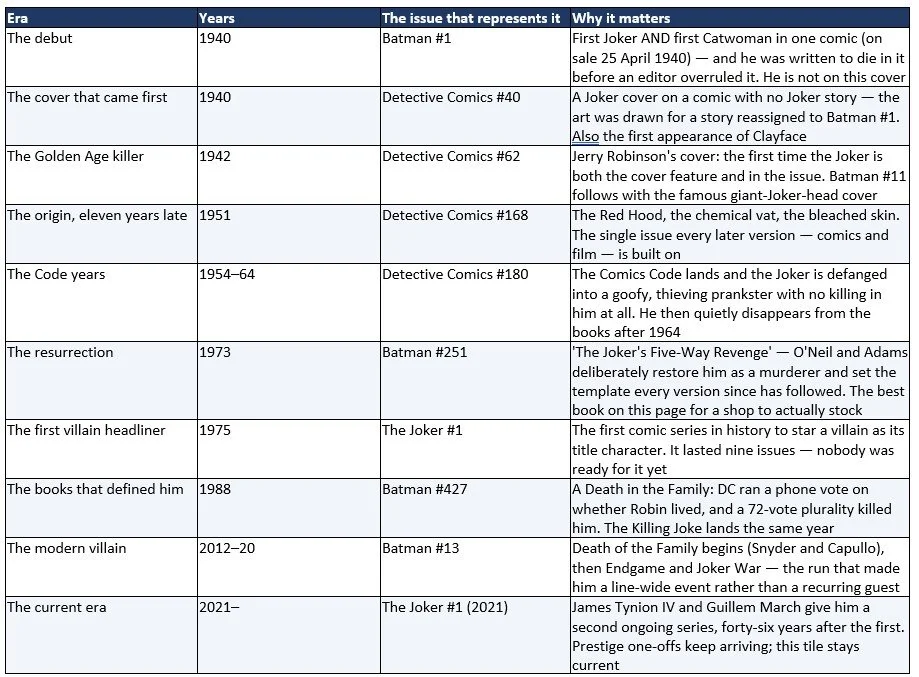
Eighty-six years, organized. Every era of the Joker, the one issue that represents it, and why collectors care:
The Keys — Issues Everyone Hunts
BATMAN #1 is the book, and it is a double key: the first Joker and the first Catwoman in a single 1940 comic. It is museum-tier — raw copies run into the tens of thousands, mid grades into the hundreds of thousands, and the record sale is in the millions — so it is authenticate-and-broker material, never a counter quote, and everything above about the four different Batman #1s applies to every copy that walks in. DETECTIVE COMICS #40 is the curiosity: the first Joker cover, on a comic with no Joker inside, which also happens to be the first Clayface — a book that sits in two collecting lanes at once and gets priced by people who only know one of them. DETECTIVE COMICS #62 is the first full Joker cover and a four-figure book in any presentable grade. DETECTIVE COMICS #168 from 1951 is the one that surprises people: his origin, thin on the ground, four figures raw and tens of thousands in grade, with roughly one high-grade sale a year — genuinely scarce rather than merely old. And then there is the one we actively want on the shelf. BATMAN #251, from September 1973 — O'Neil and Adams, 'The Joker's Five-Way Revenge' — is the rare key that is important, affordable and liquid all at once: it runs a couple of hundred dollars raw and sells somewhere in the world roughly once a day. That combination is unusual enough that we buy it whenever it appears. Below that sits a deliberately cheap modern tier: BATMAN #427, where the Joker kills Robin, is a landmark story that costs about the same as a new hardcover, and THE KILLING JOKE has been continuously in print since 1988 and sells on reputation rather than scarcity. The 1975 solo series is the quiet one — historically the first comic ever to headline a villain, still affordable, and almost never asked for by name. One warning made of money: Batman #1 and the major Joker keys all exist as facsimiles and inside oversized reprint collections, and oversized always means reprint. Key prices move constantly, so we buy and price against live sold comps — ask and we will pull them up on screen together.
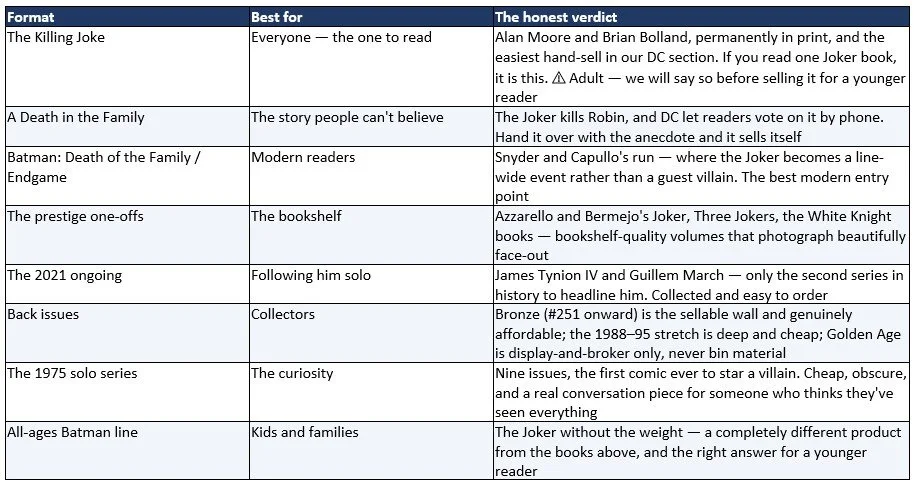
Every Format You Can Buy
Screen & Series Status
Updated August 2026: the Joker is the only comic-book villain with two Academy Award-winning performances behind him — one posthumous, one for a film that also took the top prize at Venice — and that is a fact worth knowing because it explains why this shelf behaves differently from every other one in the store. The most recent film sequel underperformed badly, and the immediate screen cycle has cooled as a result, so we are not implying anything is coming. It does not matter much, and that is the point: the Joker does not need a release to sell. He is on t-shirts, posters, Halloween costumes and tattoos belonging to people who have never bought a comic, and the collections move steadily year-round regardless of what is in production. On the comics side there is no standalone Joker ongoing on the rack at the moment; he is a permanent presence across the Batman line, whose current storyline is a line-wide event. So the play here is not a countdown to anything — it is keeping the four stories people actually ask for faced out all year. Exact dates for anything upcoming live in the Consolidated Ordering Calendar, not on this page.
Collector's Corner — Grading, Care & We Buy
Three habits govern this character at our counter, and the first one saves feelings as often as it saves money. THE BATMAN #1 CONVERSATION happens constantly, because far more people believe they own that comic than own it — there are at least four different comics called Batman #1 in circulation, and the gap between the 1940 original and a modern relaunch is the difference between a house and a coffee. We establish which one you have first, in front of you, using the indicia rather than the cover, and we do it before anybody gets excited in either direction. The second habit is what we think of as the story-not-issue rule: customers almost never want a specific issue number, they want a STORY — the Killing Joke, the one where he kills Robin, the Five-Way Revenge, Death of the Family. Knowing those four names by heart serves most Joker requests in the shop without opening a back-issue box at all, and it is how we get people to what they actually came for in about thirty seconds. The third is the Jason Todd cluster: A Death in the Family runs across Batman #426 to #429 and sellers routinely turn up with only the death issue, #427. We would rather buy the run than the single, and we will tell you what the other three are worth having. Beyond those: Golden Age Joker material is where grade drives price harder than almost anything else in the store — a two-point swing on Detective Comics #168 is tens of thousands of dollars — so we authenticate, grade honestly, and broker the serious books to the specialist market rather than shelf-pricing them. Outside the identified keys, modern Joker material is plentiful and was printed in large numbers, and we will say so plainly. And if you are selling, bring the whole run in: the credibility we earn being straight about the cheap material is exactly why people call us when something from 1951 turns up in an estate.
FAQ — Straight Answers
I have a Batman #1 — is it the one with the first Joker?
Almost certainly not, and we mean that kindly, because this is the single most common conversation on this page. There are at least four different comics called Batman #1 in circulation. The 1940 original contains the first appearance of both the Joker and Catwoman and is one of the most valuable comics in existence — raw copies run into the tens of thousands of dollars, mid grades into the hundreds of thousands, and the record sale is in the millions. There is also an official facsimile edition, which is a lovely modern reprint clearly labelled as one; a 2011 Batman #1 from DC's New 52 relaunch; and a 2016 Batman #1 from Rebirth. Those three are worth somewhere between a few dollars and a few hundred. The cover will not settle it for you, because the facsimile reproduces the 1940 cover faithfully — the indicia inside will, and so will the paper. Please do not clean it, tape it, or ship it anywhere before it has been identified. Bring it in, we will go through it with you in about a minute, and you will know exactly what you have either way. If it does turn out to be a 1940 copy, we will tell you honestly that it belongs with a specialist rather than in a shop window, and we will help you get it there.
Where does the Joker come from — what's his origin?
The honest answer is that the character is deliberately built so there isn't a settled one, and that is the interesting part. He appeared in April 1940 with no origin at all — just a killer in white greasepaint — and it stayed that way for eleven years. Then DETECTIVE COMICS #168, from 1951, gave us the version everything since has been built on: a criminal called the Red Hood falls into a chemical vat while escaping Batman and comes out with bleached skin, green hair and a permanent grin. The Killing Joke took that skeleton in 1988 and added the failed comedian and the desperate father-to-be, and the films have drawn on both ever since — but The Killing Joke itself pointedly leaves the door open, with the Joker remarking that if he has to have a past he prefers it multiple choice. So there are really two answers to give at a counter. The collector's answer is Detective Comics #168, 1951, and it is a genuinely scarce four-figure book that most people have never heard of. The reader's answer is The Killing Joke, which is in print, costs about the same as a paperback, and is the book we would put in your hands first.
Where should I start reading the Joker?
Start with a story rather than a series, because he has almost never had a comic of his own — he lives in Batman and Detective Comics, so 'a Joker comic' nearly always means a Batman comic. There are four honest answers depending on what you want. For the famous one, read THE KILLING JOKE — Alan Moore and Brian Bolland, one sitting, and the book most people mean; it is also genuinely adult, so we mention that before handing it to a parent. For the one people cannot believe really happened, read A DEATH IN THE FAMILY, where the Joker kills Robin and DC decided it by letting readers vote on a phone line. For the modern version, Scott Snyder and Greg Capullo's Death of the Family and Endgame are where he became a full line-wide threat. And for the classic, BATMAN #251 from 1973 — 'The Joker's Five-Way Revenge' — is the single issue that turned him back into a killer after the Comics Code had spent two decades making him harmless, and it is affordable enough to actually own. Come in and tell us which of those sounds right and we will put it in your hands in about thirty seconds; if it is not on the shelf, we will order it in.