
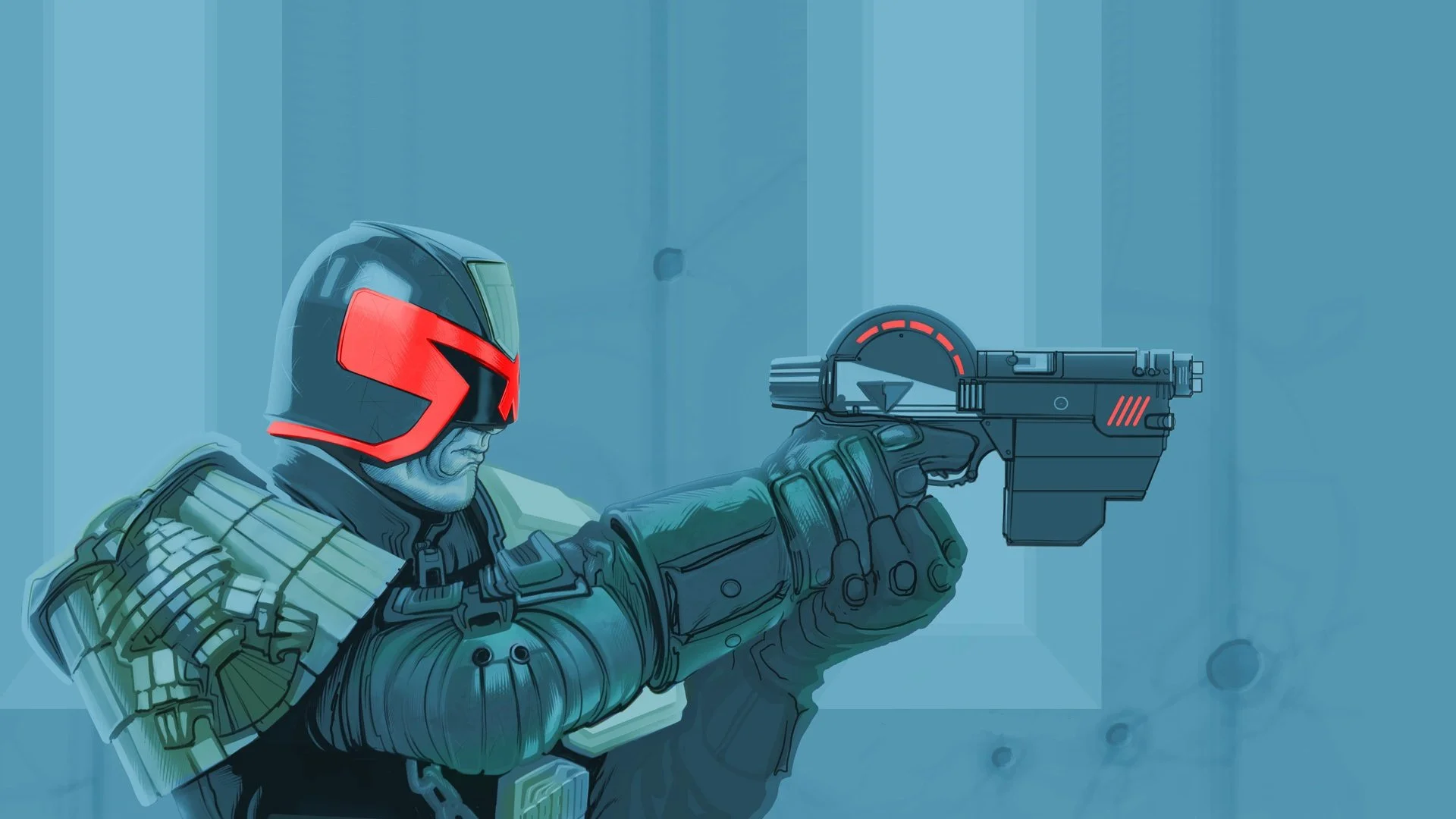
THERE IS NO JUDGE DREDD #1.
Judge Dredd — one lawman, 2,400+ weekly progs since 1977 · Comic King
Judge Dredd — The Complete Comic King Guide
In 1977 a new British weekly called 2000 AD needed a future cop for its second issue, and John Wagner, Carlos Ezquerra and Pat Mills gave it one: a lawman with the power of judge, jury and executioner, patrolling a megacity built on the ruins of America — written by satirists who understood exactly what they had made, and who have never once let him be a simple hero. Forty-nine years later the strip is still running, every single week, in the same magazine. Which means the most famous British comic character of all time has never had an issue #1 — and that one fact drives everything on this page: what is valuable, what is not, and why the “Judge Dredd #1” in your longbox is not what an online listing may have told you it is. Comic King carries Judge Dredd in Edmonton across all of it — the weekly prog itself, on North American racks for the first time in the comic's history, the collections that hold the classic stories, and honest identification of any UK material that walks through the door. If the book you want isn't on the shelf, we can special-order or source it on request.
Quick Facts
Story: A lawman with the power of judge, jury and executioner in Mega-City One, the megacity standing on a ruined America — British satire that has always known he is not a hero to cheer. That knowledge is the strip.
Length: Weekly since March 1977 inside 2000 AD — past Prog 2,488 and counting — plus the monthly Judge Dredd Megazine since 1990.
Status: Ongoing, and unique in comics: one continuous story aging in REAL TIME — a year out here is a year in Mega-City One, and Dredd has grown old on the job.
Publisher: Rebellion (2000 AD) — the comic was born at IPC in 1977; Rebellion has owned and published all of it since 2000.
Age guide: ⚠ Satire with graphic violence — a 15+ recommendation. It is not the kids' shelf and has never tried to be.
Formats: Weekly progs · Judge Dredd Megazine · Complete Case Files · Essential Judge Dredd · graphic novels · UK back-issue progs.
At Comic King: The weekly prog carried on the rack — new to North American shops in 2026 — the books behind it, and proper identification of UK progs before anyone talks money.
The Comic With No Issue #1
Here is what you actually need to know before buying or selling anything on this page. Judge Dredd has no series of his own in his home country and never has had. He lives inside 2000 AD, a weekly anthology whose issues are called PROGS and numbered continuously since 1977 — the count passed 2,488 in mid-2026. So there is nothing called Judge Dredd #1 anywhere in the UK, and the numbers that matter are prog numbers. Three of them matter enormously. PROG 1, from 26 February 1977, launched the magazine with a free “Space Spinner” gift taped to the cover — and contains NO JUDGE DREDD AT ALL. He missed the first issue. It is still a serious collectable, because the market wants launch issues, but anyone offering it as “first Judge Dredd” is wrong. PROG 2, from 5 March 1977, is the real thing: the first Judge Dredd story ever printed — and he is not even on its cover, which belongs to Dan Dare. His first cover comes seven weeks later, on PROG 9. Meanwhile every comic actually titled “Judge Dredd #1” is a later, mostly American object: Eagle Comics began repackaging the British strips for US readers in November 1983 behind new Brian Bolland covers, Quality continued it, DC published its own take in the mid-1990s, IDW another in the 2010s. Decent comics — modest money, with the Bolland-covered Eagle #1 the only one worth a careful comp. The trap runs in both directions, and we see both at the counter: the customer who believes their US “Judge Dredd #1” is a fortune, and the customer about to bulk-out a box of tatty British weeklies that might have Prog 2 sitting in it. We check the prog numbers, in front of you, before anybody says a number.
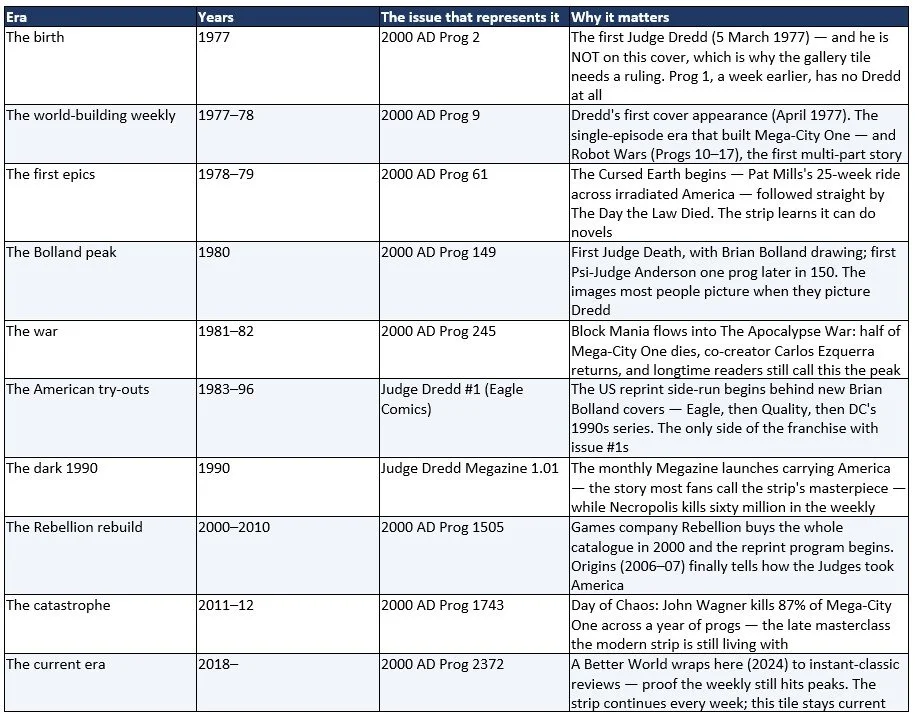
The Run, Era by Era
Forty-nine years, organized. Every era of Judge Dredd, the one issue that represents it, and why collectors care:
The Keys — Issues Everyone Hunts
2000 AD Prog 2 is the book, and everything in the section above applies to it: first Judge Dredd, 5 March 1977, Dan Dare on the cover, and no “#1” anywhere in sight. British weekly newsprint was sold at newsagents, rolled into school bags and thrown away, with no collector pipeline for decades — so while most surviving copies are well-read and priced accordingly, genuinely high-grade copies are scarce and command serious money. Prog 1 is the companion trap: no Dredd inside, but the launch issue of the magazine, and the market pays properly for it in grade — especially with the Space Spinner gift still present, which changes the object entirely. Progs 149 to 151, from early 1980, carry the first Judge Death and the first Judge Anderson with Brian Bolland drawing — and here is the shock: the raw market for them is modest, because UK back issues trade thin. That cuts both ways — cheap to build a display run, harder to flip — and graded high-grade copies are a different conversation altogether. Prog 9 is the footnote key, Dredd's first cover. On the US side, Eagle's Judge Dredd #1 from November 1983 is the first American edition with a Brian Bolland cover — a genuinely nice book that we comp carefully and honestly, while the rest of the Eagle, Quality, DC and IDW runs are affordable bin material. Batman/Judge Dredd: Judgement on Gotham, the 1991 Simon Bisley crossover, surfaces constantly in 90s DC collections — modest value, instant nostalgia, and back in print in a deluxe anniversary edition. And one discipline borrowed from everywhere else on this site: progs are ANTHOLOGIES. Rogue Trooper's and Sláine's first appearances live in this same prog run, and Strontium Dog arrived from a sister comic that merged in — so an early stack gets checked whole, never priced by Dredd alone. Key prices move constantly, so we buy and price against live sold comps — ask and we will pull them up on screen together.
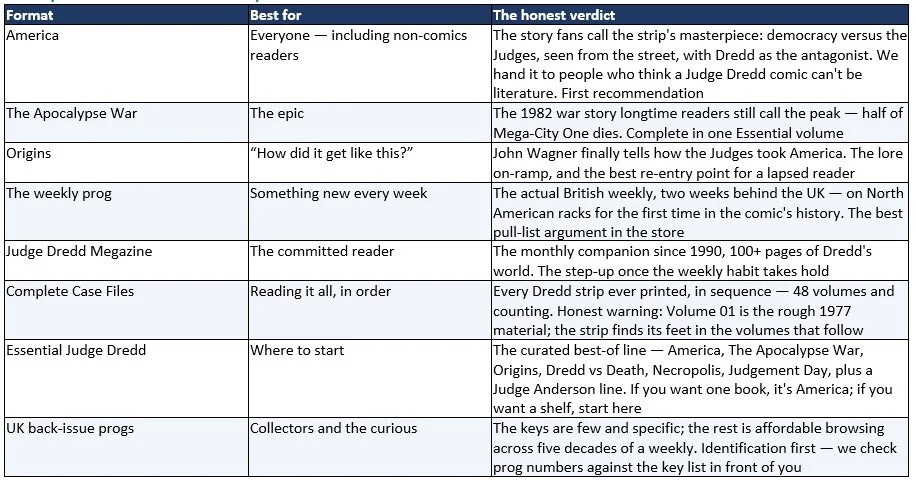
Every Format You Can Buy
Screen & Series Status
Updated August 2026: Judge Dredd has been filmed twice. The 1995 Stallone version took the helmet off and missed the point, and the fans — and the strip's own writer — have said so ever since. DREDD (2012) kept the helmet on, kept the satire, and grew from a box-office miss into a real cult classic; its admirers are exactly who the America recommendation exists for. A third film entered development in 2025 with Taika Waititi attached to direct and the publisher itself producing — nothing further is announced, so nothing further gets promised at the counter. The nearer certainty is the calendar: 2000 AD turns FIFTY in February 2027, Dredd himself in March 2027, and the publisher already runs an official Day of Dredd every 7 September. A fiftieth birthday for a comic still publishing weekly is a genuinely rare thing, and this shelf will be ready for it. Exact dates for anything upcoming live in the Consolidated Ordering Calendar, not on this page.
Collector's Corner — Grading, Care & We Buy
Four habits govern this franchise at our counter, and the first is the one that saves people money in both directions. We identify the OBJECT before discussing a number: a UK prog, a US reprint floppy, a Megazine, or an in-print paperback are four different markets that happen to share a character. The second habit is the British-stack search. UK weeklies surface in Canadian collections far more often than American ones — Commonwealth households, expat basements — and a tatty pile of 2000 ADs looks like recycling while potentially holding real keys. The checklist is short and we run it every time: Progs 1, 2, 9 and 149 to 151, then condition on anything pre-1985. The third is the free-gift rule: a Prog 1 with the Space Spinner still present is a different and much bigger sale than one without — we never detach, reunite or approximate gifts, and we broker rather than shelf-price the serious copies. The fourth is honesty about the rest: most progs are reader copies and trade for pocket money, and we will say so plainly rather than let a stack masquerade as treasure. Progs are magazine-sized, so they take magazine bags and boards rather than standard comic supplies — we stock both. We assess keys with live comps on screen, grade honestly, broker CGC submissions for the genuinely slab-worthy copies — the population on graded progs is thin and the buyers are specialists, which is exactly why the big ones deserve brokering — and if you are selling, we buy: bring the stack in whole.
FAQ - Straight Answers
What is Judge Dredd's first appearance — and is my old 2000 AD worth anything?
His first appearance is 2000 AD Prog 2, dated 5 March 1977 — and he is not on its cover, which belongs to Dan Dare. Prog 1, from a week earlier, contains no Judge Dredd at all, though as the launch issue of the magazine it is a serious collectable in its own right, especially with its free Space Spinner gift still attached. Those two facts sort out most of the confusion we see. As for value: the spread is enormous and worth understanding before you do anything. Well-preserved graded copies of the first two progs have reached four and even five figures, while the same issues well-read are worth a small fraction of that — and the overwhelming majority of later progs are pocket-money books regardless of age. The first Judge Death (Prog 149) and first Judge Anderson (Prog 150), from 1980, are genuine keys that still trade surprisingly modestly in raw condition, because the UK back-issue market is thin. If you have British weeklies of any kind, bring the stack in whole — we will go through the prog numbers with you, in front of you, and you will know exactly what you have either way.
Why is there no Judge Dredd #1? What's a “prog”?
Because Judge Dredd has never had his own comic in the UK. He has always been a strip inside 2000 AD, a weekly science-fiction anthology whose issues are called progs — short for programmes — and numbered continuously since February 1977, past 2,488 and counting. There was no relaunch, no renumbering, no jumping-on #1 — one count, nearly fifty years long. The closest thing to a solo title is the Judge Dredd Megazine, a monthly that launched in 1990, and even that began at issue 1.01 rather than a #1. Every comic on the market actually titled “Judge Dredd #1” is a later repackaging for North American readers — Eagle Comics started it in 1983 with new Brian Bolland covers, and Quality, DC and IDW followed over the decades. They are legitimate and often good comics; they are simply not the character's first anything, and only the Eagle #1 carries meaningful collector value. So when you ask us about an issue, give us the prog number — it is the only number the franchise has ever really had.
Where should I start reading Judge Dredd?
It depends on which door you want in through. For the masterpiece, read America — the story of what the Judges look like from the street, told in one short book; it is the single best answer this page has, and if you liked the 2012 film it was practically written for you. For the epic, read The Apocalypse War, the 1982 story where half the city dies and the strip becomes legend. For the history, read Origins, where the strip finally explains how America became Mega-City One. If you want to read it all in order, the Complete Case Files reprint every strip from the beginning across 48 volumes — start wherever the era that interests you begins, and let us warn you honestly that Volume 01 is the scrappy 1977 material rather than the good stuff. And if you want what makes this franchise unlike anything else on our shelves, put the weekly prog on your pull list and read it the way Britain has for five decades: a few pages of Dredd, every week, forever. Come in and tell us which of those you are after and we will put the right book in your hands in about thirty seconds.