
THE BOOK WHERE THEY ALL SHOW UP.
Avengers — 402 issues, a roster that never stops changing, and the key everybody files in the wrong box · Comic King
Avengers — The Complete Comic King Guide
In September 1963 Stan Lee and Jack Kirby put five heroes who already had their own comics into one book together, and invented the format that now runs the biggest film franchise on earth. What makes the Avengers genuinely different from every other title in this section is that it was never really about those five: the Hulk quit by the second issue, the entire founding roster walked out by the sixteenth, and Captain America rebuilt the team out of reformed villains. Sixty-three years of that churn means one title carries the first appearances and defining stories of a dozen different characters — which is exactly why an Avengers run is worth going through issue by issue rather than pricing by the inch. It also means the single most-missed key in Marvel collecting lives here rather than where anyone thinks to look for it. Comic King carries the Avengers in Edmonton across all of it: this week's issues, a deep and genuinely affordable Bronze wall, the story collections we hand to anyone who asks where to start, and careful identification of anything from the Silver Age. If the book you want isn't on the shelf, we can special-order or source it on request.
Quick Facts
Story: Earth's Mightiest Heroes — a team assembled by accident when Loki's scheme backfired, and one that has replaced its entire roster more times than any other book in comics.
Length: Since September 1963 — volume one ran 402 issues straight through to 1996, followed by nine further volumes.
Status: Ongoing, and mid-reset — a line-wide Avengers event is running now and a brand-new number one with a genuinely unexpected roster follows it.
Publisher: Marvel Comics
Age guide: Standard Marvel teen fare — the team books are among the easiest recommendations on this wall for a younger reader moving up from all-ages.
Formats: New issues · back issues · the story collections (Kree-Skrull War, Korvac, Under Siege) · Epic Collections · omnibus editions · facsimiles of the early keys.
At Comic King: New issues weekly, a Bronze run deep enough to actually complete, and we open every early Avengers box before anything gets priced — because of issue four.
Issue Four — the Most-Missed Book in Marvel Collecting
Here is what you actually need to know before buying or selling anything on this page. Captain America's return — the moment Marvel brought back its 1940s flagship character after roughly fifteen years out of print — does not happen in a Captain America comic. It happens in AVENGERS #4, March 1964, when the team finds him frozen in the North Atlantic. That single fact creates the most reliable blind spot in the hobby, and it cuts both ways. A seller sorting a collection by character files that issue under Avengers and never thinks to flag it, because to them it is a team book. A buyer hunting Cap's comeback searches the Captain America boxes, where it has never been. We have watched both halves of that mistake happen at counters, and it is why every early Avengers run that enters this store gets checked before anything is priced. What the book is actually worth is worth being precise about, because the internet is not: a well-read copy is a few hundred dollars, and it climbs into four figures from around Very Good and keeps climbing steeply from there. So the copy in a shoebox is a real find rather than a retirement fund — which is a better and more honest thing to tell someone than the number they have usually seen online. And the same title hides more than one of these. AVENGERS ANNUAL #10 from 1981 holds the first appearance of ROGUE, and annuals get bulk-priced across the entire hobby because they file as extras. That is the second annual on our shelves carrying a real key — Fantastic Four Annual #6 is the other — and it is why we check every single one.
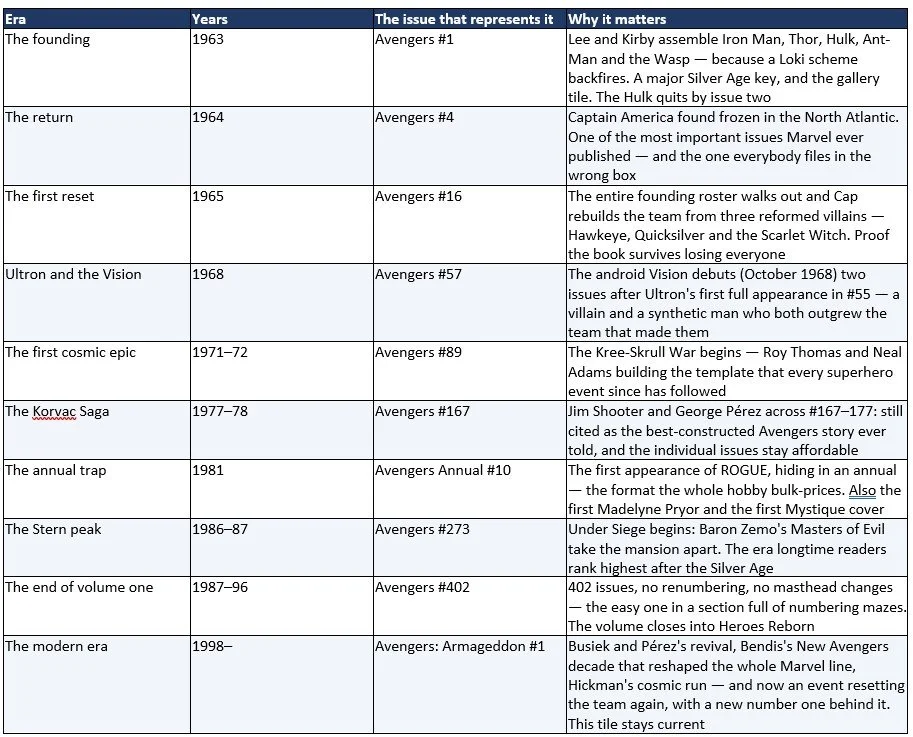
The Run, Era by Era
Sixty-three years, organized. Every era of the Avengers, the one issue that represents it, and why collectors care:
The Keys — Issues Everyone Hunts
Avengers #4 is the book, for the reasons set out above: Captain America's Silver Age return, March 1964, and the key most likely to be sitting unrecognised in a collection someone is about to sell you. Avengers #1 from September 1963 is the other major Silver Age key here and the more expensive of the two — the first appearance of the team itself, and a book that has climbed hard as the films have made the name universal. Both exist as facsimile editions and inside oversized reprint collections, so both get authenticated before anyone says a number; oversized always means reprint. Avengers #57 from October 1968 is the first appearance of the android VISION, a proven screen-driven mover whose popularity has outlasted several of the founders — and it is worth knowing that an entirely unrelated Golden Age character called the Vision, an alien lawman created by Simon and Kirby in 1940, has nothing to do with him beyond the name. Two issues earlier, #55 carries Ultron's first full appearance, and the whole #54 to #58 stretch is worth pricing as a cluster rather than issue by issue when a run comes in. AVENGERS ANNUAL #10 from 1981 is the sleeper: the first Rogue, plus the first Madelyne Pryor, in a format the hobby routinely bulks out. Avengers #16 — the roster reset — gets overlooked sitting between the famous single digits and the Vision issues, and is usually the best-value early book on the shelf. And then there is the material that sells on story rather than scarcity: the Kree-Skrull War, the Korvac Saga and Under Siege are all affordable as individual issues and move steadily as collections, which makes them the easiest recommendations we make. Key prices move constantly, so we buy and price against live sold comps — ask and we will pull them up on screen together.
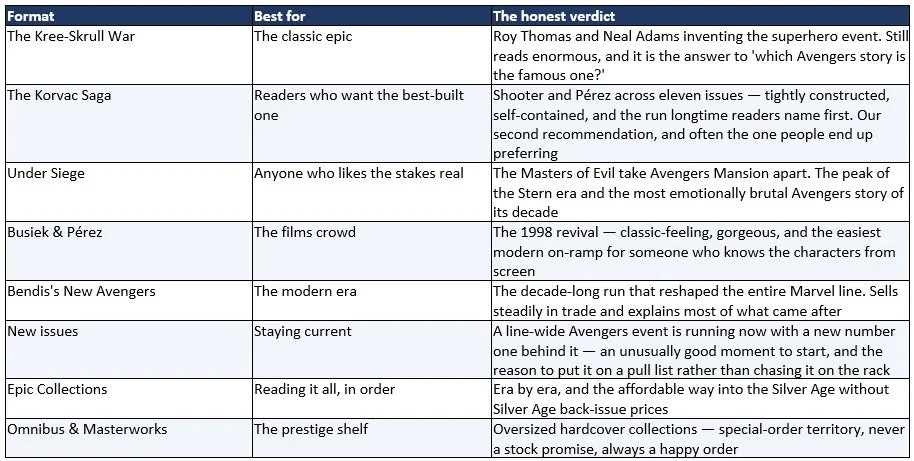
Every Format You Can Buy
Screen & Series Status
Updated August 2026: the Avengers films are the biggest thing Marvel does on screen, and the important retail difference is that they lift the ENTIRE Marvel wall rather than one character's shelf — these are store-wide events, not shelf events, and worth planning as such. Another team tentpole is the next one on the calendar, and the comics are deliberately clearing the decks to meet it: a line-wide Avengers event is running right now, it ends with the team reset, and a new number one follows with a roster most readers will not see coming. The most useful pattern on this page is the ROSTER PATTERN: when a character is announced for an Avengers film, THEIR own first appearance moves first, and their early Avengers appearances move behind it. That has played out repeatedly — the Vision on screen moved #57, Cap's films moved #4, and Rogue, Hawkeye, Scarlet Witch and Quicksilver all have keys inside this title that respond to their own news. So watch cast announcements rather than trailers, and stage each member's keys alongside the team books. Exact dates for everything upcoming live in the Consolidated Ordering Calendar, not on this page.
Collector's Corner — Grading, Care & We Buy
Four habits govern this franchise at our counter. The first is the ISSUE FOUR PROTOCOL: every early Avengers run gets checked for #4 before a single price is quoted, authenticated against the facsimiles, graded honestly and comped on screen in front of you — and the genuinely high-grade copies get brokered rather than shelf-priced, because that is a specialist market and you deserve the specialist price. The second is the ANNUAL CHECK. Annuals are bulk-priced across the whole hobby because they file as extras, and Avengers Annual #10 holds the first Rogue — the second annual on our shelves carrying a real key, alongside Fantastic Four Annual #6. We check every annual in every collection, and we tell sellers why. The third is the habit this title demands more than any other: an Avengers collection is really a MULTI-CHARACTER collection. We sort by who debuts in it, not by run position, because the money hides in whichever member happens to be having a moment — and with a rotating roster, somebody always is. The fourth is honest era pricing: issues #1 to #20 comped individually, the Vision and Ultron cluster pulled, #21 to #100 priced as real Silver Age, the long #101 to #300 Bronze stretch deep and affordable, and late volume one plus the Heroes Reborn material bought selectively and passed on kindly — it arrived in bulk and it is bin stock, and we would rather say so than pretend. Beyond that: we broker CGC submissions for slab-worthy books, and we stock the bags, boards and boxes that keep a 402-issue run worth completing.
FAQ - Straight Answers
Where is Captain America's return — I can't find it in his own comics?
It is AVENGERS #4, from March 1964, and you are in extremely good company for not finding it. When Marvel revived Captain America after roughly fifteen years out of print, they did it inside the Avengers: the team finds him frozen in the North Atlantic, and he becomes the group's moral centre from that issue on. His own solo stories restarted separately, inside an anthology called Tales of Suspense. The result is that the single most important Silver Age Captain America issue is filed, correctly, under Avengers — which means people sorting a collection by character walk straight past it, and people hunting it look in the wrong longbox. On value: a well-read copy runs a few hundred dollars, it reaches four figures from around Very Good, and it climbs steeply from there, so condition matters enormously and the difference between grades is thousands rather than tens. If you have any early Avengers issues at all, bring the run in whole and we will go through it with you — that is exactly the kind of book we would rather find for you than have you sell to someone who does not mention it.
Are Avengers annuals worth anything, or are they just extras?
Some of them are worth considerably more than the issues around them, and Avengers Annual #10 from 1981 is the one to know: it is the first appearance of ROGUE, and it also carries the first Madelyne Pryor and the first Mystique cover appearance. The problem is structural — annuals file as extras, sit at the end of a run, get stored separately and are bulk-priced across the entire hobby, which is precisely why the key ones survive in collections long after the regular issues have been picked over. This is the second annual on our shelves that carries a real first appearance; Fantastic Four Annual #6 is the other. So the honest answer is that most annuals are ordinary and a few are not, and the only way to know is to look at each one. We do check every annual in every collection that comes in, and we will happily go through yours with you rather than pricing a stack by the inch.
Where should I start reading the Avengers?
It depends which kind of reader you are, and there are four honest answers rather than one. If you want the famous epic, read the Kree-Skrull War — Roy Thomas and Neal Adams in the early seventies, essentially inventing the superhero event, and it still reads enormous. If you want the best-built story, read the Korvac Saga by Jim Shooter and George Pérez: eleven issues, self-contained, and the one longtime readers name first — plenty of people who start with Kree-Skrull end up preferring this. If you came from the films, Busiek and Pérez's 1998 revival is the friendliest on-ramp, and Bendis's New Avengers is the run that explains most of the modern Marvel line. And if you want to start right now, the timing is unusually good: an Avengers event is running, the team is being reset, and a new number one follows it with a roster nobody is expecting — which is about as clean a jumping-on point as this franchise ever offers. Come in and tell us which of those sounds right and we will put the book in your hands in about thirty seconds; if it is not on the shelf, we will order it in.