
G.I. Joe
One writer. Forty-four years. And a run that never actually ended.
G.I. Joe— The Complete Comic King Guide
G.I. Joe started as a comic made to sell a toy line, launched with a television advert, and it should by every reasonable expectation have been disposable. Instead one writer took it and ran with it for forty-four years, and it became the licensed comic that people argue is actually literature.
That is not a nostalgic exaggeration. Larry Hama started writing it in 1982, and he is writing the same series, with the same issue numbering, on the rack today. It has passed issue 330. Three different publishers have carried it, and only one of them ever restarted the count.
This page covers what that means for a collection: which issues are the keys, which two of them have reprints that will fool you, why the last Marvel issue is worth more than the first, and what is actually happening with the franchise right now as opposed to what people assume is happening.
A warning in advance, because it is the single most useful thing here: the normal way of telling a reprint from an original does not work on G.I. Joe. It fails three separate ways on this title, and one of them will cost someone real money. That is all in the Collector’s Corner further down, and it is worth reading before you buy or sell a single issue of this run.
Quick Facts
Story: An elite military unit against a terrorist organisation called Cobra — written, almost from the start, as a serious war comic with ninjas in it rather than as a toy advertisement.
Length: Since June 1982, and the original numbering is still running. It has passed issue 330.
Status: Currently published by Skybound, and busy: Larry Hama continuing the original series, plus a separate modern line sharing a universe with Transformers.
Publisher: Skybound (2023 to now). Previously Marvel (1982 to 1994), Devil’s Due (2001 to 2008) and IDW (2008 to 2022).
Age guide:Teen and up. The comic is considerably more serious than the cartoon — people die in it, and it was written that way from early on. Fine for most readers who can handle a war story.
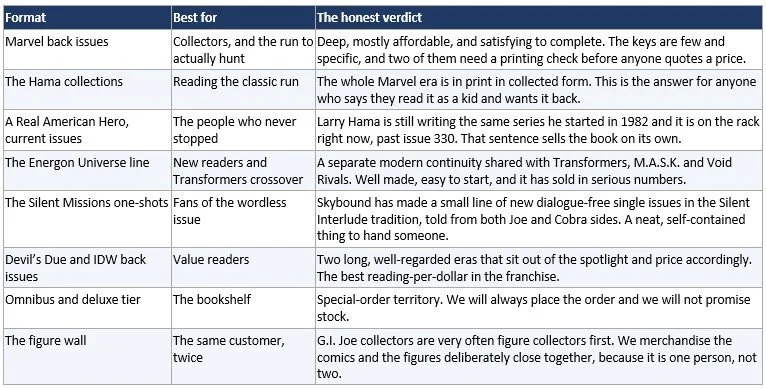
Formats: Marvel-era back issues · collected editions of the classic run · the current Skybound titles · and the modern Energon Universe line alongside Transformers.
At Comic King: A deep Marvel run in the boxes with the keys pulled and identified by printing, the Hama collections on the shelf, and the current line on the new-comics rack.
One Writer, Forty-Four Years, and a Run That Never Actually Ended
The usual way to describe G.I. Joe comics is four publishers and four number ones. That framing is tidy, and it hides the most interesting fact about the franchise.
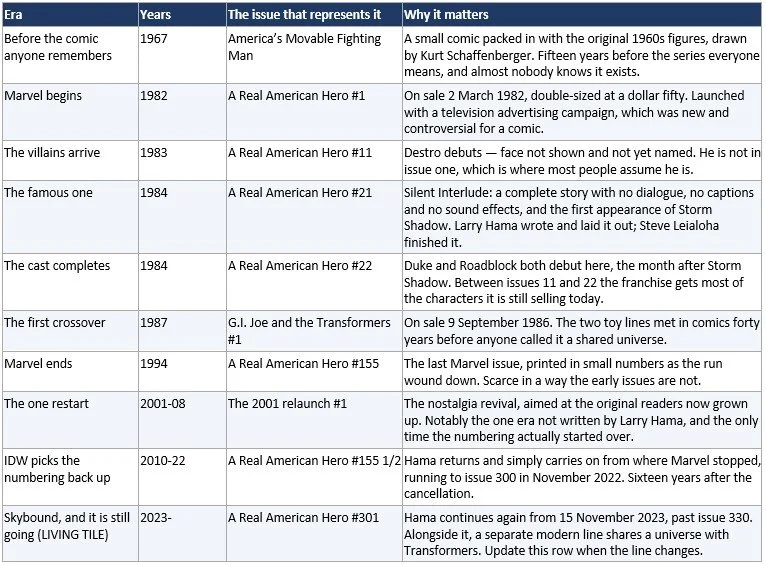
Marvel published A Real American Hero from 1982 to 1994 and ended it at issue 155. Larry Hama wrote all but a handful of those. Then, in 2010, IDW picked the series back up and did something almost nobody does: instead of relaunching at a new number one, they carried straight on from where Marvel had stopped, starting with an issue numbered 155 and a half. Hama came back and wrote it. That continuation ran to issue 300 in November 2022. When Skybound took the licence over, they did the same thing again — issue 301, November 2023, Hama still writing.
So the honest version is this: one man has been writing the same numbered comic, about the same characters, since 1982, across three publishers and a sixteen-year gap in the middle. The only true restart was the Devil’s Due revival in 2001, and that is also the one era Hama did not write.
That matters at the counter for two reasons.
The first is that it makes this a current comic, not a nostalgia relic. Issue 330 came out in July 2026, sold out at the distributor before shops could reorder, and went back to press with a new cover — because it contained a surprise appearance by Lara Croft, of all people, setting up a Tomb Raider crossover. That is a book from a series that started during the Falklands War, selling out in 2026.
The second is a buying point. Because the Marvel run has a famous ending at 155, people treat 155 as an ordinary last issue and price it accordingly. It was printed in small numbers as the title wound down, and in ungraded condition it is the more expensive of the two — worth noticeably more than issue one. A collection sorted by the usual rule of thumb, where you pull the first issue and the famous issue and bin the rest, will put a genuinely valuable comic in the bargain box. We do not do that, and we would rather you did not either.
There is one more piece of this worth knowing, because it explains why the comic is better than a toy tie-in has any right to be. Hasbro sent Hama little more than character sketches and a military speciality for each figure. He wrote them full dossiers — names, hometowns, service records, personalities — and kept them on file cards. Hasbro liked them enough to print shortened versions on the back of the toy packaging, and the company’s own salesmen used those bios to sell the line to retailers. So the writer of the comic invented the personalities that sold the toys, rather than the other way round. Snake Eyes is the clearest case: Hasbro designed the figure all in black with a masked face largely to save money on paint, and Hama turned that cost-saving into a mute commando with a tragic history and the most recognisable silhouette in the franchise.
The famous issue, for the record, is 21 — Silent Interlude, from 1984. A complete story with no dialogue, no captions and not a single sound effect, and the first appearance of Storm Shadow in the same book. It is one of the most admired single issues in mainstream comics and Hama has said plainly that he did it deliberately, to see whether he could. The story that the lettering got lost in the mail is a myth.
The Run, Era by Era
The numbering runs continuously except for one break. Before quoting anything, establish the publisher and the year — and on two specific issues, the printing.
The Keys — Issues Everyone Hunts
A Real American Hero #1, June 1982, a dollar fifty and double-sized on better paper than a normal comic of the period. It introduces most of the original team, along with Cobra Commander and the Baroness. Two things worth knowing: Snake Eyes is not on the cover, and despite what you will hear, this issue has only ever had one printing. There is no second-printing #1 to worry about.
A Real American Hero #21, March 1984, sixty cents. Silent Interlude and the first Storm Shadow. This is the one to check every stack for, and it is also the one with a genuine reprint problem — see the Collector’s Corner below, because the usual way of spotting a reprint does not work here. Storm Shadow is not on the cover either; that is Snake Eyes.
A Real American Hero #11, May 1983 — the first Destro, with his face not shown and his name not yet given. And #22, April 1984, the month after Silent Interlude, which brings in both Duke and Roadblock. Neither issue is famous, both are affordable, and both are characters the current publisher has built whole series around. If you are looking for the underrated corner of this run, it is the stretch from 11 to 22.
A Real American Hero #155, the final Marvel issue from 1994. Low print run, genuinely scarce, and the single most commonly under-priced book in the franchise. Check for it.
G.I. Joe and the Transformers #1, on sale September 1986. The first time the two properties crossed over in comics, forty years before the current shared universe made it a headline. Cheap, historically interesting, and an easy sell to anyone buying the modern line.
Special Missions #1 from 1986 and the Order of Battle miniseries are the completionist layer, and generally inexpensive. Order of Battle carries one of the great comics misprints: issue 2 listed Rocky Balboa as a member of the G.I. Joe team. Later issues printed a retraction and the collected edition quietly removed him.
One general note on the Marvel run before the modern books. Outside the handful of issues named above, most of it is affordable reader material, and we would rather say that plainly than pretend otherwise. It is a long run, it is cheap, it reads well in sequence, and completing it is one of the more achievable collecting projects in the shop. That is a feature, not an apology.
On the modern side, the Skybound relaunch produced solo first issues for Duke, Cobra Commander, Scarlett and Destro across 2023 and 2024. They sold heavily, they were speculated on heavily, and prices have come back down a long way from where they peaked. There is no Snake Eyes solo first issue in that line, whatever you may have been told — he has been deliberately held back.
Every Format You Can Buy
Screen & Series Status
Updated August 2026: the publishing side of this franchise is in genuinely good health. The screen side is quieter than people think, and it is worth being straight about the difference.
An adult animated series based on the Skybound shared universe — G.I. Joe, Transformers and the rest — was announced in October 2025, with Joe Henderson as showrunner and Hasbro and Skybound producing. It is real and it is confirmed. What it does not have is a home: no network or streamer was attached at announcement, and there was no update on it at Comic-Con in July 2026. Treat it as a project in development rather than a dated event.
The live-action Transformers and G.I. Joe crossover film has been discussed for years. As of April 2026 the director of the last Transformers film described it as still in the works but not the studio’s next priority. There is no release date and no production start.
What is actually live is the comics. The modern Skybound line has sold over seven million copies across its titles. At Comic-Con in July 2026 the publisher confirmed it is holding steady at four core series rather than continuing to launch solo miniseries — which is useful to know if you were buying those first issues expecting more of them. Larry Hama’s original series sold out in July and is going into a Tomb Raider crossover in October 2026.
The other thing worth saying about this franchise, which no announcement changes, is who it is for. The children who read this comic in 1985 are in their late forties and early fifties now. Every wave of G.I. Joe attention reaches them far more strongly than it reaches anyone under twenty, and they arrive with money and a very specific memory of a particular issue. That is why the classic collections sit where adults browse in this shop rather than in the kids section, and it is why we keep the Marvel run properly sorted instead of dumped in a bin. The customer for this franchise usually knows exactly what they are looking for.
One honest note on the back-issue market, because it is the question people ask. The shared universe with Transformers has been running since late 2023 and has been a real commercial success in new comics. It has not moved the price of the classic Marvel back issues. More copies have been sent for grading, but the extra supply has absorbed the extra attention and prices have stayed flat. If someone tells you the classic run is climbing because of the new line, the numbers do not support it.
Collector's Corner — Grading, Care & We Buy
The condition reality is straightforward: this was a kids’ comic bought off spinner racks and read to death. High-grade early copies exist in reasonable numbers because a lot of people saved them, so grade honestly and do not assume scarcity at the top of the scale. Issue 21 is the genuine exception — it is meaningfully harder to find in top condition than issue one is.
Now the important part, because G.I. Joe breaks the normal reprint test in three separate ways and this is the most useful thing on the page.
First: issue 21 has three printings, and all three carry the same sixty-cent cover price. The price box, which is the standard way to spot a reprint, is useless here. The tell is the little box in the corner of the cover: the second and third printings show Spider-Man in his black costume, and the black costume did not exist in March 1984. Black-suit Spider-Man in the corner box means you are holding a reprint, every time. Telling the second and third printings apart from each other requires reading the small print inside the front cover.
Second: there is a 1982 Special Treasury Edition that reprints issue one, with the same cover art and the same dollar-fifty cover price. Price box, again useless. The tell here is size — the Treasury is a big oversized magazine format, obviously larger than a comic, and once you have seen one you cannot mistake it.
Third, and this one catches people who know the general rules: on this title, no barcode does not mean reprint. Direct-edition copies sold through comic shops in the 1980s had artwork in the barcode box, while newsstand copies sold in shops and drugstores had a real barcode. Both are original. On G.I. Joe the newsstand copies are actually the harder ones to find in top grade and carry a premium there.
That direct-versus-newsstand split is worth understanding rather than just memorising, because it runs the opposite way to most people’s instinct. Through the 1980s the same comic was printed for two channels: comic shops got the direct edition, and newsstands, drugstores and supermarkets got copies with a real barcode. Far more direct copies survived in good condition, because the people buying them were collectors who bagged them. Newsstand copies were bought by kids alongside a chocolate bar and treated accordingly. So on this title the barcoded copy — the one that looks less collectible — is the scarcer one at the top of the grade scale, and it is priced that way.
Our general guide to spotting a first printing covers the standard tests. G.I. Joe is the title that breaks them, which is exactly why it is worth reading both.
We buy G.I. Joe, and one specific note on that. G.I. Joe collections arrive with toys more often than almost any other comic franchise. If there are figures in the garage as well as comics, tell us — it changes what the collection is and how we handle it.
FAQ — Straight Answers
Where should I start reading?
If you want the classic run, start with the first collected volume of the Marvel era and read forward — it is in print and it is inexpensive. If you want to know what the fuss is about without committing, read issue 21 on its own; it is a complete story and it needs no context at all, which is rather the point of it. If you want to be current, you have two doors: Larry Hama’s ongoing series, which is the original continuity, or the modern Skybound line, which is its own world and shares it with Transformers. Either works cold.
What is Silent Interlude and why does everyone talk about it?
It is issue 21, from 1984. Larry Hama told a complete story — beginning, middle, end, a fight, a rescue, real character work — with no dialogue, no captions and no sound effects at all. It also introduced Storm Shadow. It is widely regarded as one of the best single issues of the era and it is the issue most G.I. Joe collectors are looking for.
How do I tell if my issue 21 is a first printing?
Look at the small box in the top left corner of the cover. If Spider-Man is in there wearing a black costume, it is a reprint — the black suit did not exist yet in early 1984. The cover price will not help you, because all three printings are sixty cents. Bring it in and we will check it with you.
Is the comic like the cartoon?
No, and this surprises people. The cartoon was made for children and nobody was ever really hurt in it. The comic is a war story with ninjas, written seriously, in which characters are killed and stay dead. If you liked the cartoon as a kid, the comic is the grown-up version of it and it holds up better than you expect.
Is Larry Hama really still writing it?
Yes. He started in 1982 and he is writing the same series, with the same issue numbering, right now — past issue 330. IDW and then Skybound both continued Marvel’s original count rather than restarting it, and he came back each time. It is one of the longest single-writer runs in comics.
What is the Energon Universe and do I need to read it to follow G.I. Joe?
It is a separate modern continuity where G.I. Joe, Transformers, M.A.S.K. and Void Rivals share one world. It is not the same as Hama’s ongoing series — they run alongside each other, and you can read either without the other. If you want the classic characters, read Hama. If you want the crossover, start with the modern line and we will point you at the right first issue.