
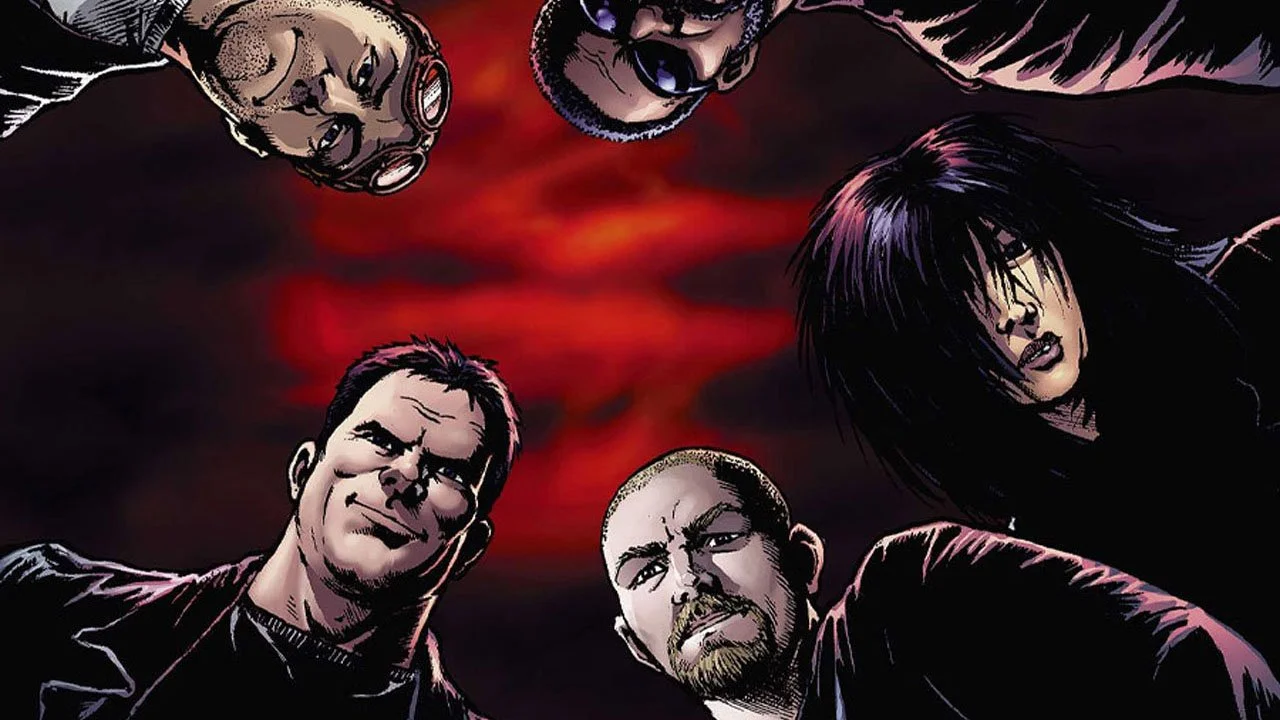
HE'S NOT IN ISSUE ONE.
The Boys — where the cast actually starts, what the collections cost, and the finished 72-issue story · Comic King
The Boys — The Complete Comic King Guide
The Boys is the book DC published and then got rid of. It launched in 2006 under WildStorm, a DC imprint, as a story about a small crew whose job is to keep superheroes in line — and after six issues DC decided it did not want to be the company publishing it. The rights reverted, Dynamite picked it up, and the run continued to issue seventy-two without anybody softening a single page. Garth Ennis has said since that being cancelled was the best thing that ever happened to it.
That is a good story, and it is true. It has also produced a set of beliefs about this run that do not survive contact with the actual numbers — that the six DC issues are the scarce ones, that the first issue is the one with everybody in it, that a red-logo copy in a box is probably worth something. We will go through all of that below, because getting it right is worth real money in both directions.
The most useful thing to know before you read any further: the story is FINISHED. Seventy-two issues, one writer, one artist, ending in 2012 exactly where Ennis meant it to end. There is no new Boys comic and none is coming. Whatever you thought of how the television version wrapped up, the comic answered its own questions fourteen years ago, and it answered them differently.
Quick Facts
Story: A crew with a grudge and a government mandate keeps superheroes in line, in a world where the superheroes are a corporate product and the corporation is the real villain.
Length: 72 issues, August 2006 to November 2012. Ninety issues counting the three six-issue spin-offs, ninety-eight counting the epilogue series.
Creators: Written by Garth Ennis throughout. Drawn by Darick Robertson, with Russ Braun and John McCrea on substantial stretches.
Publisher: TWO. WildStorm, a DC imprint, published issues one to six. Dynamite published seven to seventy-two and publishes every collection.
Where to start: Omnibus Volume One. It is the best value on the shelf and it covers the first fourteen issues, which is well past the point where you know if it is for you.
Currently publishing: No new story. But the twentieth anniversary landed in 2026 and the reprint and collectible programme around it is very much live.
Age guide: ADULT, and more so than the television version. Graphically violent and sexually explicit throughout. Never a gift without a warning, never near the all-ages wall.
The one thing to check: Which issue you actually want. Issue one is famous; issue three is the one with Homelander in it.
Homelander Is Not in Issue One
This is the single most useful fact on this page, and almost nobody walking in knows it. THE BOYS ISSUE ONE DOES NOT CONTAIN HOMELANDER. It does not contain Starlight, Black Noir or Queen Maeve either. It does not contain Mother's Milk, Frenchie or The Female. What it contains is Billy Butcher, Hughie Campbell, A-Train, and Terror the dog — and A-Train is there to do the thing that starts the story, not to introduce the Seven.
The cast arrives across three issues, deliberately, and the second issue's own chapter title tells you so: ISSUE TWO is called 'The Frenchman, the Female and the Man Called Mother's Milk,' and that is exactly what is in it. ISSUE THREE is called 'The Seven,' and it holds the first appearances of HOMELANDER, STARLIGHT, BLACK NOIR and QUEEN MAEVE — four characters that anyone who watched the television version can name, in one comic.
★ SO HERE IS THE PRACTICAL CONSEQUENCE, AND IT RUNS BOTH WAYS. If somebody wants the Homelander book and buys issue one, they have paid roughly twice as much for a comic that does not have him in it. And if a collection comes across our counter and issue three gets treated as an ordinary early number, somebody has just binned the strongest character key in the run. We check the contents, not the number, and we will show you the credits page rather than asking you to take our word for it.
None of this makes issue one a bad book to own — it is the first appearance of Butcher and Hughie, it is the debut of the whole thing, and it is the most actively traded comic in the franchise. It is simply not the comic most people think they are buying. Issue three costs about half as much and is arguably the more important book. When both are on the shelf we say that out loud, even though the cheaper answer is the one that is true.
The same discipline applies to a name the television version made famous and the comic uses twice. THERE ARE TWO SOLDIER BOYS. The one from the Second World War — the version played on screen — first appears late in the run, in issue fifty-two. The other, a member of a team called Payback, first appears in the Herogasm spin-off. They are different characters with the same name, and which one somebody wants changes the answer completely. Ask before quoting.
The Run, Era by Era
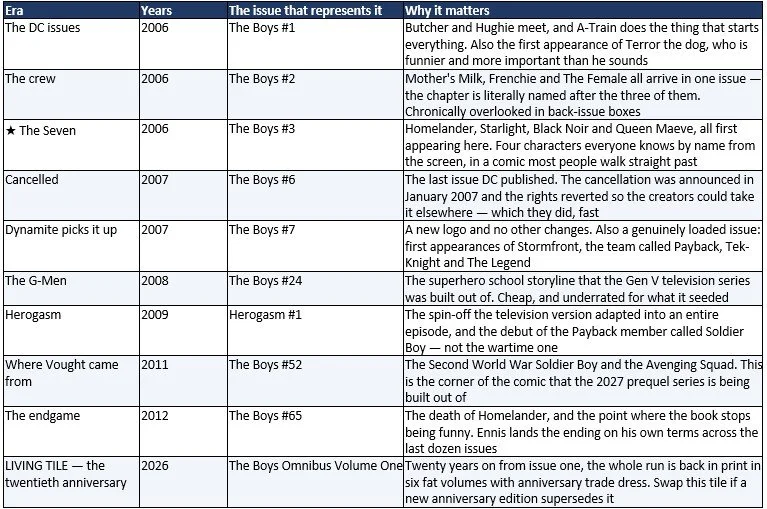
Six years, one story, two publishers, no relaunches. Every era, the one issue that represents it, and why collectors care.
Watch what happens to the publisher logo between the fourth and fifth rows.
The Keys — Issues Everyone Hunts
THE BOYS ISSUE ONE IS THE FRANCHISE KEY and the most liquid comic in the run — it changes hands roughly three times a week, which is faster than anything else here. First appearance of Butcher, Hughie, A-Train and Terror. It is a modern book, so condition expectations are high and only sharp copies earn a premium.
★ ISSUE THREE IS THE ONE WE ACTUALLY PUSH. Four first appearances, all of them characters a screen viewer can name, and it costs roughly half what issue one costs while trading about two-thirds as often. That is the best trade-off on the board: you give up a third of the liquidity to halve the price, and you get the more famous cast. If somebody has one book's worth of budget and wants the characters rather than the debut, this is the answer.
★★ AND THE BUY-ON-SIGHT RECOMMENDATION IS ISSUE SEVEN, which is the cheapest important comic in this franchise by a distance. It is the first Dynamite issue, and it holds FOUR first appearances — Stormfront, Payback, Tek-Knight and The Legend. It costs about a sixth of what issue three costs and roughly a tenth of issue one, and it still trades every week. Nothing else in the run gives you that much for that little.
There is a reason we are pointing at it right now rather than in general. THE PREQUEL SERIES COMING IN 2027 IS BUILT AROUND SOLDIER BOY AND STORMFRONT. Stormfront's first appearance is issue seven. The wartime Soldier Boy's is issue fifty-two. Both are still inexpensive comics. We would rather tell you that now, while they are cheap and sitting in a box, than after a trailer drops.
Being straight about the state of those two: issue fifty-two has ALREADY started moving — it has roughly doubled and a half over the past year, with most of that in the last few months. It is still cheap and it still trades weekly, so it is still worth owning, but the easy part is over and anybody telling you otherwise is selling. Issue seven, oddly, has NOT moved at all in raw copies even though graded copies of it have run up hard. That gap is the actual opportunity here, and it is why we recommend buying a nice raw copy rather than a slab.
HEROGASM ISSUE ONE is the third book in that group and the one most often asked for by name, because the television version adapted it. It holds the OTHER Soldier Boy — the Payback member. It costs about the same as issue fifty-two, and it is the only one of the three where a graded copy makes sense, because certified copies of it actually trade with some regularity.
⚠ NOW THE PART THAT MOST SHOPS WILL NOT TELL YOU: THE WILDSTORM PREMIUM IS NOT SUPPORTED BY THE NUMBERS. The story that the six DC-published issues are the scarce stretch is repeated everywhere, and the distribution figures do not agree. Issue one and issue seven were ordered in almost exactly the same quantity — the gap between them is a rounding error. Issue six was heavily reordered in the month the cancellation was announced, so there are MORE of those around than the story implies, not fewer. If you want the genuinely thin issues from that stretch, they are the middle ones, and they are cheap.
There is one true thing inside that myth, and it is worth knowing. ISSUES FOUR, FIVE AND SIX EXIST ONLY AS THE ORIGINAL PRINTING. Dynamite has since reissued issues one, two and three under its own logo, so a DC logo by itself no longer proves anything about those three — but nobody has ever reprinted four, five or six as single issues. Those are the cleanest original-only comics in the run.
⚠ ONE KEY WE ADVISE AGAINST, HONESTLY. There is a second printing of issue seven with a sketch cover that sells for several times what the ordinary first printing costs, and it trades a couple of times a YEAR against the first printing's every week. It has no established graded market at all. It is a real thing and some people want it; just understand that you may wait half a year to find the next buyer. The ordinary issue seven is the better comic to own by almost every measure.
The rest of the run is deep, cheap and genuinely satisfying to complete. Issue twenty-four holds the G-Men and is underpriced for something that seeded an entire television series. Issue eleven brings in Love Sausage and Little Nina. Issue sixty-five is the death of Homelander. Issue seventy-two is the oversized finale. Outside the books named above, this is a franchise where a customer can build a complete run without it becoming a project that never ends.
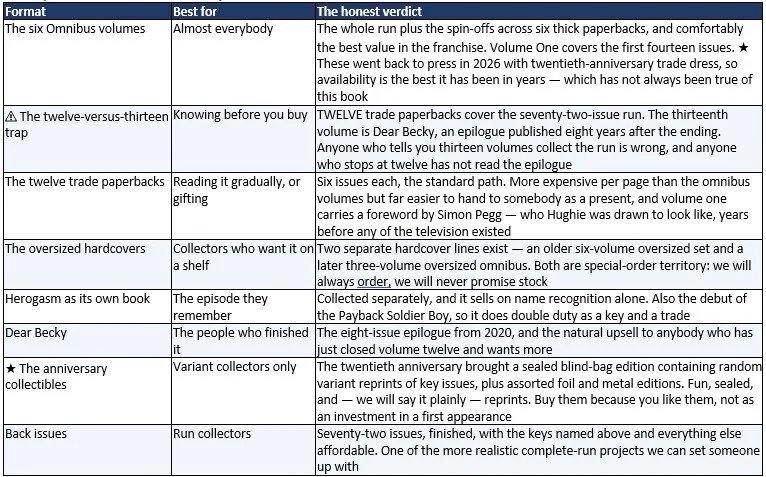
Every Format You Can Buy
The real barrier on this title is not persuasion, it is routing. Everybody already knows what Rick and Morty is. What nobody knows is which of the hundred-plus comics to pick up, and a customer left to browse will usually pull a random one-shot off the shelf, find it slight, and put the whole franchise down. So we route rather than recommend: volume one of the original series first, the Dungeons & Dragons crossover second, and everything else after that. If you tell us what you liked about the show we can be more specific than that, but those two are the answer nine times in ten.
Screen & Series Status
Updated August 2026, and the headline here is the opposite of what most people assume.
THE FLAGSHIP SERIES IS OVER. Five seasons, and the last one finished in May 2026 — the finale even got a one-night cinema screening before it streamed. The college spin-off is over too; it was cancelled in April 2026 after two seasons.
★ BUT THE FRANCHISE IS NOT OVER, AND THIS IS WHERE WE DISAGREE WITH THE CONVENTIONAL READ. A PREQUEL SERIES CALLED VOUGHT RISING FINISHED FILMING IN MARCH 2026 AND ARRIVES IN 2027. It is set decades before everything else, it is built around SOLDIER BOY and STORMFRONT, and its teaser is already out. When the college series was cancelled, the announcement went out of its way to say more projects in this universe were on the horizon. A separate Spanish-language project has a pilot script written but has not been ordered.
★★ SO THE PRACTICAL POSITION IS THIS: the engine that drove the last decade of this franchise has not switched off — it has switched over, from a finished flagship to a prequel that is already shot. That matters for what you buy. A prequel about two specific characters points at two specific comics, and both of them are cheap today. We would rather be early on those than clever about them later.
The honest caveat, because we would want it ourselves: no month has been announced, only the year. Series get moved. Buy the comics because they are good comics at a fair price with real first appearances in them — the show is the reason to buy now rather than later, not the reason to buy at all.
ON THE COMICS SIDE there is no new story and none announced. Ennis finished it in 2012 and has not signalled any intention to go back. What there IS, in quantity, is twentieth-anniversary product: the omnibus line reprinted, sealed variant editions, foil and metal editions, signed printings. The story is closed. The publishing is not.
THE EVERGREEN PLAYBOOK, which does not expire: on this franchise the CHARACTER first appearances move independently of the run, and they move on casting and trailers rather than on air dates. That is how Herogasm behaved when it was adapted, and it is what is happening to the wartime Soldier Boy book right now. Whenever any project in this universe is announced, look up which comic that character debuts in and check it against what is in the bins — and remember the pattern this whole page is built on, which is that the debut is usually not the issue people assume.
Collector's Corner — Grading, Care & We Buy
Four habits govern this franchise at our counter, and the first one is the reason this page exists.
WE OPEN THE BOOK BEFORE WE QUOTE A NUMBER. On this run the issue number does not tell you who is inside it, and the two most commonly misremembered facts in modern comics retail both live here — that issue one has Homelander in it, and that Soldier Boy is one character. Neither is true. We check, and we show you.
WE READ THE PRICE BOX ON EVERY ISSUE ONE. The original carries its 2006 cover price and a DC imprint logo. Every reprint Dynamite has issued since is priced differently — there is a dollar edition, a free giveaway edition, and a later reprint line at a modern price, plus anniversary foils. The original price and the October 2006 indicia settle it in about a second. It is the same discipline we apply to the other famous modern first issue on the wall, and it matters here for a reassuring reason: the original had ONE cover and ONE printing, so once you have identified it there is nothing else to argue about.
WE DO NOT PAY A PREMIUM WE CANNOT JUSTIFY. The six DC-published issues get priced on what they actually are, not on a scarcity story the distribution figures do not support. That cuts both ways at the buy counter and we would rather explain it than quietly benefit from it.
WE ARE CAREFUL ABOUT GRADING ON A BOOK THIS MODERN. For a 2006 comic only the top of the scale carries a real premium, and mid-grade certification on this run costs a customer more than it returns. We will tell you when a copy is worth submitting, and on this franchise the answer is usually no. Storing them: bag and board, boards behind the comic, upright and out of sunlight.
On the buy counter generally: complete runs of this DO walk in, because it is recent enough that readers kept their singles, and a full seventy-two-issue run is a nice thing to buy at a fair number. It sells as a run rather than as seventy-two individual comics, and we price it that way. Used trades and omnibus volumes are real buylist product here — they hold value better than the middle of the singles run does.
AND THE CONTENT WARNING IS AN OPERATIONAL RULE, NOT A FORMALITY. This is the most explicit book we stock. If you are buying it for somebody else, we will tell you exactly what is in it first, every time, without being awkward about it. That is not us being cautious — it is us not wanting you to have a bad conversation at a birthday.
FAQ — Straight Answers
Which issue is Homelander's first appearance?
Issue three, from 2006 — the chapter is called 'The Seven' and it also holds the first appearances of Starlight, Black Noir and Queen Maeve. Issue one does not have him in it, which surprises almost everybody. Issue three usually costs about half what issue one does, so this is one of the rare occasions where the correct answer is also the cheaper one.
Is my copy of The Boys issue one a first printing?
Check two things. The logo should be the WildStorm imprint rather than Dynamite, and the cover price should be the 2006 price — every Dynamite reprint is priced differently, whether that is the dollar edition, the free giveaway, or the later reprint line. Confirm with an October 2006 indicia and you are done. The good news is that the original had a single cover and was printed once, so there are no variants or later printings of it to untangle. Bring it in and we will look with you.
Which Soldier Boy do I want?
There are two, and this trips up nearly everyone. The Second World War version — the one from the screen — first appears in issue fifty-two. The other Soldier Boy is a member of a team called Payback and first appears in the Herogasm spin-off. Different characters, same name, and they cost about the same. Tell us which one you mean and we will get you the right book.
Is the comic like the show, and can my teenager read it?
It is much harsher than the show, and no. The television version softened a great deal, changed many endings, and left out things the comic does not flinch from — it is graphically violent and sexually explicit from early on. There is no younger-reader version and there never has been. If you want the closest thing in spirit that we can actually recommend more broadly, ask us about Invincible, which is a different book but scratches a similar itch.