
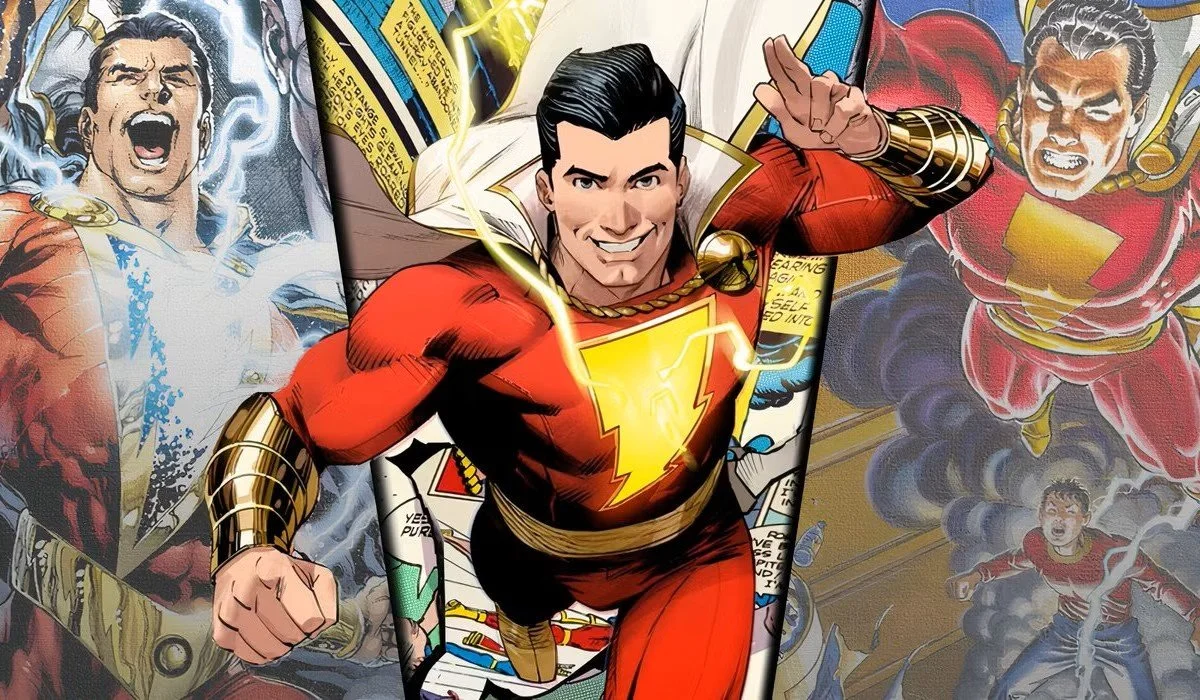
HE OUTSOLD SUPERMAN.
Then DC sued him out of existence — and later bought him · Shazam at Comic King
Shazam — The Complete Comic King Guide
In the 1940s, the best-selling superhero in America was not Superman. It was a boy called Billy Batson who said a magic word and turned into an adult hero, and his comic sold fourteen million copies in a single year. DC sued. The case ran for over a decade, and it ended with the publisher agreeing to stop printing him entirely — the most popular superhero of the era simply switched off. Nineteen years later DC licensed the character it had sued out of existence, and eventually bought him outright. It is the best story on the DC wall, all of it is true, and none of it is what customers expect when they pick up a book about a kid who says a magic word. Comic King carries Shazam in Edmonton across both halves of that history: affordable DC-era back issues and collected editions on the shelf, and Fawcett Golden Age material when we can source it. If the issue you want isn't on the shelf, we can special-order or source it on request.
Quick Facts
Story: Billy Batson, an orphaned newsboy, says one word and becomes an adult superhero. The purest wish-fulfilment premise in comics, and it worked better than anything else on the newsstand.
Length: Published 1940–53 by Fawcett, then nothing for nineteen years, then by DC from 1973 onward.
Status: Between ongoing series — see the note in Screen & Series Status, and ask us for the current DC order form.
Publisher: FAWCETT COMICS 1940–53 · DC COMICS 1973 onward — the two eras are different publishers, which matters for filing and for pricing
Age Guide: The most naturally child-facing superhero on the DC wall. Genuinely all-ages.
Formats: Back issues · collected editions · Fawcett-era reprints · omnibus & archive editions.
At Comic King: DC-era back issues and collections on the shelf, Fawcett-era material sourced on request, and we buy Golden Age collections.
The Hero Who Outsold Superman — and the Lawsuit That Switched Him Off
The numbers first, because they are hard to believe. Captain Marvel Adventures sold FOURTEEN MILLION COPIES IN 1944. It came out every two weeks with a circulation around 1.3 million copies an issue, and it carried a cover line advertising the largest circulation of any comic magazine — which was accurate. No comic published today reaches a fraction of that. DC, then called National, sued Fawcett in 1941 on the grounds that Captain Marvel infringed Superman. The case went to trial in 1948; the 1951 verdict went Fawcett's way; DC appealed; and in 1952 Judge Learned Hand's ruling upheld DC's Superman copyright. Rather than retry it, Fawcett agreed on 14 AUGUST 1953 to permanently cease publishing anything involving Captain Marvel and to pay DC four hundred thousand dollars. Fawcett shut its comics division that autumn. And then nothing — for nineteen years, the best-selling superhero of the 1940s simply did not appear. DC licensed him on 16 June 1972 and published a new series in February 1973, and eventually bought the character outright. That is why the same hero exists under two publishers, in two eras, under two names, with a two-decade hole in the middle — and it is why the practical questions on this page are all about identifying what you are actually holding.
The Run, Era by Era
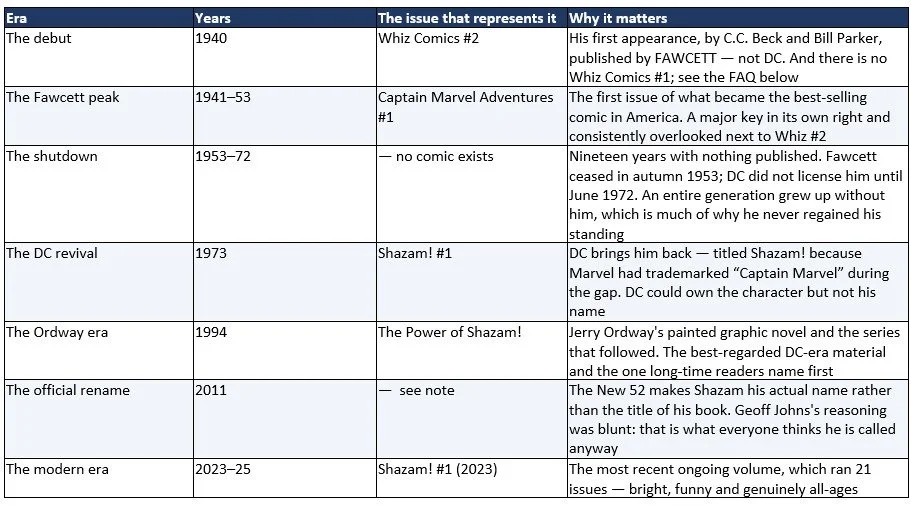
Eighty-six years and two publishers, organized. Every era, the one issue that represents it, and why collectors care:
The Keys — Issues Everyone Hunts
Whiz Comics #2 is a Golden Age heavyweight and a six-figure book in strong grade, and it hides in a way none of the other DC debuts do — because it is not a DC comic. It carries a FAWCETT logo and it files under Whiz Comics. Anyone sorting a collection by publisher, or working through the DC characters, will walk straight past it. Captain Marvel Adventures #1 from 1941 is the other major Fawcett key and it gets overlooked constantly, because attention goes to Whiz #2. The wider Fawcett line matters too: Captain Marvel Jr. and Mary Marvel both debut in it and both carry their own value, so the whole Fawcett stack is worth going through rather than just the one title. There is a scarcity factor here that is genuine rather than hype — because the line was terminated by court settlement rather than winding down naturally, there was no long tail of reprints or continued readership for decades, and survivorship is lower than the original print runs suggest. On the DC side, Shazam! #1 from February 1973 is affordable, historically interesting and the book that reintroduced him to a generation. The Power of Shazam material from 1994 is modern, cheap and good. And the standing authentication rule applies with force here: Whiz Comics #2 exists in oversized reprint and facsimile form, and if it is oversized, it is a reprint, always. Key prices move constantly, so we buy and price against live sold comps — ask and we will pull them up on screen together.
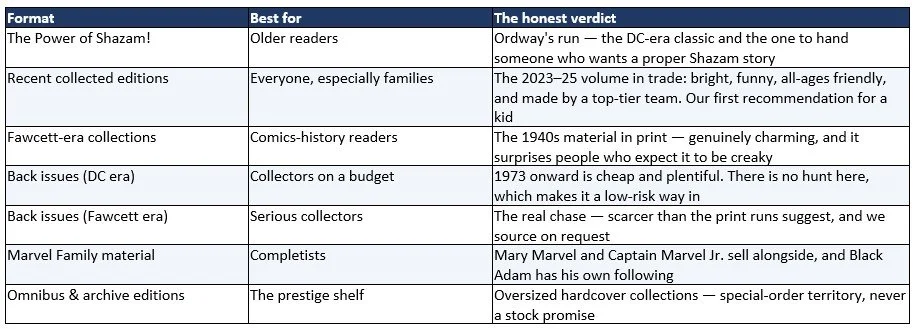
Every Format You Can Buy
Screen & Series Status
Updated August 2026: Shazam has had two feature films and a Black Adam spin-off, and the character keeps returning to screen because the premise — a child who becomes a superhero — is immediately understandable to any audience. DC's film universe is currently rebuilding around Superman and Shazam's place in the new slate has not been settled. On the comics side, the most recent ongoing volume ran from 2023 to 2025 and concluded at issue 21; ask us for the current week's DC order form to see what is shipping now, because he appears regularly across the wider line whether or not a solo title is running. Exact dates for anything on screen live in the Consolidated Ordering Calendar, not on this page.
Collector's Corner — Grading, Care & We Buy
Two checks matter on this character and neither is obvious. The first is the publisher check. His Golden Age keys carry a FAWCETT logo and file under Whiz Comics and Captain Marvel Adventures — not under DC, and not under Shazam. A collection sorted by publisher, or a seller going through what they think of as their DC books, will hide them completely. When we buy Golden Age material we ask specifically about Fawcett, and if you are selling, please mention any 1940s books even if the name on them means nothing to you. The second is the name check, and it costs real money when it goes wrong: a seller describing "old Captain Marvel comics" might mean this character or Marvel's entirely separate one from the 1960s onward. The values are nothing like each other. We establish which before quoting, every time. On condition: 1940s Fawcett newsprint is brittle and most survivors are in low grade. That is completely normal for the era and those books are still valuable — we grade honestly rather than harshly and explain what we are seeing as we go. We assess keys with live comps on screen, broker CGC submissions for slab-worthy books, and stock the bags, boards and boxes that keep a collection worth grading.
FAQ - Straight Answers
Why is there no Whiz Comics #1?
Because the first issue was never sold to the public. In the autumn of 1939 Fawcett printed an ashcan edition — a small run made purely for advertising and trademark purposes — under two different names, Flash Comics #1 and Thrill Comics #1. Neither name could be secured: Flash Comics, Thrill Comics and the character's original name of Captain Thunder were all already in use elsewhere. So the book was renamed Whiz Comics, the character became Captain Marvel, and the series went on sale starting at issue #2, cover-dated February 1940. The result is one of the great oddities of Golden Age collecting: the first appearance of one of the best-selling superheroes in history is issue two of a comic that has no issue one. There is a further irony worth knowing — one of the names Fawcett could not use was Flash Comics, because DC already had it. The company that blocked their title later sued them out of business.
Why is he called Shazam and not Captain Marvel?
He was Captain Marvel from 1940 until Fawcett stopped publishing in 1953. During the nineteen years he was off the shelves, Marvel Comics trademarked the name "Captain Marvel" for a character of their own. So when DC licensed him in 1972 and brought him back in February 1973, DC owned the character but could not use his name on a cover — the book had to be called Shazam!, after the magic word. For decades that produced a strange situation where the character was Captain Marvel inside a comic called Shazam. In 2011 DC simply made Shazam his actual name, on the reasoning that it is what everybody assumed he was called anyway. Practically, this means you should always establish which era and which publisher before you talk about a "Captain Marvel" comic — and which company, because Marvel's is a completely different character.
Is it true that Captain Marvel outsold Superman?
Yes, and by a wide margin at his peak. Captain Marvel Adventures sold fourteen million copies during 1944, published every two weeks with a circulation of around 1.3 million per issue, and it advertised itself on the cover as having the largest circulation of any comic magazine. He was, for a stretch of the 1940s, the most popular superhero in America. DC sued Fawcett in 1941 alleging that he infringed Superman, and after more than a decade of litigation Fawcett agreed in August 1953 to stop publishing him permanently and to pay DC four hundred thousand dollars. That is why a character who outsold Superman is one most people under fifty have barely heard of — he was off the shelves for nineteen years, and a generation grew up without him. It is our favourite thing to tell a customer looking at the Golden Age shelf.