
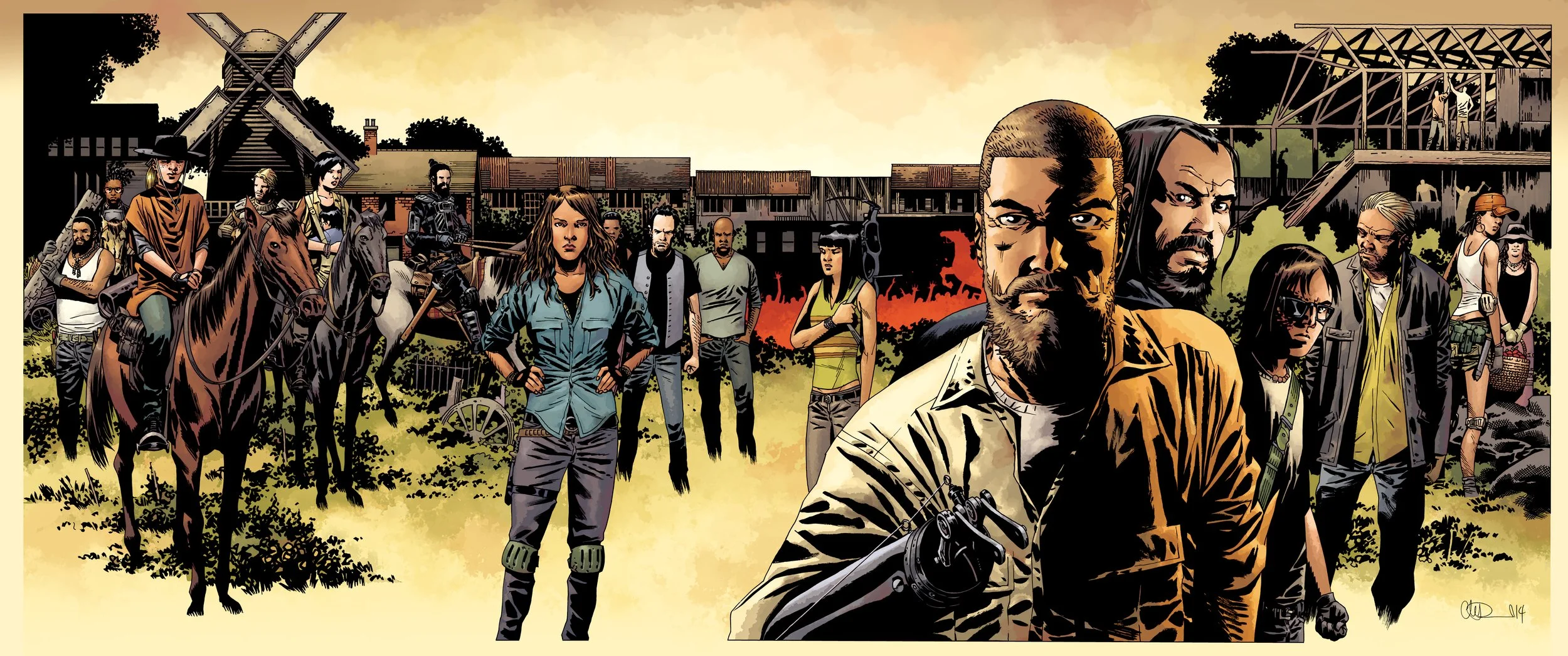
SAME COVER. VERY DIFFERENT COMIC.
The Walking Dead — one printing of issue one, a couple hundred look-alikes, and the finished 193-issue story · Comic King
The Walking Dead — The Complete Comic King Guide
The Walking Dead is the rarest thing in comics: a story with an ending. It ran for one hundred and ninety-three issues, from October 2003 to July 2019, it was written by one person the whole way through, and then it stopped — on purpose, at a moment of Robert Kirkman's choosing, with nobody outside a handful of people knowing it was coming. Nearly everything else on our shelves is still going. This one is done, and being done is the best thing about it.
That matters at the counter more than it sounds like it should. Almost every recommendation we make comes with a caveat about where a run starts, which relaunch you are looking at, or how much further it goes. Here there is one book, in one numbering, from one publisher, and four fat volumes that hold every page of it.
The complication is not the story. It is the first issue. The Walking Dead started as a black and white horror comic printed in the sort of quantity nobody worries about, and then became one of the biggest things in the medium — so everything that followed, every reprint and promotional and anniversary and recoloured edition, reproduces that same Tony Moore cover. There are roughly two hundred and seventy versions of it. One is worth a great deal and the rest are worth what a comic is normally worth. Telling them apart takes about a second once you know where to look, and most people are looking in the wrong place.
Quick Facts
Story: A small-town Kentucky deputy wakes from a coma into a world that has already ended, and spends sixteen years of publishing finding out that the dead are the least of it.
Length: 193 issues, October 2003 to July 2019 — one continuous run, one writer, no relaunches, no renumbering.
Creators: Written by Robert Kirkman throughout. Drawn by Tony Moore for the first six issues, then Charlie Adlard for the remaining one hundred and eighty-seven.
Colour: The original run is BLACK AND WHITE. The Walking Dead Deluxe is the same story recoloured, still coming out twice a month.
Ask which one somebody means before you go to the shelf.
Where to start: Compendium One. Every time, for everybody — reader, show-watcher, gift buyer.
Currently publishing: Yes, but only as the recoloured Deluxe edition. There is no new Walking Dead story being published.
Age guide: ADULT. Rated Mature by the publisher, and the cover says so. Graphic violence throughout and sexual content. This is not a young reader's book regardless of who is watching the show
The one thing to check: The price printed on the cover. It identifies the edition faster than anything else on the comic.
One Printing, and About Two Hundred and Seventy Look-Alikes
Here is the fact that governs this entire franchise, and it is the opposite of what most people have been told online. THE WALKING DEAD ISSUE ONE HAS EXACTLY ONE PRINTING. There was no second printing, no third and no fourth. Image printed it once, in October 2003, in a quantity that put it two hundred and thirty-third on the month's order chart — a few thousand copies of a black and white horror comic from a writer nobody had heard of. That single small print run is the entire reason the book is worth what it is worth today.
You will find pages online explaining how to tell the four printings apart, confidently, in detail, down to logo colours and paper stock. They are describing comics that do not exist. No dealer catalogue lists a second printing of issue one, no price guide carries one, and no grading company has ever labelled one, because there is nothing to label. Anyone selling you a 'second print' is either mistaken or selling you something else entirely.
AND SOMETHING ELSE ENTIRELY IS USUALLY WHAT IS IN THE BOX. Because the cover is famous, it has been reprinted more than almost any modern comic. A dollar promotional edition has been reprinted nine separate times across fifteen years. A weekly reprint series from 2011 reran the first fifty-two issues one per week at the ORIGINAL NUMBERING, so a weekly reprint of issue nineteen looks like issue nineteen at a glance. There is a free promotional edition from 2008 with the original script in the back, a sealed anniversary edition from October 2018 — that month alone produced more than a hundred and fifty store variants of the first issue — the recoloured edition, a newsprint one-shot, and a long tail of convention exclusives.
★ THE RULE THAT SOLVES ALL OF IT IS THE PRICE BOX, and it is the first thing to look at, before the logo, before the paper, before the seller's description. The 2003 original is the only edition that carries its original cover price. The dollar reprint says so on the cover. The weekly reprints carry a different price again and the word WEEKLY in the logo. The anniversary and colour editions carry the modern price. The free 2008 edition has no price at all and is forty pages instead of thirty-two. Four different prices, one piece of cover art. Read the price box and you have almost always finished the job in under a second.
Then confirm it: thirty-two pages, black and white inside, an October 2003 indicia, the original Tony Moore artwork with no banner, no anniversary trade dress and no publisher promotion printed across the top. That is the comic. Everything else is a reprint of it, and reprints are perfectly good comics to own and read — they are simply not the one people are excited about.
One genuine oddity is worth knowing, because it comes up. The MATURE READERS line under the price box was printed in the wrong colour sequence on part of the original run, so some copies carry it in black rather than white. Both are first printings. Collectors have opinions about which is scarcer and the published estimates flatly contradict each other, so we will not quote you a ratio — the grading companies do not distinguish between them either. Interesting, real, and not something to pay a premium for on the strength of a seller's confidence.
The Run, Era by Era
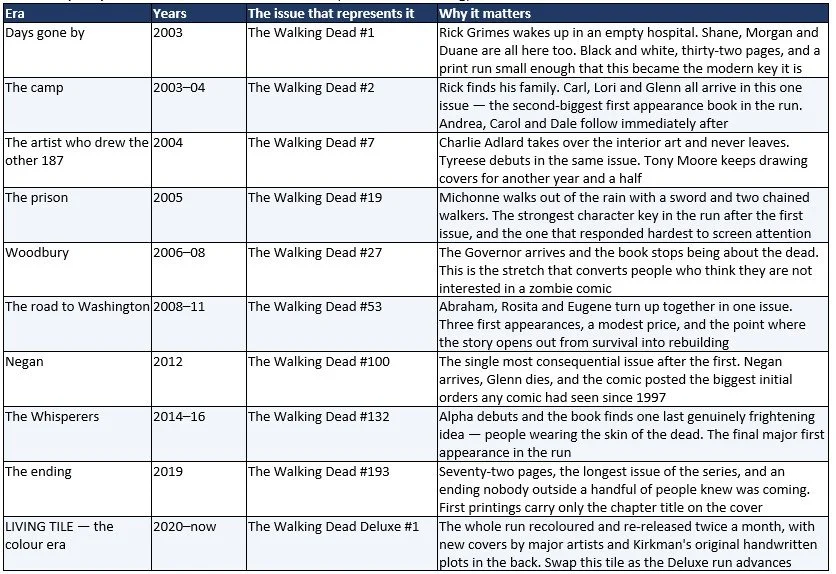
Sixteen years, one story, organised. Every era, the one issue that represents it, and why collectors care. This is an unusually
tidy run to collect — no relaunches, no renumbering, no crossovers to chase into other titles.
The Keys — Issues Everyone Hunts
THE WALKING DEAD ISSUE ONE IS THE FRANCHISE KEY and it is not close. First appearance of Rick Grimes, and of Shane, Morgan and Duane alongside him, out of a print run small enough to count. It is the most expensive modern comic we handle regularly and it trades steadily — but read the next paragraph before you decide how to buy one, because the way you buy it matters more here than on almost any other book.
★ AN HONEST NOTE ON GRADED COPIES OF ISSUE ONE, which most shops will not tell you. Raw copies and top-grade certified copies both trade about once a week. The MIDDLE of the certified ladder does not. A mid-grade slab of this book sells a handful of times a YEAR — it costs nearly what a top-grade one costs and it moves a fraction as often. If you want this comic to read and own, buy it raw. If you want it as something you can turn back into money, you want the top of the ladder or nothing. The middle is the worst of both and we will say so before you spend the money.
★★ THE BUY-ON-SIGHT RECOMMENDATION ON THIS PAGE IS ISSUE ONE HUNDRED, and it is the clearest one we have made on any franchise. Negan's first appearance and the death of Glenn, from July 2012 — the issue with the most story weight in the entire run after the debut. It is also, by a distance, the MOST LIQUID COMIC IN THE FRANCHISE: raw copies trade about once a day, and even top-grade certified copies trade twice a week, which is faster than issue one manages. And it costs a small fraction of what Michonne's first appearance costs. Important, affordable and genuinely tradeable is a rare combination, and this is the book that has all three.
The reason it is affordable is the reason to be straight about it: it was printed in enormous quantities and there is no scarcity story here at all. What there is instead is demand that has never gone away. It launched with more than a dozen variant covers and picked up later printings, so this is one to PRICE BY COVER rather than by issue number — the standard cover is common and we price it as common.
MICHONNE'S FIRST APPEARANCE, ISSUE NINETEEN, is the strongest character key after the debut and the one most people ask for by name. It sits in the middle of the run's price range and trades weekly. THE GOVERNOR, ISSUE TWENTY-SEVEN, is the other major early key and the quieter value — it trades just as often as Michonne's debut but costs roughly a third as much, which makes it the one to point at for somebody who wants an important early key without the Michonne premium.
⚠ AND HERE IS THE KEY WE ARE MOST CAUTIOUS ABOUT: ISSUE TWO. It holds three first appearances — Carl, Lori and Glenn — and it is the second most expensive issue in the run, more than twice what Michonne's debut costs. But it trades roughly half as often, and its certified market is close to dormant, with some grades selling only a couple of times a year. It is a real key and a real comic. It is also the slowest expensive book in the franchise, and if you are buying with any thought of selling later, you should know that before you buy rather than after. A footnote customers enjoy: Carl and Lori do appear in issue one, but only in a photograph.
★ THE UNDER-APPRECIATED TIER IS WHERE THIS RUN IS ACTUALLY FUN. Issue three holds Andrea, Carol and Dale and trades about once a day — one of the busiest books in the franchise, at a price that surprises people. Issue seven is Tyreese and Adlard's first issue in one comic. Issue ten is Maggie and Hershel. Issue fifty-three is Abraham, Rosita and Eugene together. Issue one hundred and eight is Ezekiel and Shiva. Every one is a genuine first appearance of a character people know by name from the television, and every one costs less than a night out. If somebody wants to start collecting keys rather than reading, this tier is where we send them.
TWO CHEAP KEYS THAT ARE SLOWER THAN THEY LOOK: Alpha's debut in issue one hundred and thirty-two, and Beta's in one hundred and fifty-four. Both are real and both trade about monthly at best — noticeably slower than the final issue, which costs about the same and trades every week. Buy them because you want them, not because they are about to move. And that final issue has a wrinkle worth knowing: it went back to press, and the first printing and the reprint carry DIFFERENT TITLES on the cover, because the reprint adds the words that give the ending away. It is one of the few printing checks in this franchise that actually matters.
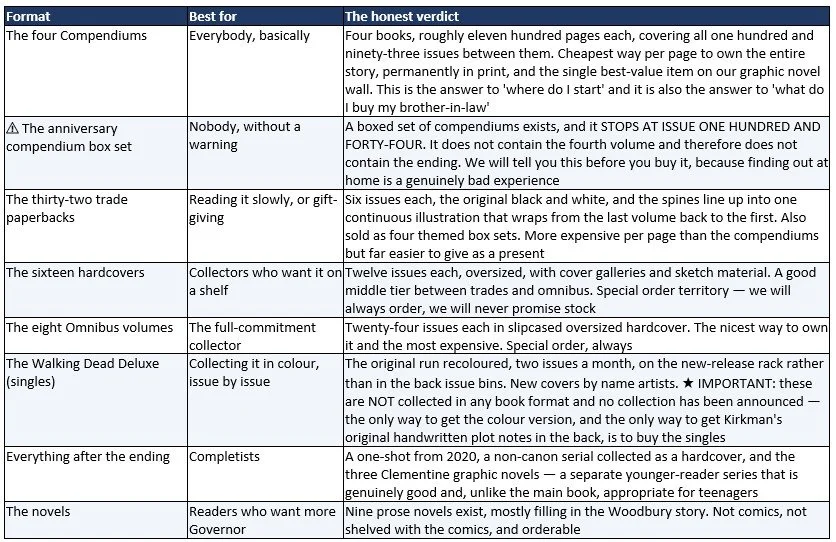
Every Format You Can Buy
Screen & Series Status
Updated August 2026, and this section changed substantially in the two weeks before we wrote it.
WHERE IT ACTUALLY STANDS. The original series finished in 2022 after eleven seasons. Of the spin-offs, two are finished, one was always intended as a limited story, and two are still going. The New York series is airing its third season right now, with its finale in the middle of September. The Daryl Dixon series is the one that ends the whole thing: its fourth season is confirmed as the final season, it finished filming at the end of 2025, and — this is the part that changed — AMC confirmed at San Diego Comic-Con in late July 2026 that IT WILL AIR IN 2027, not this year. And at the end of July a major streaming deal put every Walking Dead series, all seven of them, in front of a global audience, rolling out through 2027 and into countries that never had easy access to it.
★ SO HERE IS OUR ACTUAL VIEW, and it is a correction to what we would have told you six months ago. The screen engine behind this franchise is NOT switching off this year. It runs through a finale this September, a streaming rollout across 2026 and 2027, and a final season somewhere in 2027. There is no cliff to sell into. What is true is that the engine has a visible END — after that final season there is no announced Walking Dead television at all, and nobody should buy this material on the assumption of a screen push that has been scheduled to stop.
★★ AND THE PART THAT DOES NOT EXPIRE: the story itself. A finished, complete, universally recognised one hundred and ninety-three issue run keeps selling to new readers with no screen support whatsoever — which is exactly what happened to Sandman and Preacher, and what is happening to this book already. Reader demand is the durable half of this franchise, and reader demand buys compendiums, not slabs. Worth knowing when you are deciding what to stock and what to chase.
ON THE COMICS SIDE: there is no new Walking Dead story being published and none announced. Kirkman has said he doubts he will ever return to it for a full series, while leaving the door open. The recoloured Deluxe edition is the only Walking Dead comic on the new release rack, and at two issues a month it has a long way still to run.
THE EVERGREEN PLAYBOOK, which does not expire: on this franchise the CHARACTER first appearances move independently of the book as a whole, and they move when that character reaches screen, usually before the episode airs. That has held for sixteen years. And the corollary matters more — a large part of the television cast has NO comic first appearance at all, because they were invented for the show. Daryl Dixon is the important example: the character everyone asks for is not in the comic and never has been. There is no Daryl key issue, and anyone selling you one is selling you a misunderstanding.
Collector's Corner — Grading, Care & We Buy
Four habits govern this franchise at our counter, and the first one prevents more expensive mistakes than anything else we do.
WE READ THE PRICE BOX BEFORE WE SAY A NUMBER. On every copy of issue one that comes through the door, whoever is holding it and however certain they are. The original cover price identifies the 2003 comic; every reprint programme carries a different one, and the indicia confirms it. One second, not negotiable, and the same discipline we apply to the other famous black-and-white first issue sitting a few feet away on the same wall.
WE CHECK THE MASTHEAD ON ANYTHING FROM 2011. The weekly reprint series ran the original numbering, so its issues sit in a box looking exactly like low-numbered originals. The word WEEKLY in the logo and the wrong cover price give it away in the same glance.
WE PRICE ISSUE ONE HUNDRED BY COVER, NEVER BY NUMBER. It launched with more than a dozen variants and went back to press more than once, and the values are not close to each other. Either learn the significant covers or check every one — we check every one.
WE RUN EVERY COLLECTION FOR THE SIX BOOKS THAT MATTER. Walking Dead runs arrive here constantly and most of what arrives is the deep middle of the run, which is genuinely lovely and genuinely inexpensive. We pull the first issue, the second, nineteen, twenty-seven, one hundred and one hundred and thirty-two, comp those individually, and price the rest as readable stock. If that is what your collection is, we will tell you kindly and we will still buy it, because somebody wants to read it. Completing the run from roughly issue thirty onward is one of the more satisfying want-list projects we can set up for someone — a clear beginning, a clear end, and most of it inexpensive.
On grading, we will tell you honestly when a book is worth submitting and, far more often, when it is not — and on this franchise specifically we will talk you out of certifying anything from the middle of the run. Storing them: bag and board, boards behind the comic, upright and out of sunlight. The black and white interiors yellow like anything else.
AND WE ARE STRAIGHT ABOUT WHAT WE THINK. If you ask whether Walking Dead keys will keep climbing, the honest answer is that the television that drove the last decade of movement has a scheduled end, and that the story will keep selling to readers long after it. We would rather sell you a compendium you will actually read than a slab you bought on a story we do not believe.
FAQ — Straight Answers
Is my copy of The Walking Dead issue one a first printing?
Probably not, and that is not a criticism — most copies in the world are not. Check the cover price first: the 2003 original carries its original price and nothing else does. If the cover says one dollar it is the promotional reprint, if it carries a modern price it is an anniversary or colour edition, and if there is no price at all and forty pages it is the 2008 giveaway. Then check that it is thirty-two pages, black and white inside, with an October 2003 indicia and no banner across the cover. Bring it in and we will look at it with you either way — there is no charge for that and we would rather you knew.
Should I read the original black and white or the colour version?
It is the same story either way, so this is purely a preference. The original run is black and white and that is how it was made and how most people read it — the art was drawn for it. The Deluxe edition is the same pages recoloured, coming out twice a month, with extra material in the back including Kirkman's original plot notes, which are not available anywhere else. If you want to read the whole thing, get the compendiums. If you want to collect an issue at a time and enjoy the ritual, get the Deluxe. Just tell us which one you mean when you ask for an issue number, because both editions use the same numbers.
How different is the comic from the show?
Very, and more so as it goes. The early beats are recognisable and then the two diverge hard — characters who survive on television die here, several major show characters were invented for the screen and never appear in the comic at all, and the ending is completely different. If you liked the show, that is the reason to read it rather than a reason not to: you genuinely do not know what happens.
My kid loves the show — can I get them the comic?
No, and we will say so plainly. The comic is rated for adults by its publisher, the cover says MATURE READERS, and the violence and sexual content go well beyond what the television version shows. It is not a case of a slightly edgier version. If you have a younger reader who wants something in this world, ask us about the Clementine books — a separate series drawn for a younger audience, genuinely well made, and one of the easier recommendations we make.