
NOBODY HAD DRAWN ANYTHING LIKE THIS IN 1963.
Doctor Strange - Ditko's dimensions, the anthology that hid three franchises at once,
and the comic he isn't on the cover of · Comic King
Doctor Strange — The Complete Comic King Guide
In 1963 Steve Ditko was drawing Spider-Man every month and decided he wanted to make something that looked like nothing else on the newsstand. What he came up with was a disgraced surgeon who travels east after wrecking his hands, learns magic from a man called the Ancient One, and defends reality from things that live in other dimensions — and Ditko drew those dimensions as folded architecture and impossible geometry that genuinely had no precedent in American comics. Stan Lee wrote it. It ran as an eight-page back-up feature in somebody else's anthology. Sixty-three years later two feature films have made Doctor Strange far better known than his sales history ever justified, and the thing that made him worth adapting is exactly the thing that made him strange in 1963: the way he looks. This page will save you two specific headaches. HIS FIRST APPEARANCE IS IN A HUMAN TORCH COMIC and he is not on the cover of it. AND THERE IS NO DOCTOR STRANGE #1 FROM THE SIXTIES — Strange Tales simply changed its name at issue #169 and kept counting. Comic King carries Doctor Strange in Edmonton across all of it, and every Strange Tales run that comes through our door gets searched by feature rather than by number. If the book you want is not on the shelf, we can special-order or source it on request.
Quick Facts
Story: An arrogant surgeon destroys his hands in a car accident, exhausts every conventional option, travels east out of desperation, and ends up responsible for defending reality. The arrogance never entirely goes away, which is what makes him interesting
Length: Since July 1963 — but under two different mastheads on one continuous run, then a series of volumes since.
Ask which TITLE first: Strange Tales to #168, Doctor Strange from #169
Status: Current — a volume launched in December 2025 with Strange stranded in Asgard after losing Sorcerer Supreme of Earth.
Publisher: Marvel Comics
Age guide: Broadly fine for teenage readers — occult themes and some genuinely unsettling imagery, but not graphic. One of the more approachable adult-interest characters on the Marvel wall, and an easy recommendation for a reader who wants something odd rather than something violent.
Formats: The Ditko collections above all · Epic Collections and Masterworks · a long, cheap Bronze and 1990s back-issue wall · the current monthly · Omnibus by special order.
At Comic King: A Ditko page open on the counter, because that is what sells this character — plus every Strange Tales run searched by feature, since one masthead hides three separate franchises
He Isn't on the Cover of His Own First Appearance
DOCTOR STRANGE DEBUTS IN STRANGE TALES #110, cover-dated July 1963 — and Strange Tales at that point was a HUMAN TORCH comic. He was an eight-page back-up feature, and the cover belongs entirely to somebody else. That single fact explains almost everything awkward about collecting this character. It means his key files under S for Strange Tales rather than under D, so a seller with a Doctor Strange collection will not have it and a seller with a box of early-sixties Marvel anthologies may not know what is in theirs. It also means that "his first cover appearance" is a separate collectable question from "his first appearance" — and the answer is FANTASTIC FOUR #27, from June 1964, where he appears as a full figure on the cover of a completely different comic, nearly a year after his debut. That is not a technicality; it is a real distinction that changes what a book is worth, and it is the exact thing our Wonder Woman page explains. THE ANTHOLOGY PROBLEM GOES FURTHER, and this is where the money is. Strange Tales did not just hide Doctor Strange. It carried the Human Torch, then Doctor Strange from #110, and then from #135 it introduced NICK FURY, AGENT OF S.H.I.E.L.D. — which is the first S.H.I.E.L.D. and the first HYDRA as well, in a single issue drawn by Jack Kirby. Three separate franchises under one masthead. A run of Strange Tales priced by the inch can easily contain several hundred dollars of keys belonging to three different collecting audiences, which is why we go through them issue by issue and never bulk them. AND FINALLY THE NAME CHANGES. Strange Tales became DOCTOR STRANGE at issue #169 in June 1968, continuing the numbering, so there is no Doctor Strange #1 from the 1960s at all. If somebody offers you one, it is either the 1974 volume, a later relaunch, or a misunderstanding — and a seller with "some old Strange Tales" and a seller with "some old Doctor Strange" may be describing the same continuous run.
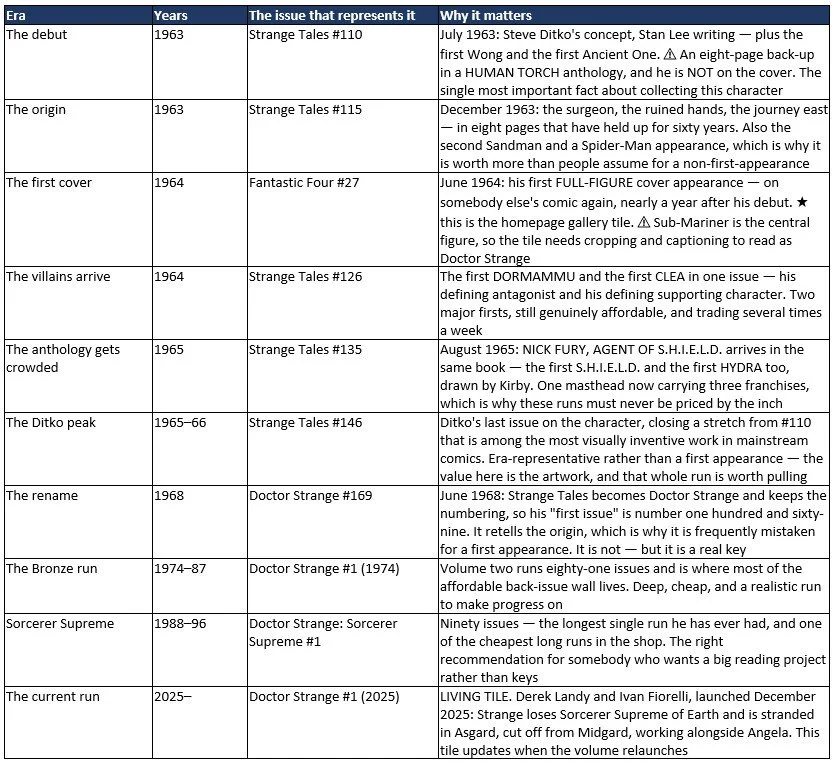
The Run, Era by Era
Sixty-three years, two mastheads on one run, and one artist who changed what comics could look like, organized. Every era of Doctor Strange,
the one issue that represents it, and why collectors care:
The Keys — Issues Everyone Hunts
STRANGE TALES #110 is the franchise key and it is a four-figure book raw, climbing hard through the grades — and it files under Strange Tales, which is the whole problem. It also carries the first Wong and the first Ancient One, so it is a triple debut rather than a single one. We comp it individually and we authenticate first, because it exists in facsimile and inside oversized reprints, and oversized always means reprint. STRANGE TALES #115 is the origin issue and it is the one we would point a collector at: about a tenth of what #110 costs, selling roughly weekly, rising in price, and carrying a Spider-Man appearance and the second Sandman on top of the origin itself. Origin issues are consistently underpriced relative to their significance across Silver Age Marvel, and this is a clean example. STRANGE TALES #126 is the best value on the page by some distance — the first DORMAMMU and the first CLEA in a single issue, at well under a hundred dollars raw, trading several times a week. Two major character debuts for the price of a modern hardcover is unusual for the Silver Age. STRANGE TALES #135 is the sleeper that belongs to somebody else: the first Nick Fury as Agent of S.H.I.E.L.D., the first S.H.I.E.L.D. and the first HYDRA, with Kirby art, sitting in the middle of a Doctor Strange run at around fifty dollars raw. Note the shape of that one carefully — it is cheap raw but it climbs steeply into the graded tiers, which tells you high grade is genuinely scarce rather than merely expensive. FANTASTIC FOUR #27 is his first full-figure cover and sits in the Fantastic Four run, so it gets missed from both directions. DOCTOR STRANGE #169 marks the rename and retells the origin — a real key, and the one most often mistaken for a first appearance. Below all of that the picture is friendly: the 1974 volume, Sorcerer Supreme and everything modern are affordable, plentiful and worth buying to read. One structural instruction that matters more here than on almost any page: NEVER PRICE A STRANGE TALES RUN BY THE INCH. One masthead, three franchises, and three different collecting audiences hunting inside it. Key prices move constantly, so we buy and price against live sold comps — ask and we will pull them up on screen together.
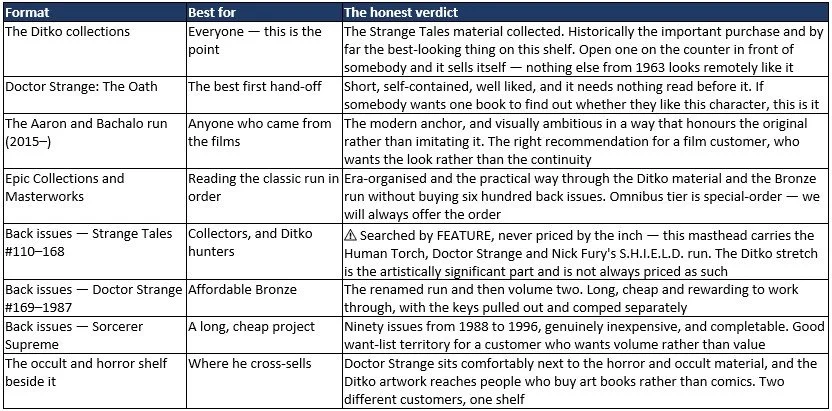
Every Format You Can Buy
Screen & Series Status
Updated August 2026: nothing on the screen side changes what we stock today, and we are not going to pretend otherwise. What is permanently true is more interesting than any announcement: two feature films made Doctor Strange far better known than his sales history ever justified, and — unusually — they leaned into the visual invention that was always the point of the character rather than flattening it. Most adaptations sand off what makes a comic distinctive; these did close to the opposite. That gives us a routing rule that runs backwards from how most Marvel characters work: A CUSTOMER ARRIVING FROM THE FILMS WANTS THE ARTWORK, NOT THE CONTINUITY. Send them to Ditko and to the modern Bachalo material, not to a chronological reading order. On the comics side, the volume that launched in December 2025 has Strange stranded in Asgard after losing Sorcerer Supreme of Earth, which is a genuinely unusual place to find him and an easy thing to describe to somebody browsing the rack. The character-key pattern applies here as everywhere: when the Ancient One, Dormammu, Clea or Mordo appear on screen, their first appearances move — and almost all of those are in the Ditko Strange Tales run, which is one more reason to pull that stretch rather than bulk it. Exact release dates for anything upcoming live in our ordering calendar, not on this page.
Collector's Corner — Grading, Care & We Buy
Four habits govern this character at our counter. THE STRANGE TALES SEARCH is the important one and it belongs beside our Showcase and Tales of Suspense habits: one anthology masthead carrying the Human Torch, Doctor Strange from #110, and Nick Fury's S.H.I.E.L.D. run from #135 — which means three separate collecting audiences are hunting inside the same run of comics. We search every Strange Tales run that arrives, by feature rather than by issue number, and nothing in one gets bulk-priced. THE TITLE QUESTION comes next: the run is Strange Tales to #168 and Doctor Strange from #169, so a seller with "some old Strange Tales" and a seller with "some old Doctor Strange" may be describing the same continuous thing. We ask about both names, every time. THE COVER DISTINCTION is worth understanding rather than memorising, because it comes up on this character more than any other: he is not on the cover of his own first appearance, so "first appearance" and "first cover appearance" are two different books at two different prices — Strange Tales #110 and Fantastic Four #27 respectively. We will tell you which one you have and what each is worth. And THE ORIGIN-ISSUE POINT, which is a buying position rather than a habit: Strange Tales #115 is an origin rather than a first appearance, and origin issues are consistently undervalued across Silver Age Marvel relative to how significant they are. We buy them whenever they appear. Beyond those: Strange Tales #110 exists in facsimile and in oversized reprints so we authenticate before quoting, grade does heavy work on early-sixties newsprint and we grade conservatively, and the Bronze and 1990s material is genuinely common — we will say so plainly rather than let anyone assume otherwise. Bring the whole box.
FAQ - Straight Answers
What is Doctor Strange's first appearance — and why isn't he on the cover?
STRANGE TALES #110, cover-dated July 1963, created by Steve Ditko with Stan Lee writing. He is not on the cover because Strange Tales was a Human Torch comic at the time and Doctor Strange was an eight-page back-up feature in it — nobody at Marvel was treating him as the main event yet. That issue also contains the first Wong and the first Ancient One, so it is a triple debut, and it is a four-figure comic in almost any condition. Two consequences worth knowing. First, it files under S for Strange Tales rather than under D, which is why people with Doctor Strange collections almost never have it and people with boxes of early-sixties Marvel anthologies sometimes do without realising. Second, because he is absent from that cover, his FIRST COVER APPEARANCE is a separate collectable question with a separate answer: Fantastic Four #27, from June 1964, where he appears as a full figure on the front of a different comic altogether. Those are two different books at two different prices, and we will tell you which one you are holding.
Is there a Doctor Strange #1 from the 1960s?
No — and this catches people out regularly. Doctor Strange ran as a feature inside Strange Tales from 1963, and by 1968 he had so thoroughly taken the book over that Marvel simply renamed the title after him at issue #169, carrying the numbering straight across. So the first comic with Doctor Strange on the masthead is number one hundred and sixty-nine, from June 1968. It retells his origin, which is why it gets mistaken for a first appearance fairly often — it is a genuine key, just not that one. Marvel does this in several places and we can usually spot it quickly: the Hulk's series restarts at #102, Captain America's at #100, Thor's at #126, and over at DC, Our Army at War becomes Sgt. Rock at #302. There ARE later comics called Doctor Strange #1 — a 1974 volume and several relaunches since, all of them affordable and none of them a first appearance. If a listing offers you "Doctor Strange #1" from the sixties, something is wrong with the description. Bring it in and we will tell you what it actually is.
Where should I start reading Doctor Strange?
With the artwork, which is the opposite of the advice we would give for most characters. This is a franchise where the visuals are the reason it matters: Steve Ditko was drawing Spider-Man at the same time, and on this book he was drawing folded dimensions and impossible architecture that nothing else on the newsstand in 1963 was attempting. So if you want the important thing, get one of the collections of the Ditko Strange Tales run and just look at it — we will happily open one on the counter, because that is genuinely how this character sells. If you would rather have a single complete story to try, Doctor Strange: The Oath is short, self-contained and well liked, and it needs nothing read before it. If you came from the films and want something modern, the Jason Aaron and Chris Bachalo run is visually ambitious in a way that honours the original. And if you want a long cheap project rather than keys, the Sorcerer Supreme series ran ninety issues and can be bought by the armful. What we would not do is start you at issue one and read forwards — this is not a character whose appeal is continuity.