
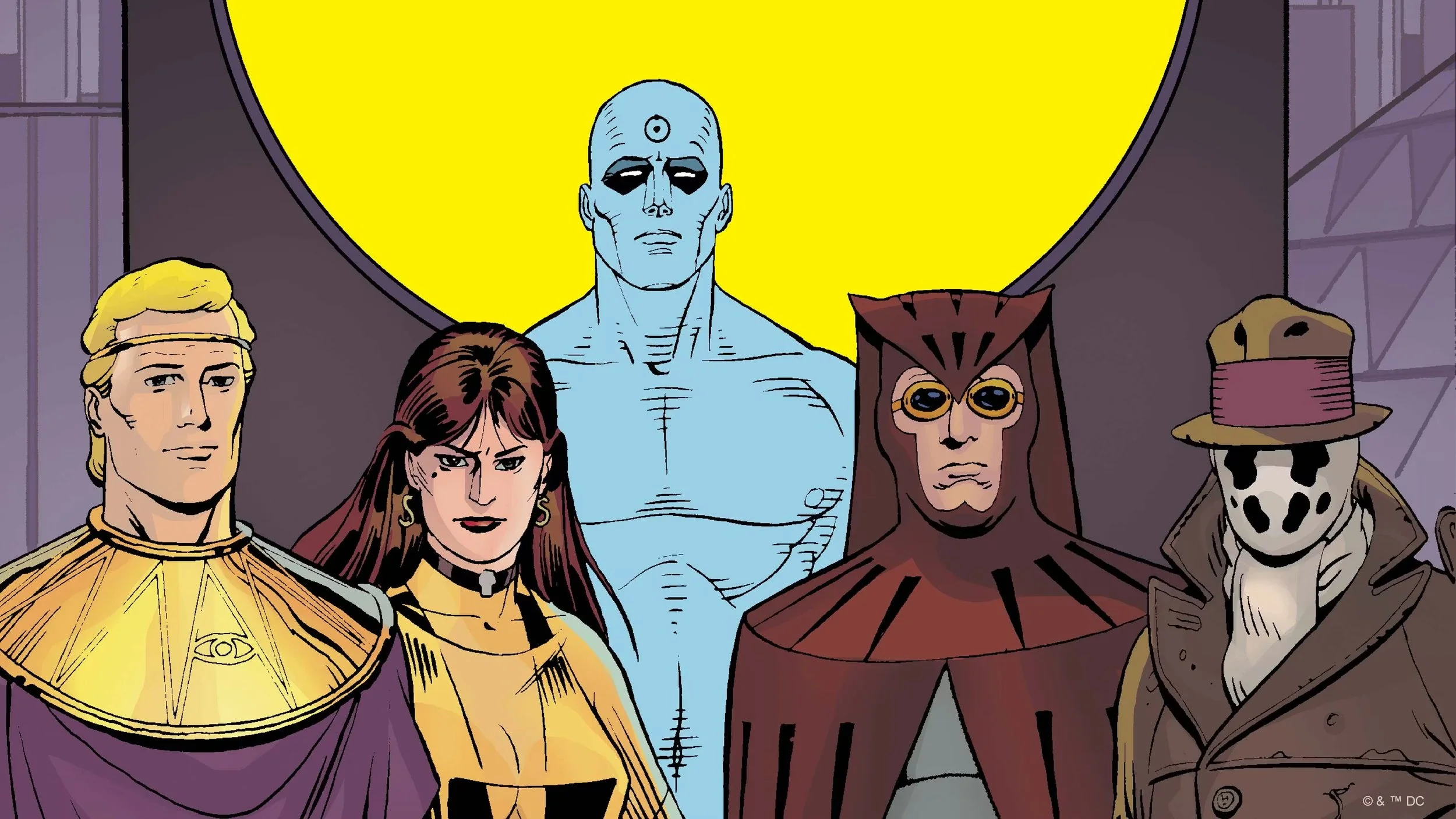
TWELVE ISSUES. ONE ENDING. NO SEQUEL NEEDED.
Watchmen — the graphic novel that changed what comics could be · Comic King
Watchmen — The Complete Comic King Guide
Every other page on this site covers a franchise — decades of issues, multiple volumes, characters handed between creators. This one does not. Watchmen is twelve comics published between 1986 and 1987 by Alan Moore, Dave Gibbons and John Higgins, and then it stopped. There is no ongoing series, no relaunch, no legacy numbering to untangle. It is one story with an ending, and forty years later it is still the book most often handed to somebody who says they do not read comics. That makes it unusual to buy, unusual to sell, and unusually easy to recommend. Comic King keeps the collected edition in stock permanently, carries the original issues when they come in, and will tell you honestly what yours are worth — which, as you will see below, is a conversation we have a lot.
Quick Facts
Story: A murdered vigilante, a conspiracy, and a group of retired superheroes in a world where they made everything worse.
Structurally the most ambitious mainstream comic ever published.
Length: TWELVE ISSUES — cover-dated September 1986 to October 1987. That is the whole thing.
Status: Complete. Finished in 1987 and never continued by its creators.
Publisher: DC Comics
Creators: Alan Moore (writer), Dave Gibbons (artist), John Higgins (colourist).
Age Guide: ⚠ ADULT — violence, sexual content and genuinely bleak subject matter. Not a book for children, whatever the superhero costumes suggest.
At Comic King: The collected edition permanently in stock, original issues when we can get them, and honest valuations.
Watchmen Is Not a Franchise — and That Changes Everything About Buying It
The collected edition of Watchmen has never been out of print. Not once since 1987 — it had passed twenty-four printings by 2017 and has kept going since. That single fact explains almost everything a buyer or seller needs to know. It means the story is permanently available for the price of a paperback, so nobody ever needs to hunt for it. It means the trade paperback, however old your copy is, carries no collector premium — a 1987 first-printing trade and a copy printed last month contain the same story and are worth broadly similar money. And it means the original twelve issues from 1986 and 1987, which were printed in the very large quantities a hugely-hyped DC series commanded at the time, are common. We will say this plainly because customers deserve to hear it from a shop rather than from a disappointing eBay search: Watchmen singles are famous, not rare. A complete set of twelve in reading condition is an affordable and genuinely satisfying thing to own, and we like selling them. What it is not is an investment. The exception is grade — pristine, professionally graded high-grade copies of the early issues do carry a real premium, because almost nobody treated these carefully in 1986. If you have a set, the question worth asking is not "are these valuable" but "are any of these in exceptional condition", and we will go through them with you and tell you either way.
The Book and Its Afterlife
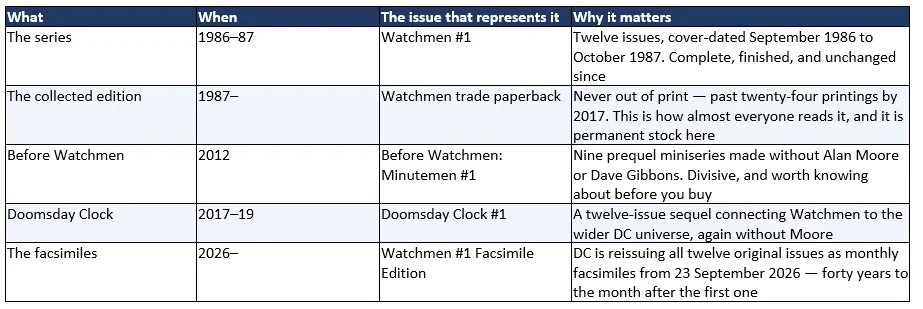
Watchmen has no eras, because it does not have a run. What it has is one complete story and everything the industry has built around it since:
The Keys — and an Honest Word About Value
Watchmen #1 is the book people ask about, and the honest answer is that it is common. It was a heavily-promoted DC series in 1986 and it sold in quantities that mean copies are not scarce today — a raw reading copy is an affordable comic and always has been. Where value genuinely exists is at the top of the grading scale: professionally graded copies in very high grade command real premiums precisely because so few were preserved that way. Issue #12, the final one, carries some additional interest as the conclusion. Beyond that, the twelve issues are a set to complete rather than an investment to hold, and we would rather you knew that going in. There is one live identification note as of this year: DC has begun reissuing all twelve issues as FACSIMILE EDITIONS, starting with issue #1 in September 2026. Facsimiles reproduce the original cover faithfully and are clearly labelled once you look, but they will circulate alongside the originals from now on and they are a different product at a different price. Check the indicia and the cover price before buying or selling — this is the same discipline that applies to every facsimile programme, and we apply it here as a matter of routine. Key prices move constantly, so we buy and price against live sold comps — ask and we will pull them up on screen together.
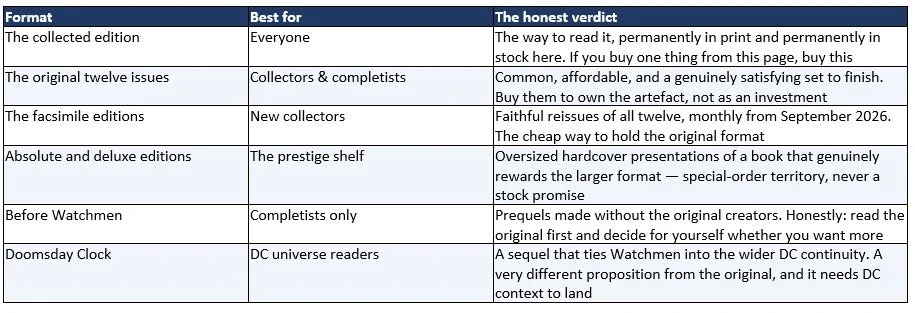
Every Format You Can Buy
Screen & Series Status
Updated August 2026: Watchmen has been adapted three times in different forms — a 2009 feature film directed by Zack Snyder, an HBO television series in 2019 that functioned as a sequel rather than an adaptation, and a two-part animated film released across 2024. None of them replaced the book, and all of them sent readers back to it. The live event this year is a publishing one rather than a screen one: DC is reissuing all twelve original issues as monthly facsimile editions beginning 23 September 2026, forty years to the month after the original first issue. That is worth a shelf position and a pull-list conversation with anyone who has only ever read the collected edition.
Collector's Corner — Grading, Care & We Buy
This is one of the two or three most common conversations we have across the counter, so here is how it goes. Someone brings in a set of Watchmen, often carefully kept, sometimes bought new in 1986, and expects it to be worth a great deal because the book is famous. Fame and scarcity are different things, and Watchmen is the clearest example of that difference in modern comics — it was printed in enormous numbers, it has never been out of print in collected form, and it is one of the most widely-owned comics in the world. So the honest answer is usually that a reading-condition set is worth a modest and fair amount, and we will show you live sold comps on screen rather than asking you to take our word for it. What genuinely changes the answer is condition. High-grade, professionally graded early issues do carry real premiums, and it costs nothing to check — if we think a copy is a grading candidate we will say so and we broker CGC submissions. We would far rather deliver that news accurately, in either direction, than have somebody find out afterwards that we were vague. And from September 2026 there is a second check: facsimile editions of all twelve issues are entering circulation, so we read the indicia and the cover price on every copy before a number is spoken. We also stock the bags, boards and boxes that keep a set worth grading in the first place.
FAQ — Straight Answers
Is my Watchmen #1 worth anything?
Usually less than people hope, and we would rather tell you that than have you find out elsewhere. Watchmen was one of the most heavily promoted comics of 1986 and sold in very large numbers, so surviving copies are common — a raw reading copy is an affordable comic. The book is enormously famous, but fame and scarcity are not the same thing, and this is the clearest example of that in modern comics. Where real value does exist is at the very top of the grading scale: professionally graded high-grade copies of the early issues command significant premiums, because hardly anybody stored these carefully forty years ago. So the useful question is not whether Watchmen #1 is valuable but whether yours is in exceptional condition. Bring it in, we will assess it honestly, show you the live sold prices on screen, and tell you whether it is worth submitting for grading.
Why does Alan Moore want nothing to do with Watchmen?
It comes down to the contract. Moore and Dave Gibbons signed a deal under which the rights would revert to them once the work went out of print — standard practice at the time, when comics simply stopped being printed after their run finished. Watchmen never went out of print. DC kept it permanently available, which meant the reversion clause could never trigger, and Moore came to regard that as the company having taken the work from its creators by keeping it in print indefinitely. He left DC in 1989 and has consistently refused payment, credit and involvement in adaptations and follow-ups ever since. Dave Gibbons has taken a more moderate public position. It is a genuinely contested piece of comics history, people hold strong views on both sides, and we are not going to tell you which view to take — we will just say that if a customer asks us in the shop, that is the factual answer we give and we leave the judgement to them.
Do I need to read anything first, and is there more after it?
You need to read nothing beforehand. Watchmen is entirely self-contained, uses its own characters, and requires no knowledge of DC continuity or of comics generally — which is precisely why it is the book most often handed to people who have never read one. Start at page one of the collected edition and finish it. As for more: DC has published two authorised continuations, neither involving Alan Moore. Before Watchmen, from 2012, is nine prequel miniseries about the characters' earlier lives. Doomsday Clock, from 2017 to 2019, is a twelve-issue sequel that connects Watchmen to the wider DC universe and does require DC context to make sense. Both are divisive among readers, for reasons that are as much about the creators' rights as about the stories. Our advice is straightforward: read the original, which is complete and needs nothing added to it, and then decide for yourself whether you want more.