
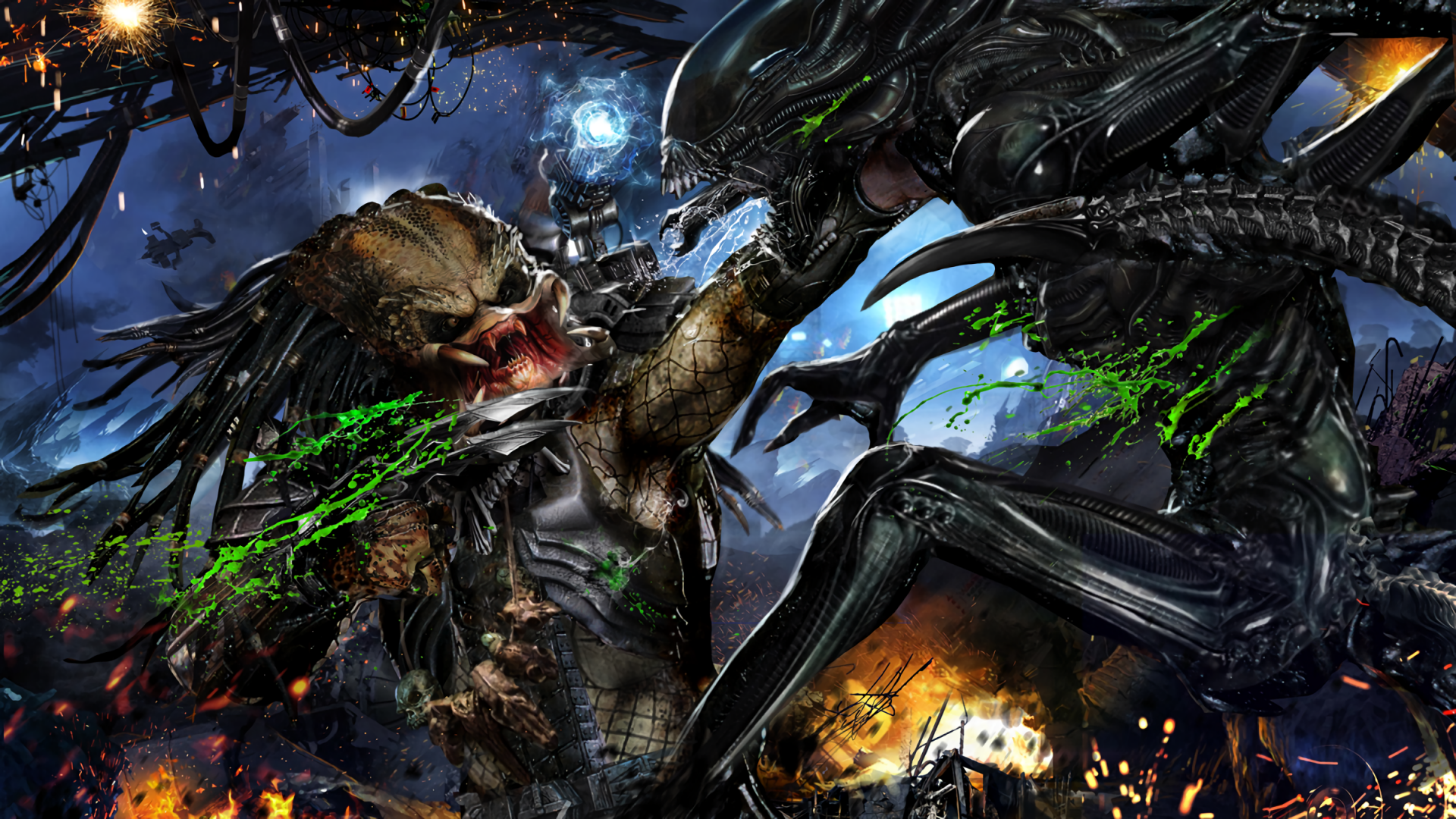
Alien vs. Predator.
The comics came first, beat the films by fifteen years, and stopped in 2020.
Alien vs. Predator — The Complete Comic King Guide
Alien vs. Predator started as a comic. Not as a film, not as a marketing idea, and not as the skull sitting in the trophy case in Predator 2 — as three chapters of a black-and-white anthology that Dark Horse published in late 1989, a full year before that skull appeared on screen and fifteen years before the first film. The Easter egg everyone remembers was a nod to these comics, put there by people who had just read them.
Dark Horse then published AvP for thirty-one years, across roughly twenty series. The last issue came out in January 2020.
Since January 2021 the licence has belonged to Marvel, along with Alien and Predator separately. Marvel has used the other two hard — there is an Alien and X-Men crossover in September and a Predator and Punisher one in November — and in five and a half years it has not published a single comic with an Alien and a Predator in it. Nothing is solicited by anyone through early 2027.
So this is a finished body of work with a held, unused licence sitting on top of it. And the numbering on the first four books is genuinely misleading, which is where we should start, because it is the thing that costs people money.
One warning before any of that, and it matters more here than on almost any page on this site: these are 16-and-up horror comics. Chestbursting, skinning, impalement — the same as the films, drawn rather than filmed. We will come back to why that gets missed so often.
Quick Facts
Story: Two of cinema’s great monsters hunt each other, and a human called Machiko Noguchi gets caught between them. She is the character the comics are actually about, and she is not in either film.
Length: Thirty-one years of comics, from November 1989 to January 2020. Roughly twenty series, mostly short ones.
Status: ★ CLOSED, and closed in an unusual way. Marvel has held the licence since January 2021, publishes Alien and Predator constantly, and has never published a single AvP comic. Nothing is solicited by anyone through early 2027.
Publisher: Dark Horse for the entire run, apart from one DC crossover. ⚠ Both Dark Horse and Marvel now distribute through Penguin Random House.
Age guide: ⚠⚠ 16 AND UP, and there are three separate reasons people get this wrong. Dark Horse rates its own AvP collections 16+ and the content matches the films exactly.
Formats: Three omnibus-scale collections · a long tail of 1990s miniseries · a small digest line · three comics that were never sold at all.
At Comic King: Back issues, the Dark Horse collections while they last, and an honest explanation of which number one you are actually holding.
The First One Isn’t Number One. And Number Zero Is a Reprint.
Here is the sequence, in the order the books actually came out.
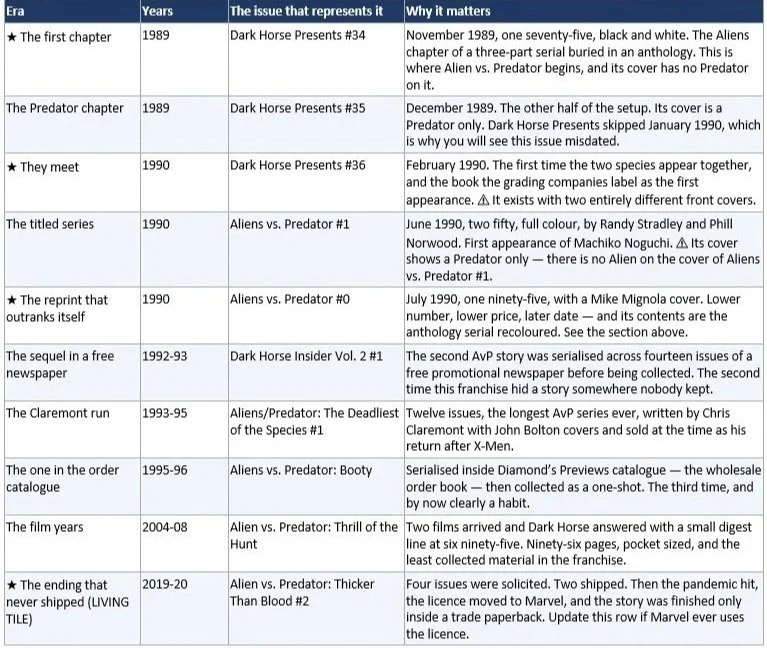
Dark Horse Presents #34, cover-dated November 1989, at one seventy-five. Thirty-two pages, black and white, written by Randy Stradley and drawn by Phill Norwood. It is the Aliens chapter of a three-part serial. Then #35 in December, the Predator chapter. Then #36 in February 1990, where the two species finally meet. That is the first appearance of Alien vs. Predator, and the grading companies say so on the label.
Then, in June 1990, Aliens vs. Predator #1 — the first issue of the first series actually named after the franchise, in colour, at two fifty. It introduces Machiko Noguchi.
And then, in July 1990, Aliens vs. Predator #0, at one ninety-five, with a Mike Mignola cover. It came out a month after #1. It costs less than #1. It is numbered lower than #1. And its contents are the Dark Horse Presents serial reprinted in colour.
A lower number, a lower price and an earlier-looking position on the shelf, on a book that shipped later and contains reprinted material. If you buy one AvP comic thinking you have bought the beginning, that is the one you will buy, and it is the only one of the four that is not a first anything.
Which of the others is "the first" is a fair question with two fair answers. #34 is the first chapter of the AvP story. #36 is the first time the two of them are in a room together. Dealers sell both as the first appearance and neither is lying. Tell us which you mean and we will get you the right book.
There is one more layer on #36, and it is the sort of thing that separates a shop that has looked from a shop that has not. That issue exists with two completely different front covers. One has a blue and purple Chris Warner line drawing on the front, with a Dave Dorman painting on the back with no logo on it. The other reverses them, putting Dorman’s orange burning-swamp painting on the front. They are separate print runs, the Dorman-front version is the more common of the two, and the Warner-front version carries meaningfully more money in a slab.
And the certification label will not tell you which one you are holding. Both versions carry the same boilerplate note describing a back-cover pin-up by Dave Dorman, which is simply wrong on the variant. The only difference on the label is the words "Variant Cover" in the title line. You have to look at the front of the book: blue line drawing, or orange painting.
None of this is trivia. It is the difference between the right book and a reprint, and between two versions of the same issue that do not carry the same value. We check it every time, and we will check yours with you.
The Run, Era by Era
Thirty-one years, one publisher, and a franchise with a strange habit of hiding its stories in places nobody kept.
The Keys — Issues Everyone Hunts
The book to buy is Aliens vs. Predator #1 from June 1990, first printing, ungraded, in very fine to near mint. It is a genuine key — the first appearance of Machiko Noguchi, who is the through-line of every AvP comic worth reading — it sits in the bins rather than behind the counter, and it trades roughly eight times a month, which makes it comfortably the most liquid book in the franchise. Important, cheap and actually saleable is a rare combination and this is the only place in AvP you get all three.
Two checks on it, and the first one is annoying.
Read the indicia. There is a second printing of #1 and it carries the same two-fifty cover price as the first. We went looking for a visible tell — a border, a logo change, a corner flash, anything you could see across a table — and we could not find one documented anywhere. So we are not going to give you a test that might not work. On this book, the inside of the cover is the only check, and anyone selling you a first printing without opening it is guessing.
Then work out which book you actually have, because four things sit in the same price band and turn up under the same searches. Aliens vs. Predator Annual #1 from 1999 is the most common substitution by a distance. Dark Horse Classics: Aliens versus Predator, six issues from 1997, is a colourised renumbered reprint — a number one that is not the number one. The One for One reprint from August 2010 is a dollar book and says so on the cover. And AvP #0, which we have already covered. The good news is that no facsimile edition and no treasury edition of AvP #1 or Dark Horse Presents #36 has ever been made, so those two traps at least do not exist here.
And now the part most guides will not tell you: do not send any of it to be graded.
We ran the arithmetic properly — what share of each book actually reaches the top grade according to the certified population, against what those grades genuinely sell for, net of selling fees, against what a submission costs a Canadian shop once shipping and brokerage are in. Nothing in the Alien vs. Predator line clears its own grading cost. Dark Horse Presents #36 is roughly break-even and everything else loses money, and those figures are the optimistic version, because the population statistics are built from copies people chose to submit — which are their best ones, not a random copy off a shelf.
The clearest illustration is that three AvP books reach the top grade on more than sixty percent of submissions. These were 1990s direct-market comics that came off the press flat and were bagged the same week. A slab on one of those is a plastic box around a bin book. The reverse is worth knowing too: Dark Horse Presents #35 makes the top grade only about one time in eight, so if someone tells you their copy is perfect, be politely sceptical rather than paying up.
One last thing to be aware of. Not one copy of any core 1989 or 1990 AvP book has ever been certified at a 9.9 or a 10. So if you are shown a price guide figure for a grade 10 on one of these, that number was calculated, not observed — there is no sale behind it anywhere.
Every Format You Can Buy
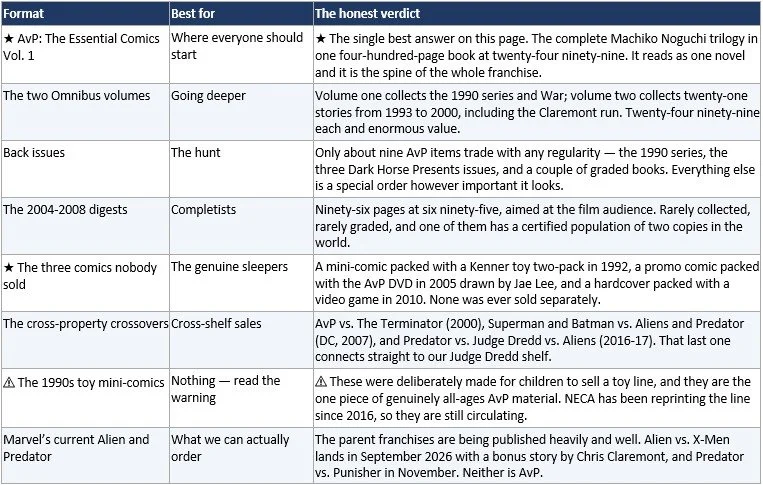
The routing on this title is unusually simple, and getting it right matters because the alternative is bad. Start at AvP: The Essential Comics Volume One. It collects the complete Machiko Noguchi trilogy in one book, it reads as a single novel, and it is the best twenty-five dollars in this section of the shop. Do not start someone in the 1990s single issues — there are twenty-odd series and they will land in the middle of a miniseries and conclude the whole thing is a mess.
Screen & Series Status
Updated August 2026: both parent franchises are the busiest they have been in decades, and the crossover itself is dormant.
Prey arrived in 2022 and was very well received. Alien: Romulus followed in cinemas in 2024. Predator: Killer of Killers, animated, came in June 2025. Alien: Earth ran eight episodes on television from August 2025 and has been renewed, with the second season expected in early 2027. And Predator: Badlands opened in November 2025, took about a hundred and eighty-five million dollars worldwide, and is the best-reviewed thing either franchise has produced in years.
Which brings us to the question we get asked most about Badlands, and the answer is more interesting than yes or no. There is no Xenomorph in it. The director has said so directly and on the record, and added that the studio was not interested in involving Alien just to push the action figures together. But Weyland-Yutani, the corporation from the Alien films, is in it and matters to the plot, and Elle Fanning plays a Weyland-Yutani synthetic. That is the first live-action bridge between the two franchises since 2007. So the rumour is half right, and the half that is right is the more meaningful half.
You will also see it reported that the Alien: Romulus sequel will feature a Predator. That traces back to a single podcast report, the outlet that carried it told readers to be sceptical, and the studio has said only that a crossover would have to happen organically. We would not plan around it.
As for the two AvP films themselves — 2004 and 2007 — they are why a lot of people assume this franchise is a joke. They are also the reason it is worth saying plainly that the comics came fifteen years earlier, were made by people who cared, and are considerably better.
Collector's Corner — Grading, Care & We Buy
★ BUY ON SIGHT: Aliens vs. Predator #1, 1990, first printing, ungraded, very fine or better. Check the indicia, buy it at bin money, and be aware that it is simultaneously the best book to stock and the worst book to submit for grading.
A word on what actually trades, because this is a franchise where the important books and the saleable books are not the same list. About nine things move with any regularity: the 1990 series, the three Dark Horse Presents issues including both covers of #36, and a small number of graded copies of #1 and #36. Everything else is a special order. Aliens vs. Predator: Sand Trap, the 2007 digest, has a certified population of two copies in the entire world and three recorded sales, yet a major price guide publishes a complete price ladder for it in every grade with not one sale behind any rung. That is a book, not a market, and we will tell you so rather than quoting you a number we cannot stand behind.
Related, and it will cost you if nobody warns you: three AvP books are published at roughly double their real price because the sales feeding those figures are full-run lots rather than single copies. Aliens vs. Predator: Duel #1, Three World War #1 and Predator vs. Judge Dredd vs. Aliens #1 are all quoted at around twice what a single copy actually sells for. And it runs the other way on AvP #0, where complete sets of #0 to #4 sell for less than a single #0, dragging its published figure down. We strip the lots out before we quote anything.
On the bigger picture, and we would rather be straight with you than sell you a story. Every Dark Horse licensed key from 1988 to 1990 is down substantially in top grade since late 2021, while the number of certified copies has doubled or tripled. That is not an Alien vs. Predator problem — we checked a book from the same publisher and the same years with no Alien or Predator content and no film attached, and it fell just as far. More slabs, less money, across the whole category. AvP did not underperform; it did what its cohort did, and #1 in top grade is actually the best of the group.
The four screen events since 2022 tell the same story from another angle. Through the second half of 2025, when Alien: Earth was on television and Badlands was in cinemas, AvP graded sales volume rose several times over while an unrelated control book barely moved. So the attention is real and measurable. But prices went flat to down over exactly the same window. The buyers showed up and the sellers showed up harder.
We buy AvP. It usually arrives as a mixed pile of 1990s Dark Horse miniseries from lapsed film fans, cheap and nearly complete. We pull #1 and the Dark Horse Presents issues, we check the front cover on #36, and we are honest about the rest. And we always look for the three books that were never sold in shops — the toy pack-in, the DVD promo with the Jae Lee art, and the video-game hardcover — because nobody in the chain has ever put a value on them.
FAQ — Straight Answers
What is the first Alien vs. Predator comic?
Dark Horse Presents #34, from November 1989 — but it only has the Aliens in it. The two species first appear together in Dark Horse Presents #36, February 1990, and that is the issue the grading companies label as the first appearance. Both get sold as "the first" and both claims are defensible. What is not the first is Aliens vs. Predator #0, which came out in July 1990 and is a reprint.
Is there a new Alien vs. Predator comic?
No, and there has not been one since January 2020. Marvel has held the licence since 2021 and publishes Alien and Predator separately and often, but has never published an AvP crossover and has none solicited. If that changes we will update this page — it is the single most likely thing to change it.
Where should I start?
AvP: The Essential Comics Volume One. It collects the complete Machiko Noguchi story — the 1990 series, War and Three World War — in one book, and it reads as a single novel. If you want more after that, the second omnibus has the twelve-issue Chris Claremont run in it.
Is it okay for my kid?
Almost certainly not, and this franchise gives you three separate reasons to think otherwise. The first AvP film was rated PG-13, Predator: Badlands last year was PG-13, and the little AvP comics that came packed with the 1990s toys were genuinely made for children. The actual comics are rated 16 and up by their own publisher and the content matches the R-rated films. Ask us and we will describe exactly what is in the book before you buy it.
Should I get my Alien vs. Predator comics graded?
No, and we will talk you out of it rather than take the money. We ran the numbers on every book in the line against what those grades actually sell for and what a submission costs, and nothing in Alien vs. Predator clears its own grading cost. Three of these books reach the top grade on more than sixty percent of submissions, which tells you the slab is not where the value is.