
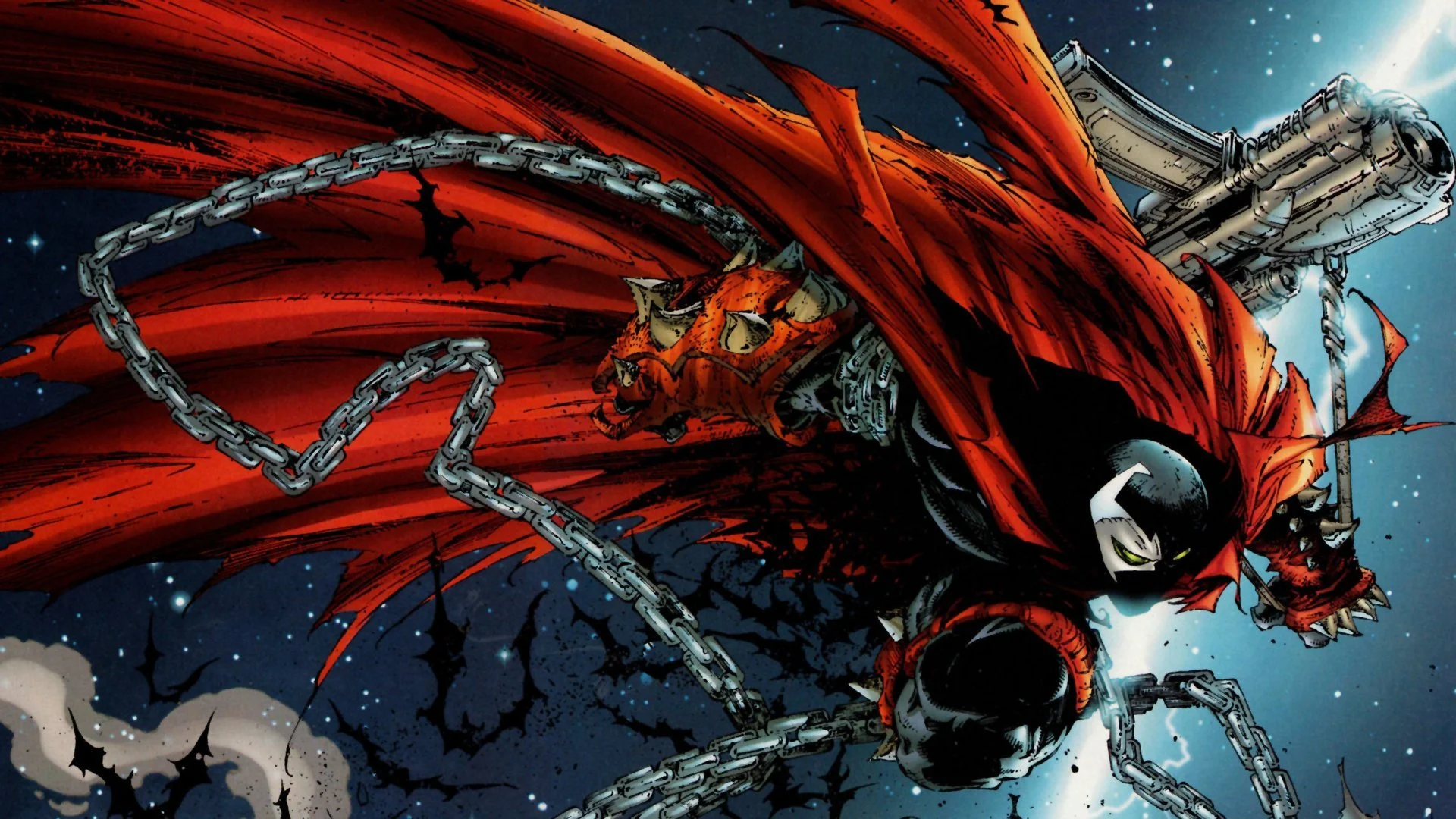
THE MOST VALUABLE SPAWN BOOK ISN'T A SPAWN COMIC.
Spawn — 1992 to the issue on the rack this month, and the honest truth about what your copies are worth · Comic King
Spawn — The Complete Comic King Guide
In 1992 Todd McFarlane walked away from the best job in comics. He was the biggest artist at Marvel, drawing a Spider-Man book he had been given his own way, selling numbers nobody had seen before — and he left, with six other artists, to start a company where the people who made the comics owned them. Spawn #1 arrived that May and sold over 1.7 million copies. Almost every creator-owned book on our shelves, Invincible and The Walking Dead included, exists downstream of that decision.
Thirty-four years later the book is still coming out, in the same unbroken numbering it started with. There has never been a reboot, never a renumbering, never a Volume Two. Whatever number is on the cover this month, it is simply the next Spawn — which makes it the easiest long-running comic in the shop to explain and one of the most satisfying to collect.
It is also the franchise most often misunderstood at a counter, and always in the same direction. People arrive certain that the famous issue is the valuable one. On this book, it is not. What follows is the whole thing laid out honestly: what is actually scarce, what is genuinely cheap, where the real money is hiding, and where to start reading if the only Spawn you know came in a plastic bubble.
Quick Facts
Story: A murdered special-forces operative makes a deal to see his wife again, comes back wrong, and spends three decades caught between a hell that owns him and a heaven that has no use for him. Horror in a superhero costume.
Length: Since May 1992, in ONE continuous volume — never rebooted, never renumbered. It has now passed the point where most comics are on their fifth or sixth Volume One.
Status: Ongoing monthly, with a family of connected titles around it. New writers took over the core books in 2026 and built a deliberate front door for new readers into the handoff.
Publisher: Image Comics — creator-owned by Todd McFarlane, which is not a footnote here. The ownership IS the historical significance of this book.
Age guide: ⚠ Mature readers. Horror imagery, violence and adult themes throughout. This is a very different thing from the McFarlane Toys shelf a younger customer may recognise — say so kindly before a parent buys it by mistake.
Formats: Monthly single issues across several titles · collected editions and compendium-style bricks · a deep and genuinely affordable back-issue run · omnibus and deluxe tiers to order.
At Comic King: A back-issue run carried on the shelf, the collections faced out, and sold comps on screen before anyone quotes you a number — on this franchise more than any other, that last part matters.
The Most Valuable Spawn Book Is Not a Spawn Comic
Here is the thing about this franchise that almost nobody walking in knows, and it is worth reading before you buy or sell anything on this page.
A month before Spawn #1 went on sale, Malibu Comics — the publisher handling Image's early distribution — put out a promotional magazine called Malibu Sun. Issue thirteen carried a McFarlane Spawn cover and a preview of the comic that had not shipped yet. It was a giveaway of sorts: a promo item, printed to advertise something else, handed out and thrown out. Nobody bags a magazine. That is precisely why it is now worth many times what Spawn #1 is worth in the same condition — not a little more, several times more, and the gap widens the higher the grade goes.
The logic is the opposite of what most people assume, and once you see it you see it everywhere in comics. Spawn #1 is famous, so it was bought by everyone, kept by everyone, and bagged by everyone. Over a million and a half copies exist and a great many of them are in beautiful shape. Malibu Sun #13 is obscure, so it was treated like what it was — an advertisement — and thrown in recycling by the shopful. Fame drives demand; scarcity drives price; and on this franchise the two point in opposite directions.
There is one more layer, for anyone who likes this sort of thing. A month before even the Malibu Sun, a small-press comic called Rust carried a full-page McFarlane Spawn advertisement on its inside back cover — the earliest printed Spawn artwork in a comic book, using a logo design he later abandoned. It is an ad rather than a cover, so it does not take the first-cover title away from Malibu Sun #13, but it is a genuine curiosity and it turns up in cheap boxes because nothing about the outside of that comic suggests Spawn is inside it.
The practical version, for anyone clearing out a 1990s collection: the box you are least interested in is the one we most want to look through. Promotional magazines, preview pamphlets, price guides and giveaways from the Image years get bulked or binned constantly, and the single most valuable Spawn item in existence lives in exactly that pile. Bring the whole lot. We will go through it with you.
The Run, Era by Era
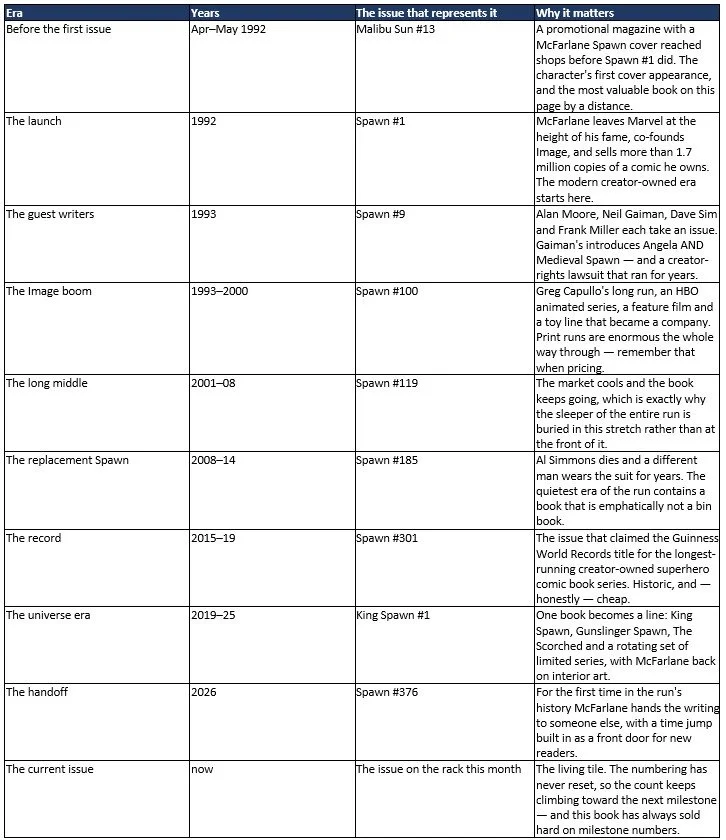
Thirty-four years, organized. Every era of Spawn, the one issue that represents it, and why collectors care:
The Keys — Issues Everyone Hunts
MALIBU SUN #13 is the money book, and the section above explains why. It is the character's first cover appearance, it is a magazine rather than a comic so it is filed and bulked wrong constantly, and it trades often enough that a fair price is easy to establish — roughly once a week somewhere in the world, which for a book of its value is genuinely liquid. Grade matters enormously here: because so few careful copies exist, the jump from a well-read one to a sharp one is one of the steepest on any book we handle.
SPAWN #1 is the first appearance of Al Simmons and the most famous comic of the entire Image boom, and we will always be glad to see one. It is also the single most-traded comic on this page — copies change hands several times a day — which tells you everything about how many were printed. Raw, it is a modest book. In certified top grade it is a real one. The gap between those two sentences is where every difficult conversation on this franchise happens, and we would rather have it with the sold prices on the screen in front of both of us.
SPAWN #9 is our buy-on-sight recommendation for anyone starting a Spawn collection, and it is not close. Neil Gaiman wrote it, and it holds the first appearance of TWO characters: Angela, who went on to become the subject of the most famous creator-rights dispute in modern comics and eventually a Marvel character, and Medieval Spawn, who has carried his own books since. It costs about what a new comic costs. It sells somewhere in the world roughly once a day, so you are never stuck with it. Historically important, genuinely affordable and properly liquid is a combination you almost never get in one issue — take it when you see it.
SPAWN #119 AND SPAWN #185 ARE THE TRAP, and this is the most useful paragraph on the page for anyone selling us a collection. Conventional wisdom on this run says the first dozen issues are the keys and everything after that is bin stock until the milestones. That is wrong twice. Spawn #119 holds the first appearance of Gunslinger Spawn — a cameo, in 2002, buried in the era everyone skips — and it is worth more than any early issue except the first. Spawn #185 is the death of Al Simmons and the debut of the man who replaced him, and it is worth several times a typical early-run issue. Both sit deep inside the stretch that gets bulk-priced without being opened. We check them every time, and so should anyone buying a long box at an estate sale.
THE FIRST YEAR IS A TIER WORTH SELLING AS A TIER. Issues #2 through #12 are, almost without exception, cheap — the price of a new comic or a little more — and they trade constantly. Inside that tier: #2 is the first Violator, the clown who became the character's signature villain and the star of the 1997 film; #5 has the first and last appearance of the run's most notorious one-off villain; #8 is Alan Moore's issue behind a McFarlane cover that homages his own Spider-Man #1. Completing the first year of the longest-running creator-owned comic in history costs less than one mid-tier Silver Age book, and it is one of the most satisfying want lists we can fill.
THE MILESTONES SELL ON THE NUMBER, NOT ON SCARCITY, and we will say so before you buy one. Spawn #100 and #300 came with stacks of variant covers; #301 is the issue that actually set the world record. All three were printed for a market that knew they were coming, so raw copies are inexpensive — the record-setting issue itself is one of the cheapest books discussed anywhere on this page. Buy them because you want the milestone on the shelf, which is a perfectly good reason, and buy certified high grade if you want the investment version. Do not buy a raw milestone expecting it to be scarce.
THE UNIVERSE-ERA FIRSTS — the debut issues of King Spawn, Gunslinger Spawn, The Scorched and the limited series around them — are modern comics with modern print runs, and they are priced accordingly. They are worth having as reading copies and as store stock. Treat grade discipline as absolute on them: only genuinely sharp copies are worth certifying, and the first appearance that actually carries value in this corner of the run is the 2002 cameo, not the 2021 launch.
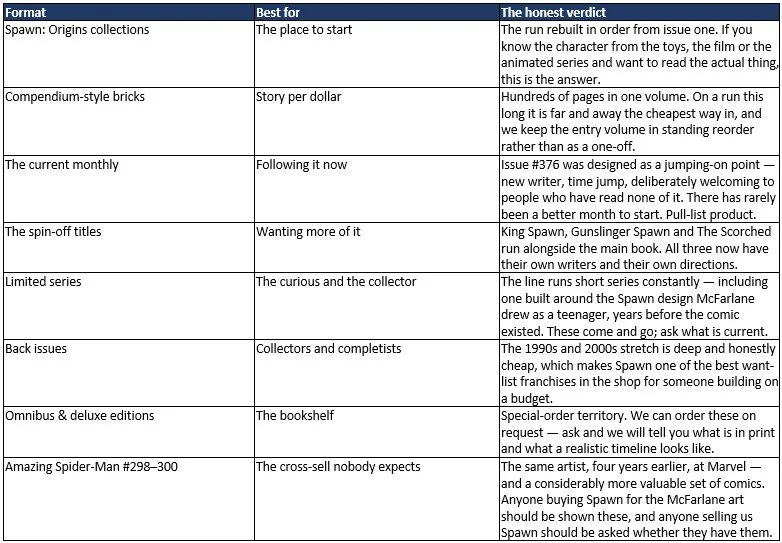
Every Format You Can Buy
Screen & Series Status
Updated August 2026: the live engine on this franchise right now is the publishing side, not the screen side, and that is unusual enough to be worth saying plainly. The core books changed hands this year for the first time since 1992, with a new writer and a time jump used as an on-ramp; a short series drawn from McFarlane's original teenage design of the character is arriving; and both Image Comics and Spawn reach their thirty-fifth anniversary in 2027, which is a display and ordering event a store can plan for well in advance. On the screen side the long-discussed live-action reboot remains unmade, and a finished animated project continuing the original animated series has been shown to exist without a release attached to it.
The evergreen rule that governs this section: on Spawn specifically, treat every film announcement as a rumour until a release date exists. This character has been announced, cast, re-cast and re-announced for the better part of two decades, and stores that ordered into the speculation each time were wrong each time. Nothing about that pattern has changed.
The lever that has actually moved this run is character migration, not film news. When Angela became a Marvel character, issue #9 moved — and it is still the issue people come in asking for by name. Watch what happens to the characters, not what happens in the trades.
And the framing that sells the most books here has nothing to do with screens at all. Spawn is comics history: the book that proved creators could own what they make, and the reason a generation of independent comics exists. That story sells collected editions to people who will never buy a single issue, and it is the honest reason this franchise deserves shelf space regardless of what any studio does.
Collector's Corner — Grading, Care & We Buy
Three habits govern this franchise at our counter, and the first one is the reason people keep coming back to us.
THE SPAWN #1 CONVERSATION comes before the price, every single time. People arrive believing this comic is a retirement fund, because it is famous and because it is from the era when comics were supposed to be an investment. It is a genuinely important comic and it is also one of the most common valuable-sounding books in existence. We will tell you that before we make an offer, we will pull the actual sold prices up on the screen, and we will show you where your copy sits. Nobody enjoys being the person who says this. We would still rather be that person than the shop that quietly bought it cheap.
GRADE DISCIPLINE ON 1990s IMAGE BOOKS IS UNUSUALLY BRUTAL, and it is a printing problem rather than a handling problem. These comics were produced on glossy stock, frequently with dark covers, at a moment when nobody was printing carefully. Spine stress, corner blunting and edge wear show up on copies that look flawless from a metre away. The practical effect is that only top-grade copies carry a real premium and mid-grade copies genuinely are bin stock. We will not broker a mid-grade 1990s book to a grading company for you — the fees would cost you more than the certification returns, and telling you so is part of the service.
THE TWO CHECKS WE RUN ON EVERY SPAWN COLLECTION are the ones described in the Keys section, and they exist because they have both paid off. First, the magazine boxes: promo magazines, previews and giveaways from the Image years hold the most valuable item in this entire franchise. Second, the middle of the run: the stretch from roughly the hundreds into the two-hundreds gets bulk-priced by people who assume the keys are all at the front, and it is not true here. We open the boxes.
COMPLETE RUNS ARE A REAL THING ON THIS BOOK, and that is rarer than it sounds. Most long-running comics fragment into volumes, relaunches and renumberings that make 'the complete run' a question rather than a shelf. Spawn does not: one volume, one unbroken count, from 1992 to whatever shipped this month. That makes it one of the genuinely completable long runs in comics, and because the middle of it is cheap, completion is a realistic project on an ordinary budget rather than a fantasy. Tell us the numbers you are missing and we will work the want list — this is the franchise where that service earns its keep, and finished runs sell as runs when their owners eventually move them on.
WE BUY SPAWN, and we are straightforward about which parts we want. Keys and milestone issues, sharp early-run copies, anything from the pre-launch promotional material, complete or near-complete runs — yes, and often enthusiastically. Bulk mid-grade 1990s Image is the single most common thing that walks through a comic shop door and among the least valuable, so we will usually buy selectively and explain exactly why rather than make a lowball offer on the lot. Full details on how we buy are on our sell page, and you are welcome to bring everything in for a look with no obligation either way.
FAQ — Straight Answers
Is my Spawn #1 worth anything?
Yes — and less than you have been led to believe, which is a difficult sentence to read and an honest one. Spawn #1 sold more than 1.7 million copies in 1992, at the exact moment everyone had been told comics were an investment, so the copies that exist were largely bought by people who looked after them. That combination — enormous print run plus careful owners — puts a hard ceiling on what an ordinary copy is worth. A raw copy in normal shape is a modest book, on the order of a nice lunch rather than a car payment. A certified near-perfect copy is a meaningfully different proposition and can be worth several times that. The honest advice is to have it looked at before you assume either way, and to bring everything else that came with it, because on this franchise the boring-looking items in the same box are frequently worth more than the famous one.
Where do I start with a comic that has been running since 1992?
Start at the beginning, which is unusual advice from us and correct here. Because the book has never been rebooted or renumbered, the collected editions run cleanly from the first issue forward, and the earliest material is also the best-known — the McFarlane art people actually came for, and the four issues written by Alan Moore, Neil Gaiman, Dave Sim and Frank Miller in the first year. If you would rather read a large chunk at once, the compendium-style volumes are the best value per page in the shop. And if you would rather start with what is happening now, this is a good moment for that too: the writing changed hands in 2026 and the new run opens with a time jump specifically designed so that someone who has read nothing is on level ground with someone who has read all of it.
Why is there a Spawn character in Marvel comics?
Because of a lawsuit, and it is the best story in the franchise. Neil Gaiman wrote the ninth issue of Spawn in 1993 and created a character called Angela in it. A dispute over who owned her — and over the terms creators had been working under at Image — ran through the courts for years, which was a deep irony for a company founded on the principle of creator ownership. Gaiman ultimately prevailed on the character, and Angela was later sold to Marvel, where she was folded into the Asgardian side of their universe. So a character created in an Image comic is now a Marvel character, and the issue she first appeared in is still one of the most requested single comics in this run. It is also, as it happens, one of the cheapest important comics we stock.