
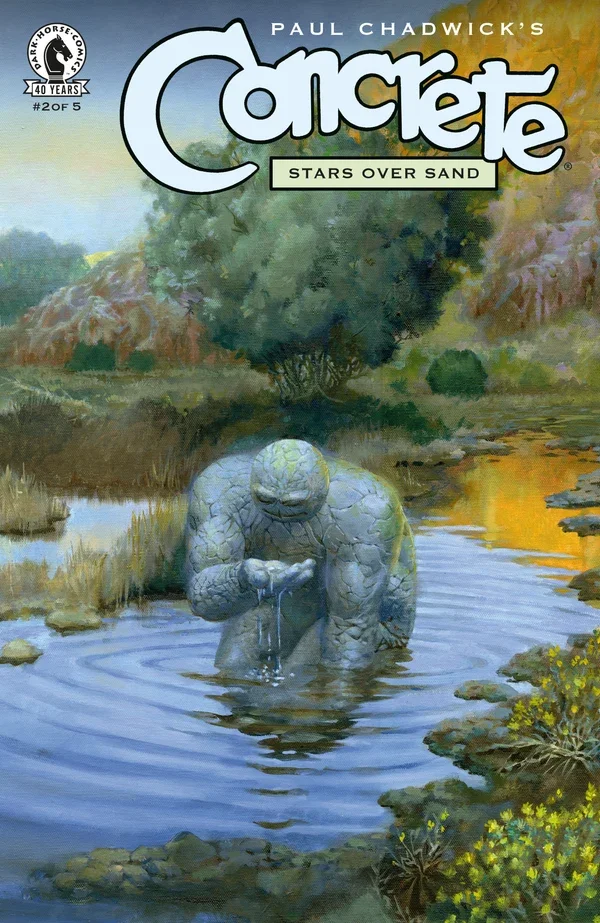
Concrete
Eight Eisner Awards. Forty years. And it still costs about what a new comic costs.
Concrete — The Complete Comic King Guide
A political speechwriter wakes up inside a twelve-hundred-pound stone body. Aliens did it. He escapes, the government tells the public he is a cyborg they built, and then he does almost none of the things a comic character in that situation is supposed to do. He does not fight crime. He travels. He takes odd jobs. He swims the Atlantic. He worries about the environment and about whether anyone will ever touch him again.
That is Concrete, and it is one of the most awarded comics ever published in North America. Eight Eisner Awards. Three Harveys. It has been running, on and off, since 1986, and there is a brand new series on the rack right now.
It is also, and we would rather tell you this up front, worth almost no money. Those two facts sit side by side on this page because both are true, and because the second one is not a criticism of the book.
Quick Facts
Story: A political speechwriter has his brain transplanted into an enormous stone body by aliens. He escapes, the public is told he is a government cyborg, and he mostly wants to travel, work and be left alone.
Length: Since July 1986 — but as a long sequence of miniseries and one-shots rather than a monthly. Ask which story, not which issue number.
Status: Live right now: Concrete: Stars Over Sand, a five-issue Paul Chadwick miniseries, is mid-run through late 2026.
Publisher: Dark Horse, always. Concrete appeared in the first comic Dark Horse ever published and has never been anywhere else.
Age guide: Adult in theme rather than in content — thoughtful, occasionally melancholy, with some nudity. Fine for a mature teenage reader. A young child will be bored rather than harmed.
Formats: Seven collected volumes covering the whole run · the current Stars Over Sand issues · cheap and plentiful back issues.
At Comic King: On the literary graphic-novel shelf where it belongs, not in the superhero section — and priced honestly, which on this title means inexpensively.
The Most Awarded Comic in the Shop Is Also One of the Cheapest
Here is the awards record, because it is genuinely remarkable and because it is the whole reason to care about this book.
In 1988, its first full year, Concrete won the Eisner Award for Best New Series, Best Continuing Series and Best Black-and-White Series — three of the top prizes in the same year — plus the Harvey Awards for Best New Series and Best Cartoonist. In 1989 it won Best Continuing Series and Best Black-and-White Series again, Paul Chadwick took Best Writer/Artist, and he took the Harvey for Best Cartoonist a second time. The Earth Day one-shot won Best Story in 1991. Fragile Creature won Best Finite Series in 1992. And then, seventeen years after the first ones, The Human Dilemma won Chadwick the Eisner for Best Writer/Artist all over again in 2005, along with a National Cartoonists Society award in the same year.
Eight Eisners and three Harveys, for a black-and-white comic about a man who does not fight anyone.
Now the other half. A copy of Dark Horse Presents #1 — the first comic Dark Horse ever published, containing Concrete’s first appearance — costs roughly what two new comics cost. In top graded condition it is worth less than a 1986 funny-animal book that exists purely to parody Teenage Mutant Ninja Turtles. Boris the Bear, the second comic Dark Horse ever released and a book nobody claims is important, trades within a few dollars of it. The industry price guide values Dark Horse Presents #1 in near-mint at about the price of a paperback.
That is not a market failure and it is not a sign the book is bad. It is a straightforward fact about how comic prices work: value comes from scarcity and from demand, usually demand created by a film or a television series. Concrete has neither. It was printed to meet demand, it was bought by adult readers who looked after their copies, and it has never been adapted for the screen. Awards do not make a comic scarce. They just tell you it is good.
We are telling you this because it is the single most useful thing we can say about Concrete, and because the alternative is worse. If we let you believe an award-winning 1980s comic must be valuable, you would eventually find out otherwise from somebody else, and you would be right to trust us less afterwards. It also cuts the other way when you are selling: people bring us runs of acclaimed independent comics from the eighties expecting serious money, and we would rather explain honestly why that is not how it works than make an offer that pretends.
What Concrete actually offers is this. It is one of the best comics almost nobody has read, the whole thing is affordable, and you can own a complete run of an eight-time Eisner winner for less than a single mid-grade superhero key. For a certain kind of reader that is a far better deal than a valuable comic.
And it is worth saying what the book is actually like, because the description does not sell it and the awards do not either. It is a comic in which a man with a body that cannot be hurt spends an issue trying to work out whether he can still enjoy food. He takes a job as a labourer because he wants to be useful. He swims across the Atlantic Ocean, and the interesting part is not the swim but what he thinks about while he is doing it. He falls for his assistant and cannot tell her. He gets involved in environmental activism and the comic is honest that he is not sure he is helping. There are almost no villains in forty years of it.
That is why it won everything, and it is also why it never sold. It is a quiet book, and quiet books do not become films.
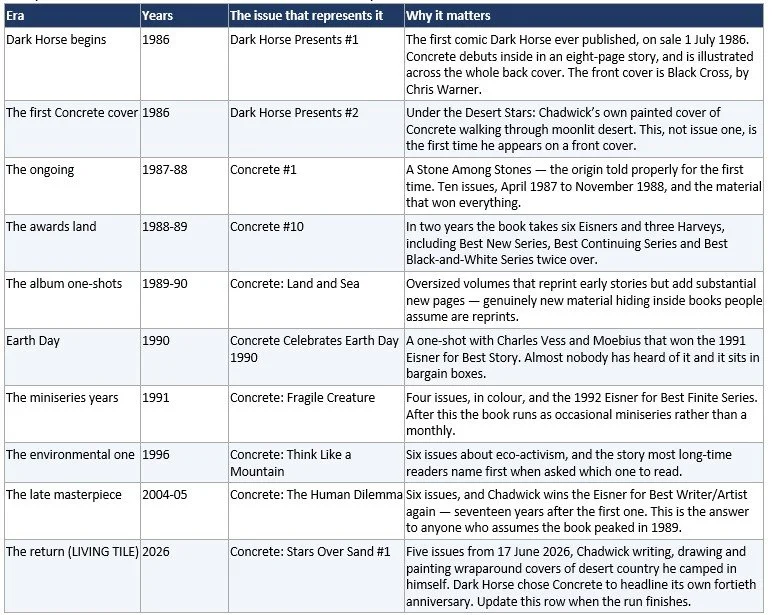
The Run, Era by Era
Concrete has never really been a monthly. It is a debut in an anthology, one short ongoing series, and then thirty-five years of miniseries and one-shots.
Ask which story, not which issue number.
The Keys — Issues Everyone Hunts
Dark Horse Presents #1, July 1986, a dollar fifty. Concrete’s first appearance, in an eight-page story called Lifestyles of the Rich and Famous, written and drawn by Paul Chadwick — and the first comic Dark Horse ever published. That double significance is the reason to own it.
One correction worth making, because it is repeated constantly and it is wrong: Concrete is not on the front cover of that issue. The front cover is Black Cross, a machine-gun-carrying figure standing in front of barbed wire and skulls, drawn by Chris Warner. Concrete is illustrated across the entire back cover, sitting in a stone chair while a friend reads him a fan letter, and the inside front cover previews the next issue. So if you want the first Concrete front cover, you want Dark Horse Presents #2 — Under the Desert Stars, Chadwick’s own painting of Concrete walking through moonlit cactus country, with a tiny pink Concrete in the corner holding up a hand-lettered sign giving the title.
Concrete #1, 1987. The first issue with his name on the cover, and the issue that finally tells the origin properly. Here is the quiet surprise: this is the harder book in top condition. Fewer than a hundred copies have ever been professionally graded and exactly one of those reached the top grade. It still costs about the same as Dark Horse Presents #1, because scarcity without demand does not move a price.
Concrete Celebrates Earth Day 1990. A one-shot with contributions from Charles Vess and the French master Moebius, and it won the Eisner Award for Best Story. It sits in bargain boxes and almost nobody knows what it is. If you want the single most underappreciated Concrete comic, it is this one.
Concrete: Fragile Creature, 1991, four issues in colour. Won the Eisner for Best Finite Series. Note the title is singular — Fragile Creature, not Creatures — which matters when you are searching for it.
Concrete: Eclectica, two issues from 1993, is the one that catches people building a complete collection. It rarely appears on checklists and it is easy to finish a Concrete run without ever knowing it existed.
And the three album one-shots — Land and Sea and A New Life from 1989, Odd Jobs from 1990 — look like reprint collections and are not. Each one adds several pages of genuinely new story to the reprinted material. They are cheap, they are common, and they contain content that is not in the regular series.
One more oddity for completists: there is a 1996 Wizard Ace Edition of Dark Horse Presents #1 — the whole comic reprinted behind a clear acetate cover with new artwork, bound as a flipbook so Concrete is on one side and Black Cross on the other. It was made in small numbers and it is a genuinely strange object. It is still a reprint, and it is priced as one.
Stars Over Sand #1 from June 2026 is a brand new comic with a modern print run. It is an excellent read and a nice fortieth-anniversary artefact. It is not a speculative book, it currently sells for its cover price, and we will say so to anyone who asks.
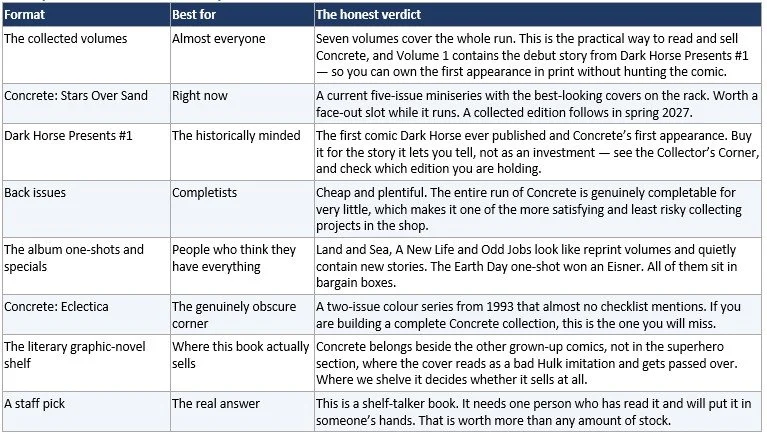
Every Format You Can Buy
Screen & Series Status
Updated August 2026: Concrete has never been adapted. There is no film, no series, no animation, and nothing announced. The live event here is a comics event.
Concrete: Stars Over Sand is running now — a five-issue Paul Chadwick miniseries, his first new Concrete in fifteen years, with wraparound oil-painted covers of desert locations he camped and sketched at himself. Issues one and two shipped in June and July, issue three is due at the end of August, and the run finishes in November. A collected edition follows in spring 2027. Dark Horse framed the whole thing around its own fortieth anniversary — which is a compliment worth understanding, because it means that out of everything the company has published in forty years, Concrete is the book they chose to bring back to mark it.
One detail about the new series that says more about Chadwick than any interview: he announced Stars Over Sand in November 2010. It shipped in June 2026. Fifteen and a half years between the announcement and the first issue, on a book he has described as roughly a decade of work. Nobody was waiting for it and he made it anyway.
The film story is worth knowing because it is better than the usual near-miss. Chadwick co-wrote a Concrete screenplay in the early 1990s with Larry Wilson, who co-wrote Beetlejuice. That went nowhere. Then, at the end of the decade, Disney hired Peter Jackson and Fran Walsh to write a Concrete film and put it on the schedule for 2003 — this was before The Lord of the Rings had started shooting. Chadwick has said the Jackson draft ended with Concrete riding a missile into space to destroy an alien ship, which is about as far from the character as it is possible to get, and that Jackson had been told to write it that way.
Then The Blair Witch Project came out in the summer of 1999, made a fortune on nothing, and studios spent the next year retreating from expensive effects-driven films with stars in them. Concrete lost its window and was killed. Chadwick has explained why it has stayed dead ever since: years of screenplay development money are charged against the property, so anyone wanting to make it now has to pay that off before they start. The film is not waiting to happen. It is carrying a debt.
So there is no screen engine here and there is not going to be one soon. That is the honest position, and it is also why the prices are what they are.
Collector's Corner — Grading, Care & We Buy
Two practical things, and the first one will save somebody money.
Dark Horse Presents #1 exists in four different versions and they are not worth the same. There is the original July 1986 first printing. There is a second printing from later the same year, at the same dollar-fifty cover price, which is the tricky one — the price box cannot help you, and telling first from second means reading the small print inside the front cover. Then there are two Commemorative Editions from 1992, at two twenty-five, which reprint the same cover art with a coloured border added around the edge — one silver, one green. Those borders are the giveaway: the original printings have no border. Commemorative copies are worth a fraction of a first printing, and they turn up misdescribed regularly, including in recent sales we have checked. Finally there is a 1996 Wizard Ace Edition, which reprints the whole comic behind a clear acetate cover with brand new artwork, as a flipbook with Concrete on one side and Black Cross on the other. It is easy to spot and quite scarce, but it is a reprint.
There is no facsimile edition of Dark Horse Presents #1, which is unusual for a book of this reputation and worth knowing.
The second thing is about grade. This is a late-eighties black-and-white comic that was bought by adults who bagged it, so high grade is common — roughly two in five graded copies are near-mint or better. That is one of the reasons values stayed flat, and it is also good news if you are buying, because clean copies are easy to find and you should not pay a scarcity premium for one. There is one real oddity: the top grade has never been awarded to this book at all.
On care, the practical note is that a lot of the best Concrete material is in oversized album formats and in the collected volumes rather than in standard comics, and those are shelf items rather than bag-and-board items. Treat them as books. The oversized one-shots in particular do not fit standard bags, which is one reason they end up loose in bargain boxes with bent corners — and, as above, those are the ones with new stories in them.
We buy Concrete, and this is the page where we should say plainly how that conversation usually goes. Someone brings in an award-winning independent run from the eighties and expects it to be worth a great deal, because the reputation is real and the comics are good. The offer will be modest, and the reason is not that we are undervaluing the work — it is that these were printed to demand, kept carefully, and never had a film to create buyers. We would rather explain that clearly, show you the comparable sales, and have you leave understanding the market than make a quick buy from someone who feels short-changed afterwards.
FAQ — Straight Answers
Where should I start?
Volume one of the collected editions, which contains the original debut story from Dark Horse Presents #1 and the first five issues of the ongoing. If you would rather start with the famous one, Think Like a Mountain is the story people name most often. If you want to be current, Stars Over Sand is running now and needs no prior reading at all.
Is it a superhero comic?
No, and that is the point of it. He has enormous strength and almost never uses it on anyone. The book is about what a person in that body would actually do with a life — travel, work, think, be lonely. It looks like a superhero comic on the shelf and it is close to the opposite of one.
Is Dark Horse Presents #1 valuable?
Not really, and we would rather say so. It is historically important — the first Dark Horse comic and Concrete’s first appearance — but it is an affordable book, in the range of a couple of new comics for a decent copy. Buy it for what it lets you say, not as an investment. And check the border and the indicia first, because there are three later editions of it in circulation.
Is Concrete on the cover of Dark Horse Presents #1?
Not the front cover — that is Black Cross by Chris Warner. Concrete is on the back cover and in an eight-page story inside. His first front cover is Dark Horse Presents #2. This gets stated wrongly all the time, including by people selling the book.
Do I need to read it in order?
Not really. After the first ten issues it becomes a series of self-contained stories, and most of them work on their own. The collected volumes are arranged sensibly and any of them is a reasonable entry point. The only thing worth reading first is the origin, and that is in volume one.
Why have I never heard of it?
Because it has never been a film, a television series or a cartoon, and because it is a quiet black-and-white comic about an ordinary man in an extraordinary body. It has won more awards than most of what was on the rack beside it. It is the clearest example in the shop of the gap between what is good and what is famous.