
Heavy Metal
The number one is not the key. Issue fifty-four is.
Heavy Metal — The Complete Comic King Guide
Heavy Metal is an adult illustrated magazine that has been running science fiction, fantasy and horror comics since April 1977. Let us get the part everyone wants to know out of the way first, plainly and once: it has always contained full nudity, explicit sexual content and graphic violence, as ordinary parts of the storytelling rather than as a special feature. It is sold to shops with a Mature Readers tag. We do not sell it to minors. That is the whole of it, and the rest of this page is about the comics.
Because the comics are the reason it matters. Heavy Metal is how English-speaking readers first met Moebius, Philippe Druillet, Enki Bilal and a generation of European artists who changed what comics looked like. The magazine format put it outside the Comics Code, which is exactly why it could print what American colour comics could not, and that freedom is what attracted the artists.
It is also being published right now. The magazine died quietly in 2023 and a new owner relaunched it at issue one on 30 April 2025. Six issues have shipped since, and we can order it. Two things about collecting it matter more than everything else on this page, and both contradict what you will usually be told.
Quick Facts
What it is: An adult illustrated science fiction and fantasy magazine. It began as the American edition of the French magazine Métal Hurlant, and it is the book that brought Moebius, Druillet, Bilal and Corben to English-language readers.
Length: Forty-nine years. Issue #1 is cover-dated April 1977, the original run ended at #320 in 2023, and a new owner relaunched at #1 on 30 April 2025.
Status: ★ LIVE and being published now. Six issues since the relaunch, and #6 reached shops on 12 August 2026.
Publisher: ⚠ Heavy Metal International LLC — it is its own publisher. It has no distributor account of its own and reaches shops through Lunar, under Massive Publishing’s Massive Indies programme.
Age guide: ⚠ ADULT, and has been since 1977. Full nudity, explicit sexual content and graphic violence run all the way through, as ordinary parts of the storytelling rather than as a special feature. It is solicited to shops with a Mature Readers tag and we do not sell it to minors.
Formats: The current 232-page perfect-bound issues · fifty years of back issues, most of which are genuinely inexpensive · and the separate English-language Métal Hurlant, which is a different magazine on a different order route.
At Comic King: We will tell you issue one is not the key, then show you the issue that is.
Issue One Isn’t the Key. Issue Fifty-Four Is.
Ask almost any dealer which Heavy Metal is the valuable one and you will be told issue one, April 1977. It is the first issue, it has Moebius in it, and the logic is obvious. It is also wrong, and the gap is not small.
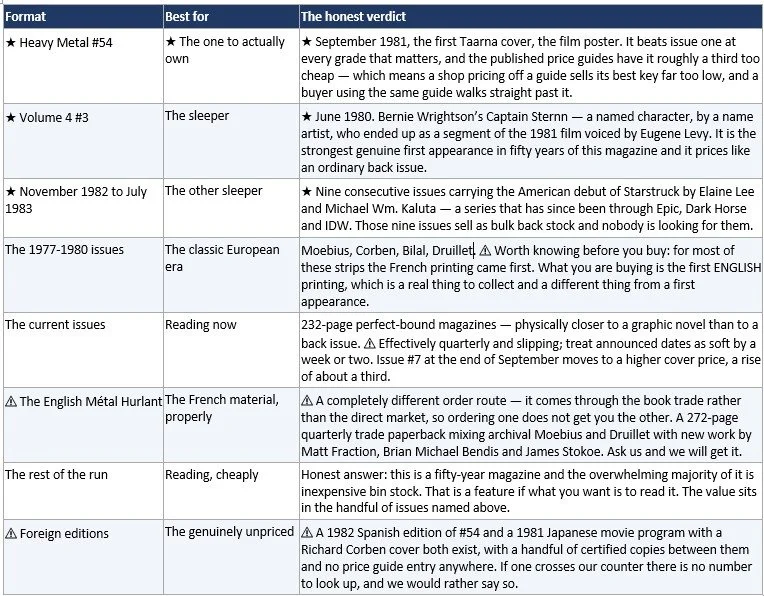
The book the market actually pays for is Heavy Metal #54, September 1981. It carries the first cover appearance of Taarna, painted by Chris Achilleos — and that painting became the poster for the 1981 animated film. Raw, in reading condition, the two issues are much the same money. Certified, at every grade above the middle of the scale, #54 pulls away, and around the upper-mid grades it runs more than double issue one.
What convinced us it is real rather than a blip is the certified population. Forty-four months ago there were nine certified copies of #54 in existence. There are now more than a hundred. And the point at which that curve turns upward is the middle of 2023 — a year and a half BEFORE the relaunch was even announced. That is a market working something out on its own, not excitement about a new publisher.
Here is the part that should interest you most, and it is the reason this page exists. The published price guides have not caught up. The headline raw figure the main guide shows for #54 sits roughly a third below what the book actually changes hands for, because that headline follows the most recent transaction rather than the trend and the last few happened to be cheap.
Which means the same mistake bites both ways. A shop pricing #54 off a guide sells its best key too cheaply; a collector using that same guide reads the number, decides it is an ordinary magazine and walks past it. We would rather tell you that than quietly be on the right side of it.
One warning on the same book, because it would be dishonest to sell the upside without it. Do not buy a #54 hoping to grade it into the top tier. There is exactly one top-grade copy in the entire certified census, and across roughly a hundred copies certified since the end of 2022, not one more has been added.
The Run, Era by Era
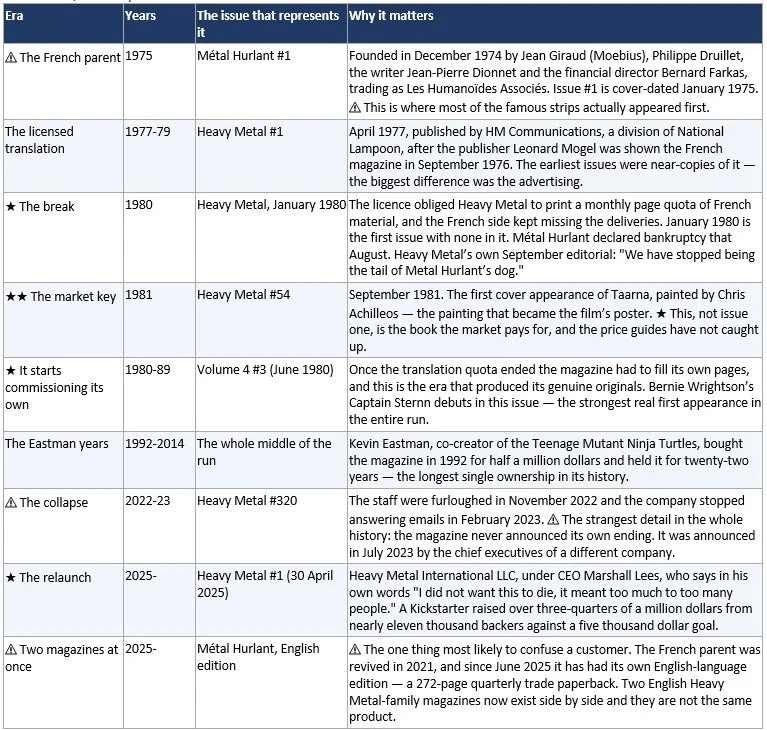
The short version: Heavy Metal began as a licensed translation, broke away in 1980 when the French side could not deliver pages on schedule, and spent the next forty years as its own thing. Ask which era someone means and which language they care about, and most confusion on this title disappears.
The Keys — Issues Everyone Hunts
Here is the second thing, and it is the one that will make a serious collector trust you. For the famous European strips, Heavy Metal is not the first appearance. Métal Hurlant printed them first, in French, and often by a year or two. Moebius’s Arzach is Métal Hurlant #1 in January 1975 and Heavy Metal #1 in April 1977. The Airtight Garage is the French #6 in March 1976 and the American #6 in September 1977. The Long Tomorrow ran in the French #7 and #8 in 1976 and the American #4 and #5 in July and August 1977.
So Heavy Metal’s claim on those strips is FIRST IN ENGLISH, not first appearance. Both are perfectly legitimate things to collect. They are simply different books, and knowing which one you are chasing is the difference between buying the right issue and buying a nice reprint.
There is a genuinely good wrinkle inside that, too. The Long Tomorrow was written by Dan O’Bannon in English and translated INTO French for Métal Hurlant. So the French printing is the first PUBLICATION but not the original language. If you want the first appearance you want Métal Hurlant #7. If you want the first thing printed in the language it was written in, you want Heavy Metal #4. It is widely credited as a visual source for both Alien and Blade Runner.
So what DID appear here first? A shorter and much cheaper list than you would expect, and it is where the value hides.
The strongest genuine first appearance in fifty years of this magazine is Captain Sternn, by Bernie Wrightson, in Volume 4 #3, June 1980. A named character, created by one of the most collected horror artists in comics, in a specific identifiable issue, who went on to be a segment of the 1981 film voiced by Eugene Levy. It prices like an ordinary back issue. If we had to point one person at one book on this title that nobody else is pointing at, that is the one.
The second is Starstruck, by Elaine Lee and Michael Wm. Kaluta. It was not first published in Heavy Metal and it was not first published in America — it ran in Spain in 1982. But Heavy Metal gave it its American debut across nine consecutive issues from November 1982 to July 1983, and those nine issues sell as bulk back stock. A Kaluta-drawn series that has since been reissued by Epic, Dark Horse and IDW, sitting in the bargain bins.
Beyond those: Tex Arcana by John Findley from March 1981; The Bus by Paul Kirchner, a cult strip with a real international reputation that ran seven years from 1978 and whose original appearances price as generic back issues; and Alien: The Illustrated Story by Archie Goodwin and Walt Simonson, published here as a standalone book in 1979.
And because it is a magazine rather than a character title, the covers are keys in their own right. Issue #39, June 1980, has an H.R. Giger cover and gallery. Issue #169 from 1997 has a Milo Manara cover. Issue #183 from 1999 is a Frank Miller benefit cover for the Comic Book Legal Defense Fund, limited to five thousand.
One correction to have ready, because the error is genuinely everywhere. Heavy Metal #1 is not the first appearance of Den. Den began as a 1968 animated short by Richard Corben, appeared in comics in Fantagor #4 in 1972, and first appeared under the name Den in Grim Wit #2 in September 1973. Both are underground books from the Last Gasp era. Corben expanded the character for Métal Hurlant in 1975 and 1976, and only then did the twelve-part Heavy Metal serial run.
Every Format You Can Buy
Screen & Series Status
Updated August 2026. Forward visibility on this title is about six weeks, which is shorter than anything else on the site.
The 1981 film is why most people have heard of Heavy Metal at all. Columbia released it on 7 August 1981, ninety minutes, rated R, made for around nine million dollars and grossing more than twice that. It is an anthology, and the segments come from the magazine: Soft Landing, Den from Corben, Captain Sternn from Wrightson, So Beautiful and So Dangerous from Angus McKie. B-17 and Harry Canyon are original screenplays, as is the Grimaldi framing story. The Den segment drew the most critical praise.
Two things repeated about that film are wrong and worth knowing. Harry Canyon does not adapt The Long Tomorrow — it is an original screenplay whose visual design is heavily indebted to it. And Taarna is not Arzach. She was developed as a substitute after the original framing concept hit licensing problems. She is built on Arzach’s visual language, which is precisely why the current magazine can run new Taarna stories and could not run new Arzach.
Two footnotes. The soundtrack album reached number twelve on the Billboard chart, but music licensing blocked a CD release until 1995 — which is why the film was genuinely hard to find for years. And the 2000 sequel, Heavy Metal 2000, went direct to video and is not well regarded; it adapts The Melting Pot, a comic by Kevin Eastman, who owned the magazine at the time.
Nothing is currently in development that anyone has announced. The slate of film and television projects announced in 2022 belonged to the company that collapsed four months later, and no source says any of it survived. The strongest living descendant of the Heavy Metal film idea is Netflix’s Love, Death and Robots — a David Fincher and James Cameron Heavy Metal feature was abandoned when its funding stopped in 2009, and Fincher reworked the concept.
There is one live signal and it should be read carefully. Issue #6, in August 2026, launched a new Taarna serial presented by Ridley Scott and Scott Free Productions, written by Aaron Guzikowski of Raised by Wolves. ⚠ That is a comics credit, not an announced screen project. It is the shape a development deal often takes before anything is announced, and it is a reasonable thing to mention in conversation. It is not a fact we will print as one.
And a straight answer on the question that usually follows: no, the 2025 relaunch did not move back-issue prices. We tested it against two control magazines from the same era and format with no Heavy Metal content, and every Heavy Metal move sat inside the range the controls were doing anyway — in some buckets the moves ran in opposite directions. The certified volume tells the same story from the other side: grading submissions on issue one grew about half again over the same period, which lands between the two controls, not above them. More slabs, the same money, and a slightly worse average grade. Do not pay a premium on 1977 to 1981 stock because the magazine came back.
Collector's Corner — Grading, Care & We Buy
Three rules on this title, and the first is unusual enough to be worth stating publicly.
RULE ONE: on Heavy Metal, rank by sales, never by the printed price. We audited fourteen product pages on the main price guide covering sixty-eight displayed prices, and thirty-five of them — just over half — had no recorded sales behind them at all. They are estimates presented in the same typeface as real numbers. The published ranking of "most valuable Heavy Metal issues" is therefore mostly synthetic. The worst example we found is a headline top-grade price on a book that has exactly one top-grade copy in existence and no recorded sale of it, ever.
The worst single data point we have found anywhere is on this title: the highest raw-priced Heavy Metal product in the entire catalogue has one sale behind it, and that sale is of a completely different comic from a different publisher. It looks plausible because the artist named on the entry died in 2022 and his covers are genuinely sought.
RULE TWO: think very hard before grading issue one. Its raw price already exceeds what a certified mid-grade copy sells for, which means grading a copy that comes back below the middle of the scale actively destroys value. And the odds are worse than the headline suggests. The cumulative rate at which issue one reaches top grade looks like roughly one in five — but that figure was built from a handful of warehouse-fresh copies certified twenty years ago. Of the two hundred-odd copies certified since the middle of 2022, only four reached it. The current rate is nearer one in fifty. Anyone justifying a grading submission with the cumulative number is using a figure that stopped being true four years ago.
RULE THREE, and it is the counterpart: #54 is the grading play instead. It grades worse than issue one, but its price ladder between grades is far steeper, so the return on a mid-to-upper grade is several times better. The engine on that book is the upper-middle grades, not the top.
On Canadian variants, we checked and the answer is that there are none worth paying for. Heavy Metal does not appear in the standard Canadian price variant guide’s six-hundred-plus catalogued titles, which do list Creepy, Eerie, Vampirella and Savage Sword of Conan. And across more than nine hundred sales records we looked at, not one was a Canadian variant. If someone offers you a Heavy Metal Canadian variant at a premium, we would want to see it before believing it.
WE BUY. Heavy Metal usually arrives in long runs from someone clearing a basement, and the seller usually wants a number for the whole stack. That is fine — bring it. What we sort for is #54, issue one, the June 1980 Giger cover, the June 1980 Wrightson issue and the November 1982 to July 1983 Starstruck stretch, and we will point them out while we go. The rest is honestly bin stock, and a fifty-year run takes up a great deal of shelf, so we would rather be straight with you about it.
FAQ — Straight Answers
Is Heavy Metal still being published?
Yes. A new company relaunched it at issue one on 30 April 2025 and six issues have shipped, the most recent on 12 August 2026. It runs at roughly quarterly and the dates slip, so treat announced ship dates as soft. We can order it — it comes through Lunar under Massive Publishing’s Massive Indies programme rather than the usual channels, which is why some shops will tell you they cannot get it.
What is the most valuable issue?
Issue #54 from September 1981, not issue one — it has the first Taarna cover, the painting that became the film poster. And be careful with any published ranking of the most valuable issues, because just over half the prices on this title are estimates with no sales behind them.
What is the difference between Heavy Metal and Métal Hurlant?
Métal Hurlant is the French magazine that came first, founded in 1974 by Moebius and Philippe Druillet among others. Heavy Metal launched in 1977 as its licensed American edition and became independent in 1980. For most of the famous strips, the French issue is the first appearance and the Heavy Metal issue is the first English printing. Both magazines are publishing again today, and the French one now has its own English edition, which is a different product on a different order route.
Is it appropriate for a teenager?
No. It is an adult magazine — nudity, explicit sexual content and graphic violence throughout, since 1977 — and we do not sell it to minors. One thing we will add rather than leave you to discover: critics writing about the 1977 to mid-1980s issues specifically document how much rape and attempted rape drives the plots of that era. That is a description of the classic material, not a modern reframing of it, and you should know it before buying a stack of the old ones for someone.
Did the relaunch make the old issues worth more?
No. We measured it against control magazines from the same era and format, and every move was inside the range those controls were doing anyway. There is no relaunch premium on 1977 to 1981 stock and you should not pay one.