
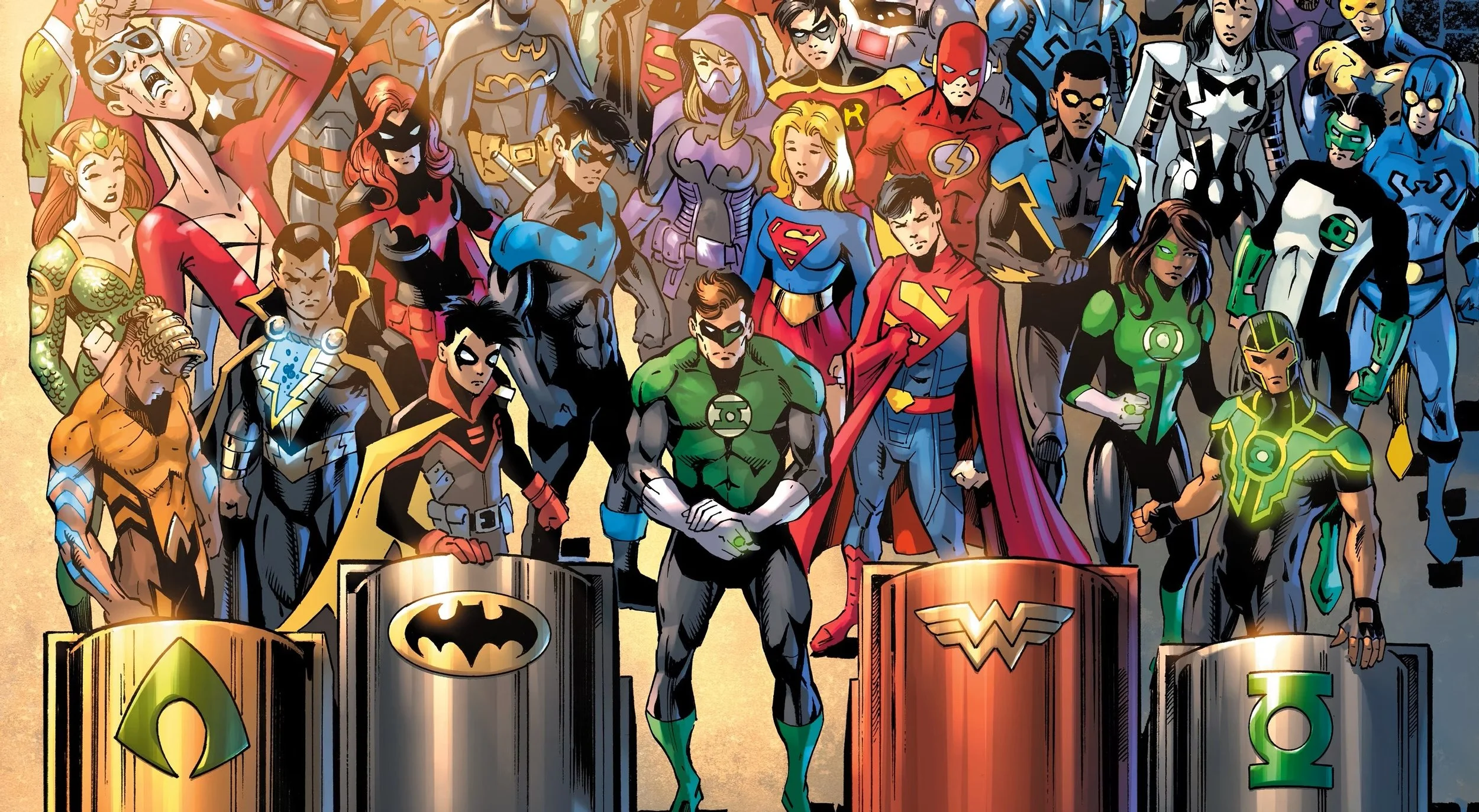
EVERY DC HERO. ONE BOOK.
Justice League — the team that invented the team book · new issues, back issues and honest collection valuations · Comic King
Justice League — The Complete Comic King Guide
In 1960 DC put Superman, Batman, Wonder Woman, the Flash, Green Lantern, Aquaman and the Martian Manhunter in a single comic together, and the superhero team book was invented. It worked so well that Marvel went away and built the Fantastic Four in response a year later — which is to say that this one title is, indirectly, the reason the Marvel universe exists. Comic King carries the Justice League in Edmonton with a genuine run in stock: new issues each week, and a back-issue wall that is deeper and considerably cheaper than most people expect. If the issue you want isn't on the shelf, we can special-order or source it on request.
Quick Facts
Story: The biggest heroes in DC, in one team, dealing with the things none of them could handle alone.
Length: Publishing since 1960 across several differently-named series — see the era table.
Status: Ongoing — the current series is Justice League Unlimited, which passed issue #22 in August 2026.
Publisher: DC Comics
Age Guide: Broadly all-ages, with a dedicated younger-reader line drawn from the animated series.
Formats: New issues · back issues · graphic novels · omnibus & Absolute editions.
At Comic King: New issues weekly, a run in stock, and we buy DC collections — including the ones people think are Justice League collections.
Why a Justice League Collection Is Almost Never Worth What People Think — and Often Worth More
This is the single most useful thing on the page, and it applies whether you are buying or selling. The Justice League is a TEAM, which means it works completely differently from a character title. On Batman or Spider-Man, the valuable issues are inside the title itself — the first appearance of a villain, the first appearance of a costume. On the Justice League, the value is mostly somewhere else entirely, because the members did not debut here. The Flash debuted in Flash Comics and then Showcase. Green Lantern debuted in All-American Comics and then Showcase. Superman debuted in Action Comics, Batman in Detective Comics, Wonder Woman in All Star Comics. Their Justice League appearances are team appearances, and team appearances are not first appearances. So when somebody brings us a box and calls it a Justice League collection, the first thing we do is sort it by CHARACTER rather than by title — because the money, if there is money, is usually in the other books in the box. It cuts both ways, and both ways are good news for a collector. It means the Justice League run itself is genuinely affordable to build. And it means the box in your basement might be worth considerably more than the League issues in it would suggest. Bring the whole thing in and we will go through it properly.
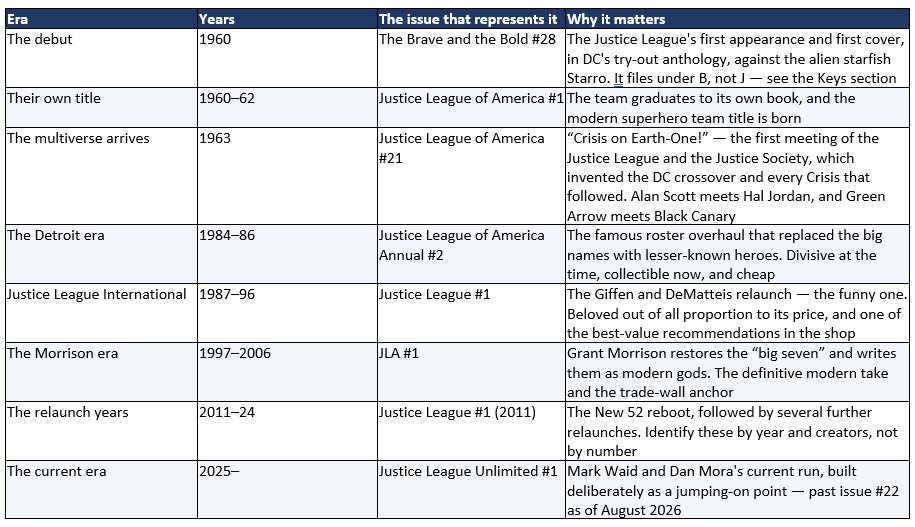
The Run, Era by Era
Sixty-six years, organized. Every era of the Justice League, the one issue that represents it, and why collectors care:
The Keys — Issues Everyone Hunts
There is one book here that matters more than all the rest combined, and it hides in plain sight. The Justice League did not debut in a Justice League comic — it debuted in THE BRAVE AND THE BOLD #28, DC's try-out anthology, in 1960. That means it files under B. Sellers do not know they have it, dealers sorting by title walk past it, and it is one of the most-missed major Silver Age keys in a DC collection. We check every Brave and the Bold run that comes through the door, and so should you. Issues #29 and #30 are the other two try-out appearances before the League got its own title, and both are routinely overlooked as well. Justice League of America #1 is a strong Silver key in its own right. Justice League of America #21, from 1963, is the first JLA/JSA crossover — the book that established the multiverse and made every subsequent DC Crisis possible, and it carries the Silver Age debuts of Dr. Fate and Hourman alongside it. After that the run becomes affordable fast: Justice League #1 from 1987 is a cheap and cheerful entry key, and the post-2011 relaunch #1s exist in enough volumes and variants that they are mostly bin books. Key prices move constantly, so we buy and price against live sold comps — ask and we will pull them up on screen together.
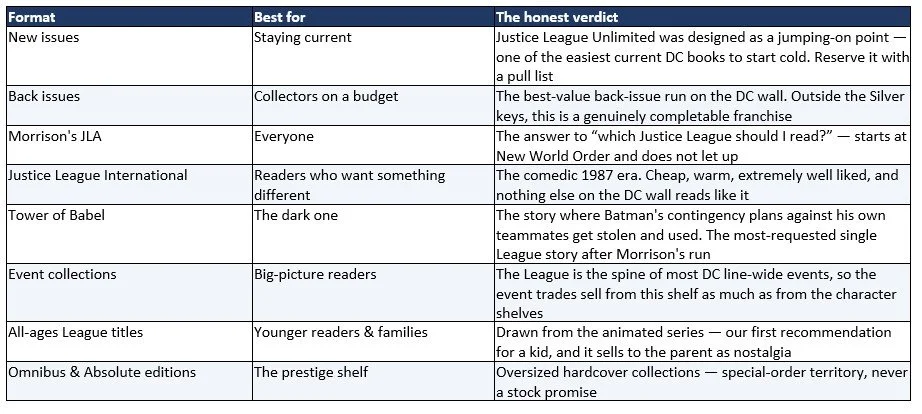
Every Format You Can Buy
Screen & Series Status
Updated August 2026: DC's screen universe is being rebuilt character by character, starting with Superman and continuing outward. A team film is not on the announced schedule yet — and that is precisely why now is the good moment to build a Justice League back-issue wall rather than after one is announced. A rebuilt superhero universe assembles a team eventually; it is a question of when. On the page, Justice League Unlimited continues — ask at the counter for the newest issue. Exact release dates for anything on screen live in the Consolidated Ordering Calendar, not on this page.
Collector's Corner — Grading, Care & We Buy
Two habits matter on this franchise, and neither is obvious. The first is the Brave and the Bold check. The Justice League's first appearance is not in a Justice League comic, so it does not sit where anybody expects it to. We run every Brave and the Bold stack in every collection we are offered, because #28 is exactly the kind of book that gets bulk-priced by someone in a hurry. It also exists in official reprint and facsimile form, so authentication comes before any conversation about money. The second habit is the one described further up this page: we sort a team collection by character, not by title. If you are selling us what you think is a Justice League collection, the League issues are usually the least valuable part of it and the individual character books around them are where we find things worth paying for. That is a better outcome for you than the alternative, and it is the reason we ask you to bring the whole box rather than the part you thought we wanted. We assess keys in front of you with live comps on screen, grade honestly, broker CGC submissions for slab-worthy books, and stock the bags, boards and boxes that keep a collection worth grading.
FAQ - Straight Answers
Which comic has the first Justice League?
The Brave and the Bold #28, from 1960 — not a Justice League comic at all. DC used Brave and the Bold as a try-out title for new concepts, and the League appeared there three times, in issues #28, #29 and #30, before earning its own series. This matters practically: the book files under B rather than J, which is why it slips past people sorting a collection by title and why it is one of the most commonly missed Silver Age keys. It has also been officially reprinted and produced as a facsimile, so any copy needs authenticating before a price is discussed. If you think you have one, bring it in and we will look at it properly.
I have a box of Justice League comics — what is it worth?
Probably not what the League issues suggest, and possibly quite a lot more than you expect — and the reason is worth understanding. The Justice League is a team book, so its members' valuable first appearances are in other titles: Action Comics, Detective Comics, Showcase, Flash Comics, All-American Comics and so on. League issues are team appearances, which is a different and much cheaper thing. So the honest answer is that we cannot tell you from the title alone. What we do is sort the box by character rather than by series, because that is where anything valuable will be. Bring the whole collection, not just the part with Justice League on the cover — that is genuinely where the money hides.
What is the difference between Justice League of America, JLA and Justice League?
They are different series, and the wording on the masthead tells you which era you are holding. Justice League of America is the original, running from 1960 to 1987. Plain Justice League from 1987 onwards is the Giffen and DeMatteis International era — the comedic one. JLA, the initials on their own, is the 1997 to 2006 run that Grant Morrison launched. After 2011 the name resets several times across different volumes, so for anything modern you identify by year and creative team rather than by issue number. If you are holding something and are not sure, bring it in — the masthead and the year together will tell us exactly what it is in about ten seconds.