
TWO COPIES OF THE SAME 1977 COMIC. FIVE CENTS APART.
Star Wars comics — three publishers, fifty years, and the one corner of the cover we check every single time.
Star Wars Comics— The Complete Comic King Guide
In April 1977, six weeks before a single person had seen the film, Marvel put a comic on the newsstand adapting a science-fiction movie nobody had heard of. It worked. Nearly fifty years later Star Wars comics have been published by three different companies, four of them have been called issue number one, and one of the most valuable single books that walks into this shop is hiding inside that pile — identifiable, if you know where to look, by five cents printed in a box on the front cover. This page is how we sort all of it out.
Quick Facts
First comic: Star Wars #1 (Marvel), on sale 12 April 1977 — six weeks before the film opened.
Publishers, in order: Marvel 1977–86 · Dark Horse 1991–2014 · Marvel again 2015–present.
Also publishing Star Wars now: Dark Horse (all-ages and High Republic, since 2022) and Mad Cave / Papercutz (middle grade, new in 2026).
The one book to check: Star Wars #1 (1977) — and specifically whether it is the 30-cent or the 35-cent edition.
Best value key: Star Wars #42 (1980) — Boba Fett's first standard comic and his first cover.
Cheapest famous issue: Star Wars #8 (1978) — first appearance of Jaxxon the green rabbit.
Currently at Marvel: Limited series and adaptations. There is no ongoing Star Wars monthly as of August 2026.
The big one coming: Star Wars/Marvel: Hope Assembles — five issues, January 2027.
Why 2027 matters: It is the 50th anniversary of the first film, and the whole publishing plan is built around it.
In stock here: Marvel-era and Dark Horse-era back issues, collections, and the current line.
Five Cents Is the Difference Between a Common Comic and One of the Rarest Books of the Bronze Age
Here is the thing you actually need before buying or selling anything on this page. In 1977 Marvel ran a price test. In a handful of American cities it shipped copies of Star Wars #1 with a 35-cent cover price instead of the usual 30 cents, to see whether the market would carry an increase. The test was small. The Overstreet guide's working estimate is around 1,500 copies, and the guide itself prints that number with a question mark beside it, because no Marvel production record has ever surfaced. What we can count is what has been graded: as of April 2026 the grading company CGC had certified roughly 20,000 copies of the standard Star Wars #1 and roughly 350 of the 35-cent edition. That is about one variant for every fifty-seven ordinary copies.
The two books are otherwise identical. Same cover art, same date, same interior. The difference is the price box in the top-left corner, and a genuine test-market copy in high grade is worth a life-changing multiple of a common one — the biggest gap between two apparently identical comics that we deal with in this store.
So the rule at our counter, and the rule we would give you for your own collection, is that every Star Wars #1 from 1977 gets the corner checked before anyone says a number out loud. What you are checking is the shape and the content of that price box, not the date and not the barcode. Both of those appear on reprints too, and trusting them is how people talk themselves into believing they own something they do not. And if a copy does read 35 cents in the right kind of box, the correct next step is not a price — it is professional authentication, because the one thing an altered 30-cent copy looks exactly like is a genuine one. We will happily walk you through it. We will not guess at it.
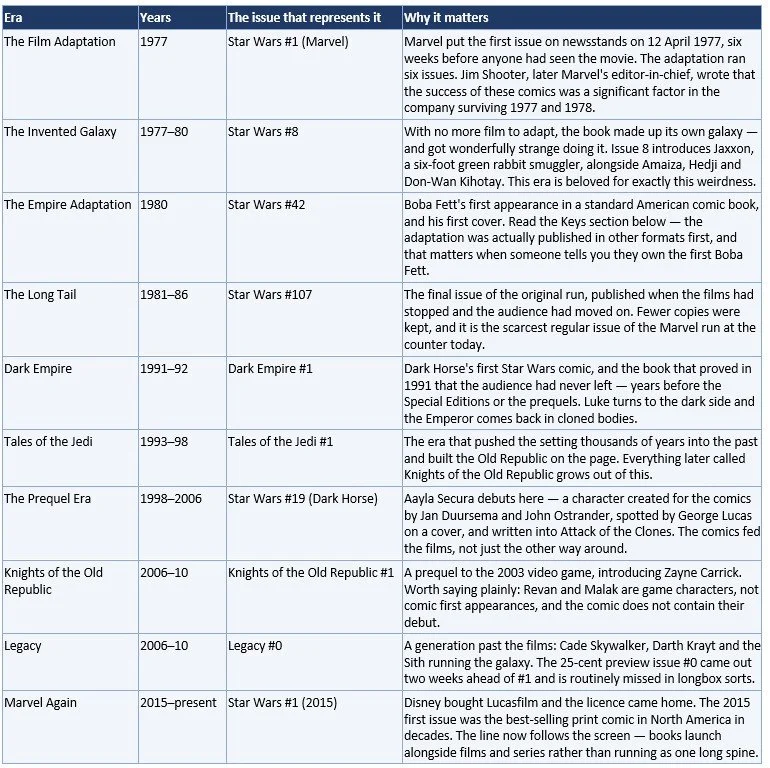
The Run, Era by Era
Nearly fifty years across three publishers, organized. Each era gets the one issue that represents it, and those issues are also the covers we hang on the wall for this section.
The Keys — Issues Everyone Hunts
STAR WARS #1 (1977) is the book, and it is really two books. The common 30-cent edition is famous, widely available and priced accordingly — it is a lovely thing to own and it is not rare. The 35-cent test-market edition is one of the genuinely scarce Bronze Age books. The section above tells you how the two are separated. Note also that the original has been reprinted repeatedly over five decades — Whitman multipack editions in the seventies, a dollar reprint in 2016, facsimile editions in 2019 and again in April 2025. Every one of those reprints carries a modern cover price on the front. The original carries 30 or 35 cents. That single detail settles most of the conversations we have about this book.
STAR WARS #42 (1980) is the issue we recommend most often, and it is the one to buy on sight if you find a clean copy. It is Boba Fett's first appearance in a standard American comic book and his first cover, from the Empire Strikes Back adaptation, with a superb Al Williamson and Carlos Garzon cover. It trades constantly — of every key on this page it is the one with a real, daily market rather than an occasional one — and its graded values step up cleanly from low grade to high with no strange gaps. Be precise about what it is, though. The Empire adaptation was published complete in a Marvel paperback in May 1980 and in Marvel Comics Super Special #16 before it was serialized in the monthly book, so #42 is not the earliest printed Boba Fett. It is the first one in a normal comic, it is the first cover, and that combination is what the market pays for. Anyone who tells you otherwise is selling something.
STAR WARS #8 (1978) is our favourite cheap book on the whole page. First appearance of Jaxxon, the six-foot green rabbit smuggler, plus Amaiza, Hedji and Don-Wan Kihotay. It costs about what a new comic costs, it sells steadily, and it comes with the best story on the shelf: this is what Marvel did when it ran out of film to adapt and had to invent a galaxy on deadline. Jaxxon has since come back in current comics, which is exactly the kind of thing that turns a dollar-bin curiosity into a book people ask for.
STAR WARS #107 (1986) closed the original run at a moment when the films had stopped and almost nobody was paying attention. Fewer copies were saved, and it is the hardest regular issue of that run to find in nice shape. Honest caveat: no circulation statement exists for Marvel in 1986, so anyone quoting you a print run for #107 is quoting a guess. What is real is the scarcity at the counter and the fact that it has been climbing while much of the rest of the Bronze Age run has been flat.
DARK EMPIRE #1 (1991) is the most historically important Dark Horse issue and one of the most misunderstood books on this page. It relaunched Star Wars comics after a five-year silence and it is why the nineties Expanded Universe existed at all. It is also, in its regular edition, an affordable common comic — a great read and a modest asset. The gold and platinum foil editions from 1993 are genuinely scarce in graded terms, but they trade rarely and online price data for them is badly contaminated by six-issue sets and by an unrelated Marvel collection listed under the same name. If someone quotes you a foil price off a price-tracking site, check what actually sold. We do.
LEGACY #0 (2006) is the quiet one. A 25-cent preview released two weeks before Legacy #1, introducing the Cade Skywalker era. The market argues about which issue carries which first appearance, and we are not going to pretend that argument is settled — what is not in dispute is that #0 came out first, and it gets skipped in almost every collection we sort.
THE MODERN FIRSTS worth knowing are both in the same series. Darth Vader #1 (2015) has the first Black Krrsantan, who turned up in live action in The Book of Boba Fett — that is the clearest case on this page of a modern comic moving because of a show. Darth Vader #3 (2015) has the first Doctor Aphra, a fan favourite who, despite what you may have read, has not yet appeared on screen at all. Both were printed in very large numbers, both have been graded in the thousands, and both have softened over the past year. We will always buy them; we will not tell you they are scarce.
STAR WARS #1 (2015) deserves a straight answer, because we get asked about it weekly. It was the best-selling single comic in North America in decades — close to a million copies shipped in one month. That is a genuine record and it is also the entire reason it is not valuable. A million copies, bagged and boarded on day one by people expecting exactly this conversation, with no first appearance inside. It is a great-looking comic and a fine read. It is not a retirement plan. The value in that release, such as it is, sits in the scarce ratio variants, not the regular cover.
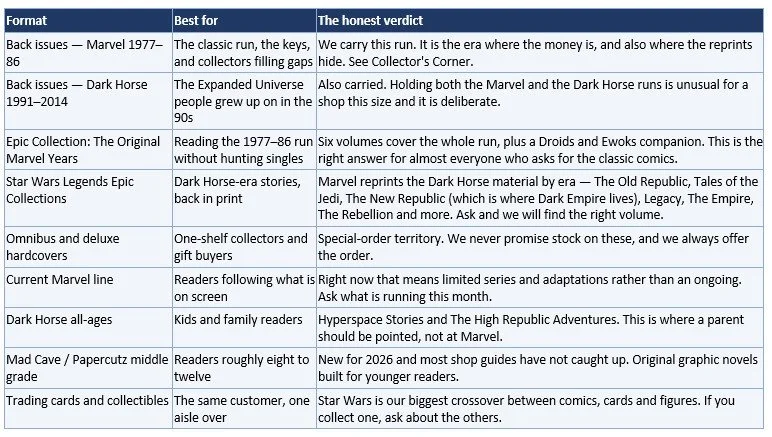
Every Format You Can Buy
Screen & Series Status
Updated August 2026: The Mandalorian and Grogu opened in cinemas on 22 May 2026 and finished as the lowest-grossing Star Wars feature to date, which is worth saying plainly rather than dressing up; it reaches Disney Plus on 2 September 2026. On streaming, Maul: Shadow Lord ran through April and May 2026 and has been renewed, and Visions Presents: The Ninth Jedi dropped all eight episodes on 5 August 2026. A LEGO Star Wars: The Mandalorian special arrives 2 September 2026. Ahsoka season two is set for early 2027 with Hayden Christensen returning. On the games side, Star Wars Zero Company — a Clone Wars-era tactics game — releases 27 August 2026, and Star Wars Galactic Racer follows on 6 October 2026.
The year that actually matters is 2027, and it is close enough to plan around. It is the fiftieth anniversary of the first film. The original 1977 theatrical cut returns to cinemas, restored, on 19 February 2027. Star Wars Celebration comes to Los Angeles from 1 to 4 April 2027, its first time in that city since 2006. Star Wars: Starfighter, with Ryan Gosling, opens 28 May 2027. And in January 2027 Marvel publishes Star Wars/Marvel: Hope Assembles, a five-issue series by Kevin Smith and David Marquez in which the Avengers meet Luke, Leia, Han and Chewbacca while Doctor Doom throws in with Darth Vader — the first crossover of its kind in fifty years of the licence. Behind all of it, Lucasfilm changed hands at the top: Kathleen Kennedy stepped down in January 2026 after fourteen years and Dave Filoni now runs the company.
The pattern underneath all of this never changes, and it is the only forecasting tool anyone needs here. When a character reaches the screen, their comic first appearance moves. Boba Fett did it for Star Wars #42. Black Krrsantan did it for Darth Vader #1. Watch announced casts, not release dates, because the money moves on the announcement. And when a Star Wars event lands, it does not just light up the comic wall — it moves the Topps card shelf and the figure wall at the same time. We stage all three together, and you should shop them together.
Collector's Corner — Grading, Care & We Buy
Three habits govern this franchise at our counter, and the first one is worth more than everything else on this page combined.
CHECK THE CORNER, EVERY TIME. Any Star Wars #1 from 1977 gets its price box looked at before anyone talks about money — yours, ours, anyone's. Not the date, not the barcode; those appear on reprints as well and they are the reason people convince themselves wrongly. The price box, and then the indicia inside the front, because reprints declare themselves there. If a copy passes, it goes to a grading company, not to a price conversation. We would rather send you away with an authentication plan than hand you a number we cannot stand behind.
ASSUME THE REPRINT UNTIL PROVEN OTHERWISE. This run has been reprinted for almost fifty years — Whitman department-store editions in the seventies, dollar reprints, facsimile editions in 2019 and 2025. Facsimiles are lovely and we sell them happily; they are just not the 1977 book. The fast test here works: the original cost 30 or 35 cents and the modern editions carry a modern cover price right on the front. That test does not work on every comic — plenty of newer keys were already priced the same as their reprints — but on this one it is clean. Our How To Tell A First Printing guide covers the rest.
EXPECT MIXED LOTS, AND PRICE THEM HONESTLY. Star Wars collections almost never arrive as comics alone. They come as comics plus Topps cards plus figures, often from the same childhood bedroom, and we value across all three rather than cherry-picking the comics and leaving you with a box. On condition: the 1977 to 1980 issues were bought by children and read to pieces, so sharp copies of the early issues are scarcer than the print runs suggest — which cuts both ways, because it means a genuinely clean early issue is worth more than the guide implies, and a well-loved one is worth less. Most Star Wars comics from every era were printed in large numbers and most of them are honest bin books. The value concentrates in a short list. We will tell you which of your books are on it.
We buy Star Wars comics, collections and mixed lots. Bring the box, or send photographs first — a picture of the top-left corner of any 1977 issue is the single most useful thing you can send us.
FAQ — Straight Answers
I have a Star Wars #1 — which one is it?
There are four different comics called Star Wars #1: Marvel's 1977 original, Dark Horse's various launches, and Marvel's 2015 relaunch, plus reprints of the 1977 book that also say #1 on the cover. Start with the publisher logo and the cover price. Bronze-era paper with a Marvel logo and a 30 or 35 cent price is the 1977 book. A Dark Horse logo puts you between 1991 and 2014. Glossy modern paper with a modern price is 2015 or later. Then check the corner, as above.
Is my 1977 Star Wars #1 valuable?
Almost certainly it is a nice book rather than a rare one — the standard edition sold in enormous numbers and roughly twenty thousand copies have been professionally graded. Condition is what separates copies, and the 35-cent test edition is the exception that changes the answer completely. Bring it in and we will look at the corner with you in about ten seconds.
Which comic has Boba Fett's first appearance?
Star Wars #42, if you mean a normal comic book, and it is his first cover too. If you want to be strictly correct, the Empire Strikes Back adaptation appeared first in a Marvel paperback and in Marvel Comics Super Special #16 in May 1980, before it was cut up into the monthly series later that year. Collectors chase #42 anyway, and that is a reasonable thing to chase — just know what you are holding.
Are the old comics still canon?
No, and it does not matter as much as people fear. Everything published before 2014 is now labelled Legends, which is a shelving decision rather than a judgement — those stories are still in print, still being reprinted by Marvel, and Legends characters keep getting pulled back into current canon anyway. Read what looks good.
Where should I start reading?
Tell us what you love and we will match the era. If it is the original trilogy, the Epic Collections of the 1977–86 run. If it is the Expanded Universe you remember from the nineties, Dark Empire and the Legends collections. If it is whatever you are watching right now, we will hand you this month's tie-in. If it is for a child, we point you at Dark Horse or the new Papercutz middle-grade books, not at the Marvel line, which is written for older readers.
Who publishes Star Wars comics now?
Marvel has the main line and has held it since 2015. Dark Horse publishes all-ages and High Republic material. Mad Cave, through its Papercutz imprint, started publishing middle-grade Star Wars graphic novels in 2026. IDW's old all-ages line has ended, though its collections are still around. Four publishers, four different readers — which is why asking who published your comic is always the first question.
Should I get my Star Wars comics graded?
For most of them, no — grading costs more than it adds on a common issue. It is worth it on a genuinely high-grade 1977 first issue, on a sharp #42, and it is not optional on anything that might be the 35-cent edition. Ask us before you spend the money; we have no reason to talk you into it.