
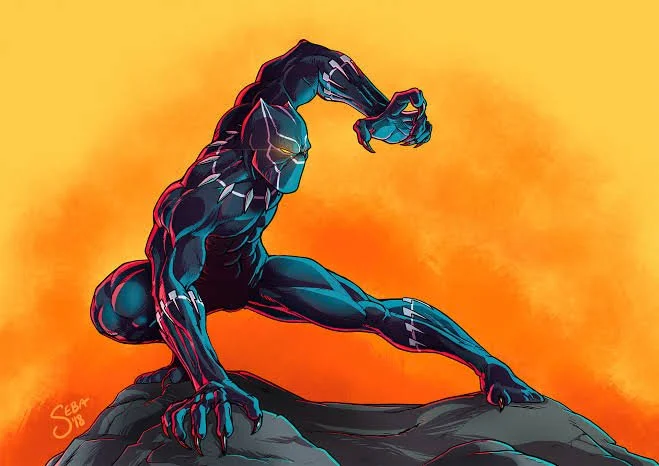
THE MOST IMPORTANT BLACK PANTHER COMIC IS FILED UNDER J.
Black Panther — 1966 to now, the run that hides in someone else's title, and where to start · Comic King
Black Panther — The Complete Comic King Guide
In July 1966, in the fifty-second issue of Fantastic Four, Stan Lee and Jack Kirby introduced a king named T'Challa who ruled a technologically advanced African nation that had never been colonised. He was the first Black superhero in American mainstream comics — not the first Black character, and not the first Black person to headline a comic, but the first with actual powers, in a mainstream book, as a hero. That is a genuinely significant comic and this page treats it as one. What this page also does, and what most Black Panther guides do not, is tell you where his best material is actually filed. Because the answer is not obvious, it is not under B, and it costs people money every week.
Quick Facts
Story: T'Challa, king of Wakanda — a technologically advanced African nation that was never colonised. A monarch and a scientist as much as a superhero, and the character Marvel most often uses to write about power rather than crime.
Length: Since July 1966 — but for his first eleven years he had no title of his own, and his best early material is in other people's books.
Status: Permanently in print in collected form. On the monthly rack the picture moves — see Screen & Series Status for where it stands right now.
Publisher: Marvel Comics
Age guide: Broadly fine for teenage readers and up. Panther's Rage is more violent and more serious than its era suggests, and the mid-1970s Klan storyline deals with racist violence directly — strong material, handled seriously, but worth knowing about before handing it to a younger reader.
Formats: Graphic novels and collections · the Penguin Classics edition · back issues · omnibus and Epic Collection tier by special order.
At Comic King: The collections faced out where general browsers walk, not buried in the Marvel alphabet — plus the back-issue hunt, and staff who know which of these books aren't shelved under B.
The Books That Don't Say Black Panther
Here is the thing to understand before you buy or sell anything on this page. Black Panther is a character whose most important comics are, over and over again, printed under somebody else's masthead. Not occasionally — as a pattern, across sixty years, and it is the single most useful piece of knowledge on this page.
HIS DEBUT IS IN FANTASTIC FOUR. Fantastic Four #52, July 1966. If you sort a collection by character, that book is not in the Black Panther box; it is in the Fantastic Four run, and anyone hunting for the first appearance of Black Panther by looking under B will never find it. The very next issue, Fantastic Four #53, carries his origin and the first appearance of Klaw, and it is routinely passed over because it is the ordinary-looking issue after the famous one.
HIS FIRST SOLO RUN IS IN A COMIC CALLED JUNGLE ACTION. This is the one that matters. In 1973, Marvel gave him a starring feature — not in a new title, but inside an existing reprint book with a name that has aged extremely badly. It files under J. It looks, on a shelf, like exactly the kind of low-value 1970s genre filler that gets bulk-priced without being read. And inside it is Panther's Rage, and inside Panther's Rage is the first appearance of Erik Killmonger, a character several hundred million people met in a cinema in 2018.
A note on that title, because customers do ask and it deserves a straight answer rather than an awkward one. 'Jungle Action' is a name that has not aged well, and we are not going to pretend otherwise. What happened is that Marvel put its first Black lead into an existing title rather than launching him a new one, and the name came with the title. What Don McGregor then did inside that book is one of the most serious and ambitious things Marvel published in the whole decade. Both of those facts are true at once, and the second one is why the comics are worth reading.
HIS FIRST SERIES DOESN'T EVEN FINISH IN ITS OWN TITLE. McGregor's follow-up arc, in which the Panther takes on the Ku Klux Klan, was running in Jungle Action when the book was cancelled mid-story. The conclusion eventually appeared years later in Marvel Premiere — a try-out anthology. So the ending of a Black Panther story is filed under M, in a title with no connection to him at all.
AND HIS SUPPORTING CAST DEBUTS SIDEWAYS TOO. The rival king M'Baku first appears in an issue of Avengers. Everett Ross — the government handler from the films — was created by Christopher Priest a year before Priest's Black Panther run began, in an issue of Ka-Zar.
The practical version of all this is short enough to memorise, and it is the standing habit at our counter: when a collection comes through the door, we search the Fantastic Four run, we search every Jungle Action, we search Avengers, and we do not bulk-price 1970s anthology titles. That habit is why we find things.
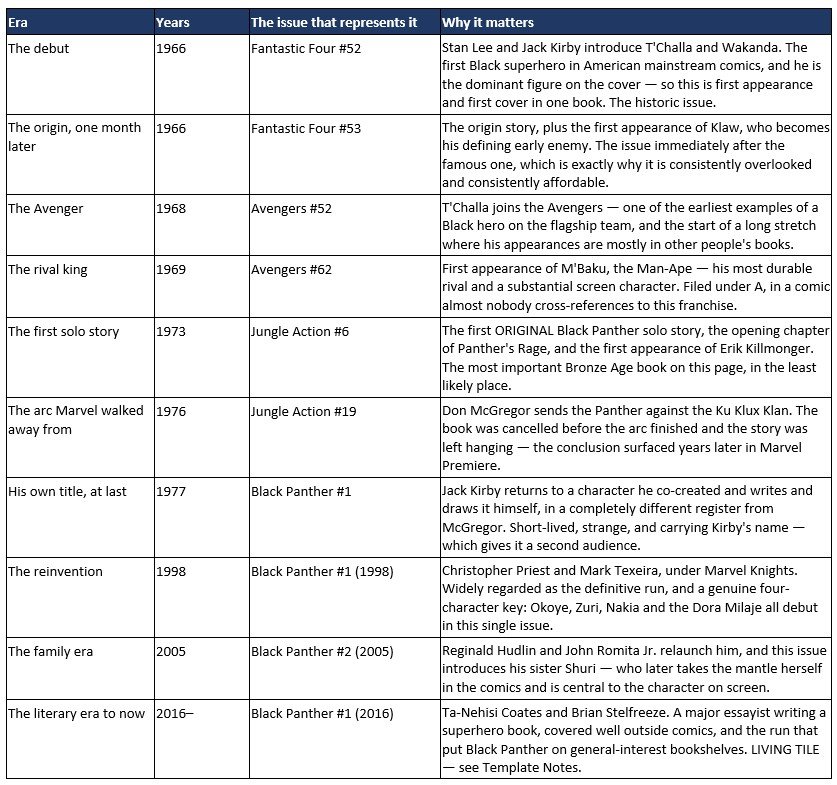
The Run, Era by Era
Sixty years, organised. Every era of the character, the one issue that represents it, and why collectors care.
Note how often the representative issue is in a comic that isn't called Black Panther:
The Keys — Issues Everyone Hunts
FANTASTIC FOUR #52 is the book. First appearance, first cover, July 1966, and one of the more historically significant single issues in the medium. It is a serious Silver Age key: raw mid-grade copies sit in the low hundreds and climb steeply through the grades into five figures at the top end. It also trades constantly — several ungraded sales a week across the market — which means comps are plentiful and there is no excuse for anyone quoting you a number out of thin air. Ask for the comps. We will show you ours.
JUNGLE ACTION #6 IS THE ONE WE TELL PEOPLE TO BUY. September 1973, Don McGregor and Rich Buckler. It is the first original Black Panther solo story and the first appearance of Erik Killmonger, and it currently sits in the middle-double-digits raw while selling roughly twice a week — important, affordable and genuinely liquid, which is a combination that does not come along often. High grade is a different animal entirely: this is a 1970s Marvel with fragile covers, and the jump from a nice mid-grade copy to a top-graded one is a factor of dozens, not a percentage. If you are buying one Black Panther back issue this year, we would point you here.
THE WHOLE SCREEN CAST IS STILL CHEAP, and that is the honest headline of this page. It surprises people. Nearly every Wakandan character the general public knows from the screen has a first appearance you can still buy for less than the cost of a dinner out, and most of them trade weekly. The Dora Milaje, Okoye, Nakia and Zuri all debut together in Black Panther #1 from 1998, one of the cheapest genuine four-character first appearances anywhere in Marvel. Shuri debuts in Black Panther #2 from 2005. M'Baku debuts in Avengers #62. Klaw and the origin are both in Fantastic Four #53. Every one of those is in the low tens of dollars raw. You could assemble the entire screen cast's first appearances for less than one mid-grade copy of the 1966 debut, and we think that is the most interesting buying fact on this page.
THE 1998 #1 DESERVES ITS OWN SENTENCE. It is one of the cheapest comics on this page and it holds four first appearances, and it is also the run everything on screen actually comes from. As an entry point it is close to unbeatable — the reading is excellent, the price is nominal, and the top-graded copies still move regularly, which makes it one of the more sensible grading candidates in modern Marvel.
BLACK PANTHER #1 FROM 1977 is the clean Bronze key: his first ongoing solo title, written and drawn by Jack Kirby. It carries a Kirby premium and sells about as often as anything on this page — roughly daily, market-wide — because it has two separate collector audiences bidding on it, Panther collectors and Kirby collectors. Worth knowing that Kirby only did the first twelve issues; the last three are Ed Hannigan and Jerry Bingham, and they are priced accordingly.
THE PANTHER'S RAGE RUN, Jungle Action #6 through #18, is one of the most satisfying small want-lists we can sell. Thirteen issues, historically important as a single continuous work, and — outside #6 — genuinely affordable. Someone can start it on a Saturday and realistically finish it. Add Marvel Premiere #51 to #53 on the end if they want the abandoned Klan arc's conclusion, which almost nobody knows exists and which costs very little.
REPRINT AND MIS-LISTING WARNINGS, because there are two specific ones here. First, Fantastic Four #52 exists as facsimile reprints and in oversized collected form; oversized is always a reprint, and a facsimile will say so in the indicia even when the cover looks identical. Check the indicia and the cover price, never a photo. Second, and this one is subtler: JUNGLE ACTION #5 IS FREQUENTLY LISTED AS A MAN-APE KEY. It is not. Issue #5 is the first issue where Black Panther takes over the title, but the story inside it is a reprint of Avengers #62 — so it contains the Man-Ape story without being the Man-Ape first appearance. It is a real and collectable book on its own terms, but if you are buying it as a first appearance, you are buying the wrong comic. The first appearance is Avengers #62, and it is cheaper.
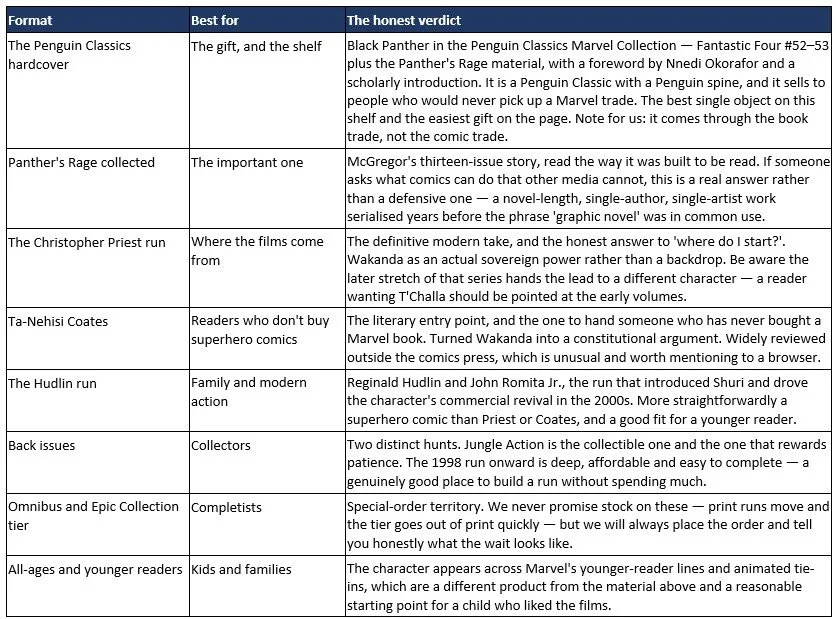
Every Format You Can Buy
Screen & Series Status
Updated August 2026: this franchise is in an unusual position, and it is worth being straight with customers about it.
ON THE PAGE: there is currently no ongoing monthly Black Panther solo series. The most recent ongoing concluded in 2024, the Ultimate Black Panther series ran its course, and the most recent solo book was a short limited series spinning out of a line-wide event. What Marvel did publish this year is a 60th Anniversary Special — an oversized one-shot marking sixty years since that 1966 debut, with several writers who have defined the character. That is already out, so it is a back-issue and reorder item rather than something to pre-order; we can order copies in while they remain available.
The honest read on this is that the shelf here is a collections-and-back-issues shelf right now rather than a monthly subscription one, and anyone wanting to follow him month to month is currently following him through team books. That will change — which brings us to the reason it will change.
ON SCREEN: a third Black Panther film has been announced, with Ryan Coogler returning to direct and the mantle passing to T'Challa's grown son, played by David Jonsson. Letitia Wright returns as Shuri and Winston Duke returns as M'Baku, and Denzel Washington has been cast in a role that has not been announced. It is set for December 2028.
THE EVERGREEN PLAYBOOK, which is what actually matters and which does not expire: ahead of any Black Panther film, the first appearances of whichever characters are confirmed in the cast are what move, and they move earlier than the collections do. The pattern is reliable and the lead time is long. The specific consequence of the current casting is that Shuri's and M'Baku's first appearances are the ones with a named reason to appreciate, and both are still inexpensive — which is exactly the window in which to buy, rather than after a trailer. When a film is announced, order the collections deep and pull the relevant first appearances out of the bins before the general market catches up.
Ask us for the current Marvel order form, or tell us which characters you are watching and we will keep an eye out on your behalf.
Collector's Corner — Grading, Care & We Buy
Three habits govern this character at our counter, and the first one is the one that actually finds money.
WE SEARCH THE ANTHOLOGIES, ALWAYS. When a collection comes in, Jungle Action gets pulled and checked issue by issue. So does the Fantastic Four run, so does Avengers, and so does Marvel Premiere. This is not us being thorough for the sake of it — it is because this specific franchise hides its keys in other titles more consistently than almost any character we handle, and a 1970s title that looks like filler is exactly where the good book is. If you are selling to us, you do not need to know any of this. Finding it is our job, and we would rather find it and tell you than have you learn about it afterwards from someone else.
WE COMP BEFORE WE QUOTE, on everything above the bin tier. Fantastic Four #52 gets authenticated and comped individually, every time, with no exceptions and no ballpark. Jungle Action #5 and #6 get pulled and comped and regularly surprise the person who brought them in. The 1977 Kirby issues get comped. Everything from 1998 onward is keys-pulled, remainder-to-bins, and we will say so plainly rather than dressing it up.
GRADING IS A SERVICE, NOT A SALES PITCH. We will tell you honestly when a book is worth submitting and, far more often, when it is not. On this franchise the maths is unusually clear at both ends: the 1966 and 1973 books have a very steep grade curve and a genuinely high-grade copy is worth the submission, while most of the 1998-onward material is worth more as a nice raw reading copy than as a graded one — with the notable exception of the 1998 #1, where top-graded copies still move regularly enough to justify it. We are happy to look at what you have and tell you which pile it is in.
Storing them: bag and board, boards behind the comic, upright in a proper box, off concrete floors and away from exterior walls. Edmonton basements swing hard on humidity between February and July and that swing is what does the damage, not age. If you have books in a basement right now, moving them upstairs is free and it is the single most useful thing you can do for them.
Selling: bring them in, or send us a list first if it is a large collection — we buy comics, and details are on our sell page at https://www.comickingedmonton.com/sell-your-comics.
FAQ - Straight Answers
What is the first appearance of Black Panther, and why can't I find it under B?
Fantastic Four #52, cover-dated July 1966, by Stan Lee and Jack Kirby. It is filed in the Fantastic Four run because it is a Fantastic Four comic — he is a guest in someone else's book, and he stays a guest for years afterwards. This is the single most common reason people miss it: they sort a collection by character, look under B, find nothing earlier than 1977, and conclude there is nothing there. He is also the dominant figure on that cover, leaping across the moon under a banner introducing him, so unusually for a debut of this age the first appearance and the first cover are the same book. While you are in that run, look at the very next issue too — Fantastic Four #53 carries his origin and the first appearance of Klaw, and it costs a fraction of what #52 does because it is the ordinary-looking issue after the famous one.
Where is Killmonger's first appearance?
Jungle Action #6, from September 1973, written by Don McGregor with art by Rich Buckler — and yes, that is a real comic and that is really its title. Marvel gave Black Panther his first starring feature inside an existing reprint-driven book rather than launching him a new one, so his first solo run is filed under J. It is the best-hidden Bronze Age key we deal with regularly. The same issue is also the first original Black Panther solo story and the opening chapter of Panther's Rage, so it is carrying three separate reasons to matter in one comic, and it is still affordable. One caution: the issue before it, Jungle Action #5, is often listed as a first appearance too. It isn't — the story in #5 is a reprint of an earlier Avengers issue, and the actual first appearance it contains belongs to that Avengers comic instead.
Where should I start reading Black Panther?
Start with Christopher Priest's run from 1998, then Ta-Nehisi Coates from 2016. That is the honest answer for almost everybody, and particularly for anyone who came to the character from the films — Priest is where the Wakanda you recognise comes from, and the first issue alone introduces four characters you already know. If you want the historically important one instead, that is Panther's Rage: thirteen issues of Jungle Action from 1973 to 1975, conceived and executed as a single novel-length story years before anyone was routinely using the phrase graphic novel, and widely credited with pioneering the long-form arc that the entire industry now runs on. It is collected, including in a Penguin Classics edition. And if you simply want the 1966 material, that is Fantastic Four — which is, as ever with this character, not a book with his name on it. All of these are on the shelf or can be special-ordered; just ask.