

THE BOOK MARVEL GAVE TO ITS BEST ARTISTS.
Silver Surfer — Kirby, Buscema, Moebius and Tradd Moore · the 18-issue run, the art books,
and the one key that isn't in a Silver Surfer comic · Comic King
Silver Surfer — The Complete Comic King Guide
Jack Kirby put him into a Fantastic Four issue in 1966 without being asked to, because — by his own account — he was tired of drawing spaceships. Stan Lee's first reaction was that Kirby had gone too far. Sixty years later the Silver Surfer is one of the most recognisable images Marvel owns, he has been drawn by Kirby, John Buscema, Moebius and Tradd Moore, and he has never once managed to hold down a comic of his own for long. That contradiction is the whole story of this shelf: a character everybody knows, whose own title was cancelled at eighteen issues for poor sales, which means the classic run was printed in smaller numbers than his fame would ever suggest. It also means an eighteen-issue Silver Age run is one of the few complete-the-set goals still realistically achievable in this hobby. Comic King carries the Surfer in Edmonton the way he should be sold — as an art shelf first: the Moebius and Tradd Moore books face-out, the Galactus Trilogy in trade, the 1968 run comped issue by issue, and honest help telling the film version from the comics one. If the book you want is not on the shelf, we can special-order or source it on request.
Quick Facts
Story: Norrin Radd of Zenn-La gave himself to Galactus as a herald to spare his own world, was exiled to Earth for turning on his master, and has spent sixty years being the most powerful character in the room and the least happy about it.
Length: Since March 1966 — but never in one place. A short 1968 run, a fifteen-year gap, a long 1987 series, and a string of minis and revivals since. Always ask which volume by YEAR.
Status: No ongoing series on the rack. The 2025 film brought a new audience and Marvel published a one-shot for them in June 2026 — the back issues and the art books are the business here.
Publisher: Marvel Comics
Age guide: Broadly all-ages in the classic material — cosmic, philosophical and violence-light, which makes him one of the easier Marvel characters to hand to a younger reader.
Silver Surfer: Black is more intense visually than thematically.
Formats: Graphic novels and art books · back issues across seven-plus volumes · the Galactus Trilogy trade · facsimiles of the two big keys
· Omnibus and Masterworks by special order.
At Comic King: The art books face-out where people can see them, a searched Silver Age section, and a straight answer about which comic the film character is actually in.
His First Appearance Isn't in a Silver Surfer Comic
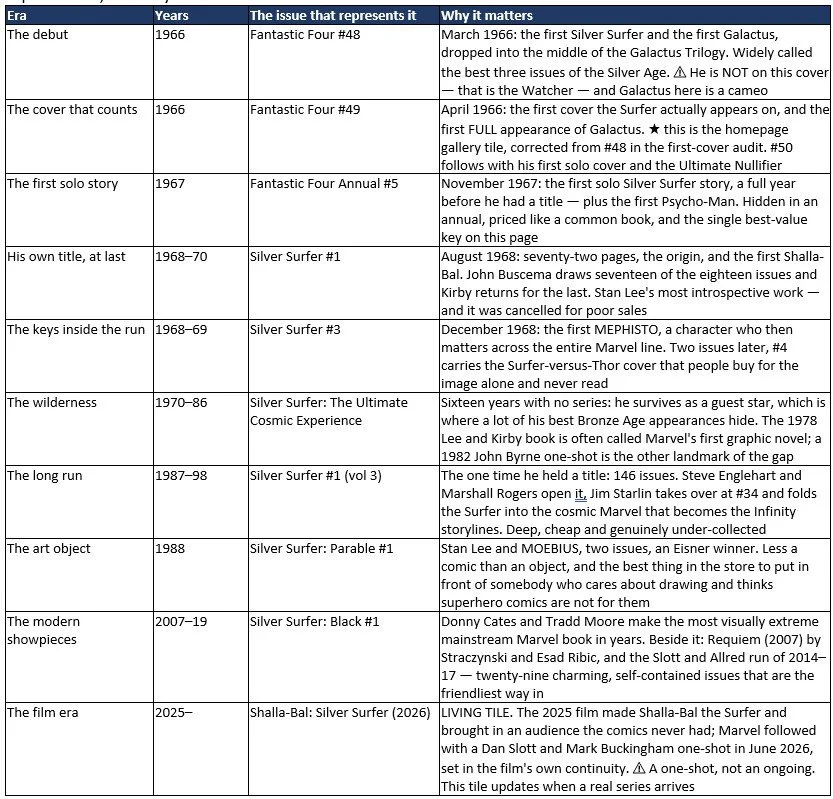
This is the thing to get right before you buy anything on this page, and it catches almost everybody. The Silver Surfer debuts in FANTASTIC FOUR #48, March 1966, in the middle of the three-issue Galactus Trilogy — not in a comic with his name on it. His own title would not exist for another two and a half years. That single issue is the first Silver Surfer and the first Galactus, which is why it belongs to two shelves at once and why every Fantastic Four collection that comes through our door gets checked for it. Now the part that saves money. The market splits hairs on the Galactus half, and the hairs are worth hundreds of dollars: Galactus only appears at the very end of #48, so collectors treat that as the CAMEO and treat FANTASTIC FOUR #49 as his first FULL appearance. #49 also happens to be the first cover the Surfer actually appears on — #48's cover belongs to the Watcher — and #50 gives him his first solo cover. So the honest answer to "which one do I need" depends entirely on what you are collecting, and #49 costs meaningfully less than #48 while being the better Galactus book. And then there is the issue nobody mentions. FANTASTIC FOUR ANNUAL #5, from November 1967, contains the FIRST SOLO SILVER SURFER STORY — a year before his own series launched — along with the first appearance of Psycho-Man. It sits in an annual, which is where collectors habitually stop looking, and it trades for about the price of a new hardcover while selling steadily every week. That is the same trap the Avengers and Fantastic Four pages already warn about, and this is the third book in it. SILVER SURFER #1 finally arrives in August 1968: seventy-two pages, John Buscema drawing, the full origin, and the first Shalla-Bal — a name worth remembering, because it is now the name of the character in the films.
The Run, Era by Era
Sixty years across seven volumes and no single spine, organized. Every era of the Silver Surfer, the one issue that represents it, and why collectors care:
The Keys — Issues Everyone Hunts
FANTASTIC FOUR #48 is the franchise key and it is not a Silver Surfer comic — first Surfer, first Galactus, and it sells several times a week nationally at a few hundred dollars raw, climbing hard through the grades. It is the most liquid Silver Age key we deal with on this side of the store, which also means the comps are excellent and there is no excuse for guessing at a price. FANTASTIC FOUR #49 is the one more people should be buying: first full Galactus, the first cover with the Surfer on it, and consistently cheaper than #48 despite selling just as often. FANTASTIC FOUR ANNUAL #5 is the buy of the page — the first solo Surfer story and the first Psycho-Man, for roughly the price of a new hardcover, moving about twice a week. Almost nobody asks for it by name. SILVER SURFER #1 from 1968 is the most-hunted book with his name on the cover: the origin, the first Shalla-Bal, and a genuinely remarkable liquidity profile — raw copies sell somewhere in the world about once a day. SILVER SURFER #3 is the first Mephisto and is the run's other real first appearance, worth more than people expect for a book they think of as a mid-run issue. SILVER SURFER #4 is the Buscema Thor cover, bought for the image, and it sits right alongside #1 in price — a rare case of a cover key holding its own against an origin issue. The rest of vol 1 carries real value in grade, and here is the honesty that earns trust with a seller: this run was CANCELLED for poor sales, so the print run is smaller than the character's fame implies. Reputation usually inflates scarcity; here it understates it. Below all that, vol 3's 146 issues from 1987 to 1998 arrive in bulk, cost very little, and read well — we buy them, price them to move, and check the Starlin stretch for the Infinity crossover issues. Two warnings made of money: FF #48 and Silver Surfer #1 both exist as clearly-labelled facsimile editions and inside oversized reprint collections, and oversized always means reprint; and modern minis were printed in modern numbers, so on those it is a high grade or nothing.
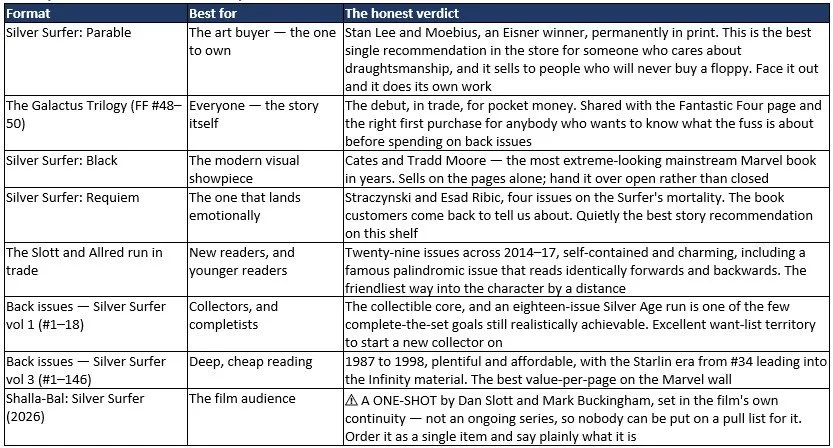
Every Format You Can Buy
Screen & Series Status
Updated August 2026: the Silver Surfer is having the strangest moment of his sixty years, and handling it honestly is worth more than any display. The 2025 Fantastic Four film made the Surfer a woman — Shalla-Bal, played by Julia Garner — and it worked: the film became the highest-grossing Fantastic Four movie made, and it brought in an audience for a character whose classic comics are mostly cheap. Marvel followed it in June 2026 with a Shalla-Bal one-shot by Dan Slott and Mark Buckingham set in the film's own continuity. There is no ongoing Silver Surfer series on the rack, and we are not going to pretend one is coming. What this means at the counter is a routing problem, and it is the single most useful thing on this page: someone who saw the film wants the character they saw, and in the original comics Shalla-Bal is the Surfer's lost love from his origin story, not the Surfer. Saying that clearly, and then offering both the new one-shot and the 1968 issue she first appears in, is the difference between a happy customer and a returned comic. His demand has always tracked whatever cosmic story is running rather than any solo project, so the reliable play is to keep the art books face-out year-round and stage the Galactus Trilogy beside them whenever the cosmic corner of the films is in the news. Exact release dates for anything upcoming live in our ordering calendar, not on this page.
Collector's Corner — Grading, Care & We Buy
Four habits govern this character at our counter. THE FANTASTIC FOUR CHECK RUNS BOTH WAYS, and it is the most valuable one: the Surfer's first appearance lives in somebody else's title, so when a Surfer collection comes in we ask about Fantastic Four, and when an FF collection comes in the Surfer customer is who #48 is for. One book, two walls, and sellers routinely do not connect them. The second is THE SCARCITY HONESTY, which is unusual enough to be worth saying out loud: the 1968 run was cancelled for poor sales, so it was printed in smaller numbers than the character's reputation suggests. Almost every other famous run in this store is the opposite — famous, therefore over-printed. We tell sellers that, because it usually works in their favour and because being the shop that volunteers it is how we end up buying the next collection too. Third, GRADE DOES BRUTAL WORK ON THESE COVERS. Late-sixties newsstand paper carrying big flat areas of silver and black shows every crease, every spine tick and every bit of colour-break, so high grade on vol 1 is genuinely scarce against the print run and the price ladder climbs steeply. We grade conservatively and we broker the top of the market rather than shelf-pricing it. Fourth, THE CAMEO-VERSUS-FULL DISTINCTION on Galactus in Fantastic Four #48 and #49 is a real pricing difference and we will explain which one you have rather than letting you assume. Beyond those: facsimiles and oversized reprints of both big keys are in wide circulation and are clearly labelled once you know to look, modern minis were printed in modern numbers and we will say so, and vol 3 is cheap and always will be. Key prices move constantly, so we buy and price against live sold comps — ask and we will pull them up on screen together.
FAQ - Straight Answers
What is the Silver Surfer's first appearance?
Fantastic Four #48, cover-dated March 1966 — not a Silver Surfer comic, which surprises most people. He turns up in the middle of the Galactus Trilogy, the three-issue story that runs from #48 to #50 and is often called the high point of the Silver Age, and his own title did not launch until August 1968. A few details are worth knowing before you spend anything. He is not on the cover of #48 — that is the Watcher — so the first cover he actually appears on is #49, which is also the first FULL appearance of Galactus, since Galactus only shows up right at the end of #48. #50 gives the Surfer his first solo cover. And his first solo STORY is in Fantastic Four Annual #5 from 1967, a year before his series started, which is a book most collectors walk straight past. If you want the story rather than the investment, the Galactus Trilogy is collected in trade for very little money. If you want the first book with his name on it, that is Silver Surfer #1 from August 1968 — the origin issue, and a strong key in its own right.
The Silver Surfer in the movie is a woman — which comics is she in?
She is Shalla-Bal, and this is the most common conversation we have about this character, so here is the straight version. In the original comics the Silver Surfer is Norrin Radd, and Shalla-Bal is the woman he left behind on his home world when he became Galactus's herald — she first appears in Silver Surfer #1 in 1968, but she is a character in his origin, not the Surfer herself. The 2025 film made her the Surfer, and Marvel published a Shalla-Bal one-shot in June 2026 set in the film's own continuity, so the version you saw does now exist in print. What does not exist is a long run of classic comics starring her — and we would much rather tell you that before you buy a stack of 1968 issues expecting to find her in them. If you want the character from the film, the one-shot is the book, and we can order it. If you want to know where she came from, Silver Surfer #1 is where the name starts.
Where should I start reading the Silver Surfer?
It depends on what you actually want, and the honest answer is that this character rewards starting with a book rather than a series — he has never had one long run to work through. If you want the famous story, start with the Galactus Trilogy in trade: three issues from 1966, cheap, and the reason anyone cares. If you want something beautiful, Silver Surfer: Parable is Stan Lee written over Moebius artwork, it won an Eisner, and it is the book we hand to people who tell us they do not read comics. If you want to be emotionally ambushed, Silver Surfer: Requiem. If you want something modern and easy to keep up with, the Slott and Allred run from 2014 is self-contained, funny and only twenty-nine issues. And if you want the deep end for very little money, the 1987 series ran 146 issues and can be bought by the armful. What we would not start you on is the 1968 run — it is the collectible one, it is priced accordingly, and it is a better second purchase than a first.