
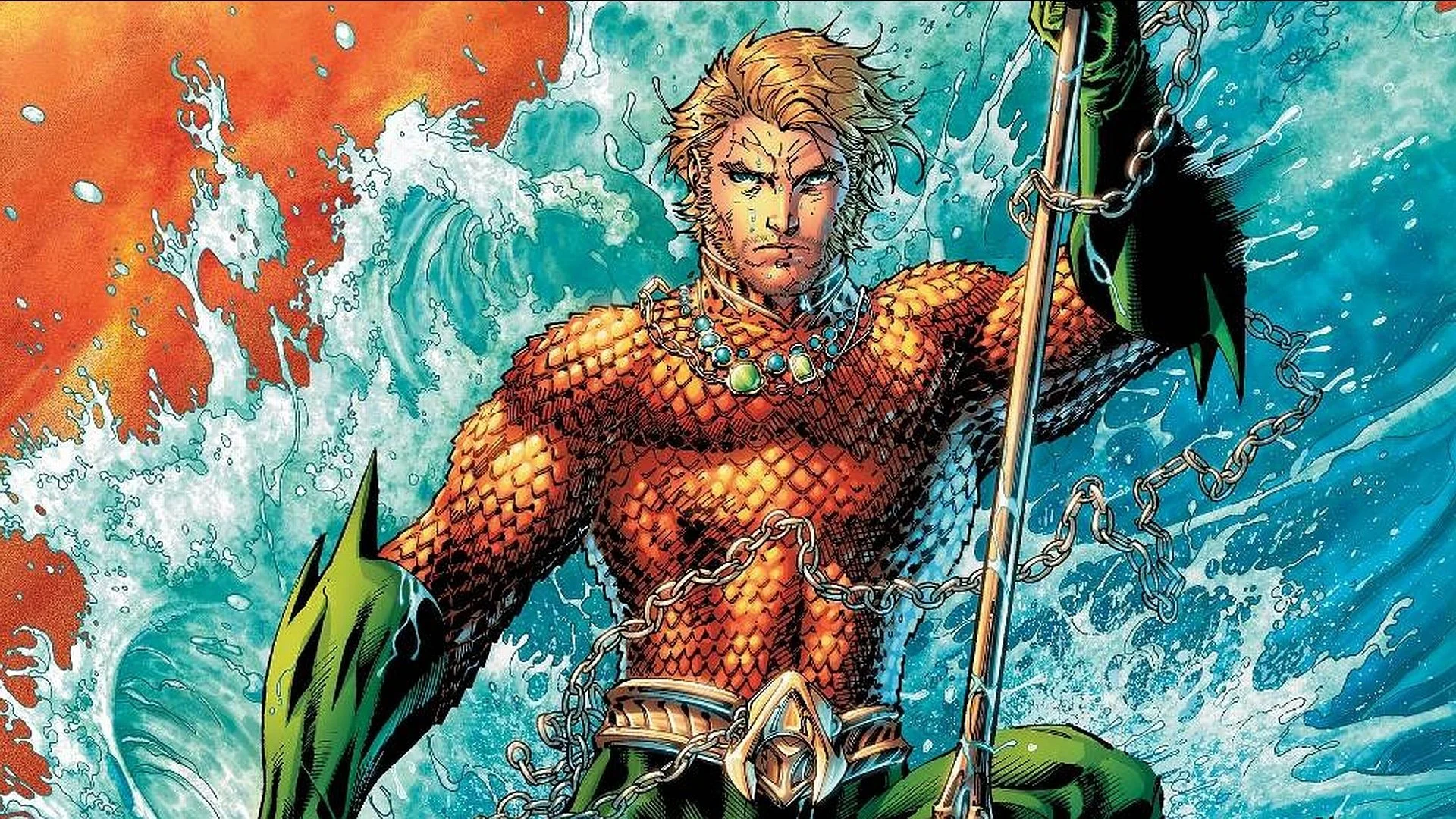
HE WAITED NINETEEN YEARS
FOR A COVER.
Aquaman — 1941 to now, the Silver Age run that holds all the keys, and where to start · Comic King
Aquaman — The Complete Comic King Guide
Aquaman has been published continuously since November 1941, which almost no Golden Age character managed — most of them were cancelled outright when the superhero boom collapsed after the war. He survived. What he did not get, for nineteen years, was a cover. He spent the whole of that time as a back-up feature inside other people's comics, and that single fact explains almost everything a collector needs to know about him: where his early material is filed, why it is so easy to miss, and why the keys people actually chase are not where they expect them to be. He is also the character with the worst public reputation to overcome of anyone on this wall, and we are not going to join in with that. He rules two thirds of the planet, and the best runs of the last thirty years are specifically about people underestimating him.
Quick Facts
Story: Arthur Curry — king of Atlantis, ruler of roughly two thirds of the planet's surface, and a founding member of the Justice League.
The modern runs are built around people underestimating him.
Length: Continuously published since November 1941 — one of very few Golden Age heroes never to be cancelled outright — but a back-up feature for the first two decades of it.
Status: Currently publishing monthly. The book has changed its title mid-run without restarting its numbering — see Screen & Series Status.
Publisher: DC Comics
Age Guide: Broadly all-ages friendly and one of the easier DC characters to hand to a younger reader.
The 1990s Peter David era is notably darker and more violent than the rest — worth flagging to a parent.
Formats: Graphic novels and collections · back issues · the current monthly · omnibus and Absolute tier by special order.
At Comic King: The Johns and Peter David collections faced out, the 1960s run in the back-issue boxes, and staff who will not make the fish joke.
Nineteen Years Before Anyone Put Him on a Cover
This is the thing that makes Aquaman different from every other character on this site, and it is worth going through carefully because it is the reason his books hide.
HE DEBUTS IN 1941 AS A BACK-UP, IN AN ANTHOLOGY. More Fun Comics #73, November 1941, by Paul Norris and Mort Weisinger. He is not on that cover. He is a supporting strip inside a comic named after nothing in particular, and he stays a back-up feature — through More Fun Comics to issue #107, then across to Adventure Comics from 1946, where he sits behind Superboy for another fifteen years. Two decades of continuous publication without a title of his own.
THAT DEBUT ISSUE IS A DOUBLE KEY, AND IT HIDES TWICE OVER. More Fun Comics #73 is the first appearance of Aquaman AND the first appearance of GREEN ARROW. Two DC characters who are still headlining today, in one 1941 comic, and neither of them is on the cover. It files under M, for More Fun. A Golden Age collection sorted by character will not surface it at all, and that is exactly why we search every More Fun run that comes through the door.
HIS FIRST COVER IS ON SOMEBODY ELSE'S DEBUT. When he finally does appear on a cover, in early 1960, it is not his own comic and it is not a solo shot — it is BRAVE AND THE BOLD #28, the issue that introduces the Justice League of America. He is in the middle of the fight with Starro along with Wonder Woman, the Flash, Green Lantern and the Martian Manhunter. So the first time the public sees Aquaman on the front of a comic, he is one of seven, on a book that is famous for something else entirely, and which is priced and traded as a Justice League key rather than an Aquaman one.
HIS FIRST SOLO COVER IS THE ONE IN OUR GALLERY. That comes a year later, in SHOWCASE #30, January 1961 — DC's try-out anthology, where the company tested whether he could carry a book on his own. He could, and his own title followed within twelve months. Showcase #30 is a genuine and separately traded key, and it is the cover we use to represent him.
★ AND SHOWCASE IS NOW A THREE-CHARACTER HABIT. Showcase #4 is the Silver Age Flash. Showcase #22 is the Silver Age Green Lantern. Showcase #30 to #33 are Aquaman's solo try-out. One modest anthology title holds three of the most significant DC keys of the era and its masthead names none of them. If you learn one search habit from this page, learn that one.
The practical shape of all this: his first appearance is under M, his 1946–61 material is under A for Adventure, his sidekick's first appearance is under A as well, his first cover is under B for Brave and the Bold, and his first solo cover is under S for Showcase. The only place you will not find early Aquaman is filed under Aquaman.
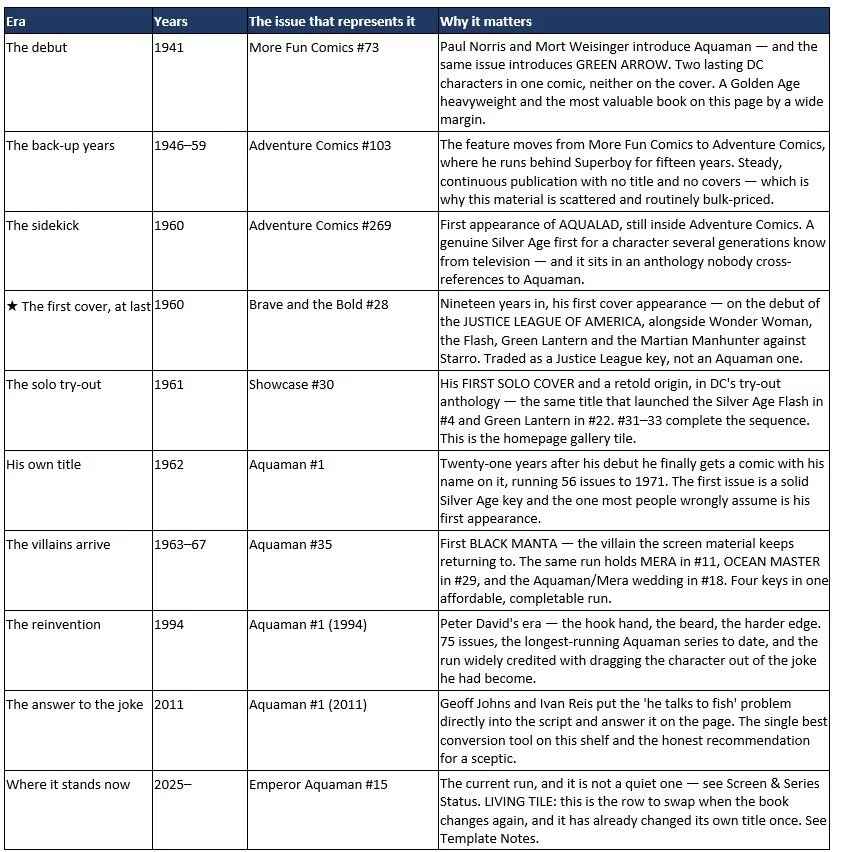
The Run, Era by Era
Eighty-five years, organised. Every era, the one issue that represents it, and why collectors care.
Note how far down the table you have to get before the issue is actually called Aquaman:
The Keys — Issues Everyone Hunts
MORE FUN COMICS #73 is the big one, and it is broker territory rather than shelf stock. First Aquaman and first Green Arrow, November 1941. Raw copies run into four figures and a mid-grade graded copy runs into five, but the number that actually matters is the frequency: it sells roughly twice a YEAR across the whole market. That is not a book you price off a memory of what one went for. It is authenticated, graded and brokered, every time, and anyone who quotes you a confident number on the spot is guessing.
THE 1960s RUN IS WHERE THE VALUE ACTUALLY IS FOR MOST PEOPLE, and this is the part of the page worth reading twice. Aquaman's own title from 1962 to 1971 holds four separate keys, all of them affordable, and every one of them trades roughly once a week — which is unusually liquid for Silver Age DC. AQUAMAN #29 is the first OCEAN MASTER, and he is the villain of the 2018 film; it is the cheapest of the four and we think the best buy on the page. AQUAMAN #35 is the first BLACK MANTA, the most famous of them and the one that moves hardest on any screen news; it costs roughly two and a half times what Ocean Master does. AQUAMAN #11 is the first MERA, and she has grown steadily more important to the character over the last fifteen years. AQUAMAN #18 is the wedding issue — more on that below.
★ ADVENTURE COMICS #269 IS THE ONE PEOPLE MISS. First appearance of AQUALAD, February 1960, and it sits inside Adventure Comics where nobody looking for Aquaman material will think to check. It is one of the cheaper Silver Age firsts we handle, it sells about weekly, and it is a character two or three generations know from television. If you want a single quiet recommendation from this page, that is it.
SHOWCASE #30 IS THE GALLERY BOOK, AND IT IS THE LEAST LIQUID OF THE KEYS — which is worth saying out loud. It is his first solo cover and a retold origin, it is a real Silver Age key, and it costs more than any of the villain firsts. But it sells around twice a month rather than weekly, so it takes longer to move and the comps are thinner. Buy it because you want it, not because you expect to flip it quickly.
AQUAMAN #1 from 1962 sits above the villain keys on price and is the issue most people assume is the first appearance. It isn't — that is twenty-one years earlier — but it is a clean, well-known Silver Age first issue that trades about weekly, and it anchors the run nicely.
AQUAMAN #18, from December 1964, is the one with the story attached. Aquaman and Mera marry, and it is generally credited as the first superhero wedding shown on the page in comics — the qualifier matters, and we will use it honestly. It is a historical curiosity rather than a serious value key, it costs very little, and it sells itself the moment you tell somebody what it is.
REPRINT AND GRADING WARNINGS. More Fun Comics #73 exists in oversized reprint and facsimile form; oversized is always a reprint, and a facsimile declares itself in the indicia. Check the indicia and the cover price, never a photo. And a specific caution on the graded ladders here: on several of these books the sample sizes at the top grades are so small that the published averages misbehave — Aquaman #35's near-perfect tier currently prints out of order for exactly that reason. We comp the grade you actually have, not the grade above it.
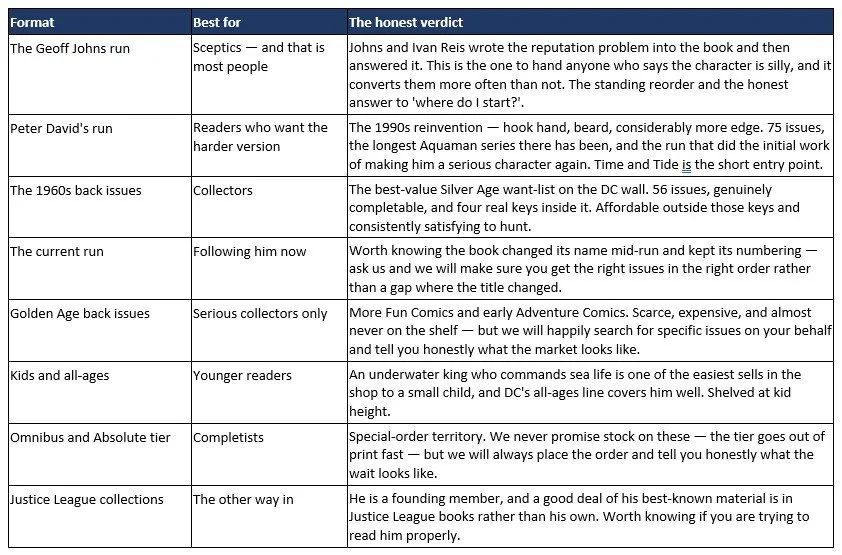
Every Format You Can Buy
Screen & Series Status
Updated August 2026: there is more going on here than usual, and it points in a useful direction for anyone buying.
ON THE PAGE: the current run is the loudest Aquaman book in years. It launched in January 2025, and from issue #15 in March 2026 it changed its title to EMPEROR AQUAMAN while keeping its numbering — same creative team, same series, new name. The character has reclaimed the Atlantean throne, absorbed his wife Mera's water powers, become the self-styled Avatar of the Blue after defeating a water god, taken up a new weapon, and picked up a very large cosmic power source that has pushed the book off the ocean floor and into space. It ties into DC's current line-wide events. Whatever you think of that direction, it is not the sleepy Aquaman book people expect, and it is the reason to actually ask what is on the rack rather than assume. Tell us if you want it on a pull list.
ON SCREEN: this is a quiet moment, and quiet moments are when you buy. DC's film universe is being rebuilt from Superman outward; Jason Momoa's version of the character is no longer part of the continuity going forward and he has been recast in a different DC role entirely, which means Aquaman himself will be recast at some point rather than continuing. No new Aquaman film has been dated.
THE EVERGREEN PLAYBOOK, which does not expire: this character's keys have historically been softer than equivalent DC characters because of the joke, and they correct sharply and quickly whenever he is on screen. The 2018 film moved them hard. So the window to buy is precisely now, while nothing is announced — not after a trailer. Ahead of ANY Aquaman screen window, the villain first appearances move first and move most, Black Manta hardest of all, because he is the villain adaptations keep returning to. Have those identified and in the case before the announcement, not after it.
Ask us for the current DC order form, or tell us what you are watching for and we will keep an eye out.
Collector's Corner — Grading, Care & We Buy
Four habits govern this character at our counter, and the first two are search habits rather than pricing ones.
WE SEARCH MORE FUN AND ADVENTURE, ALWAYS. His first appearance is in More Fun Comics, his first fifteen Silver Age years and his sidekick's debut are in Adventure Comics, and both titles get treated as anonymous old anthologies by people who are sorting a collection by character. If you are selling to us you do not need to know any of this — finding it is our job, and we would far rather find it and tell you than have you hear about it afterwards from somebody else.
WE CHECK EVERY SHOWCASE, AND WE CHECK IT AGAINST THREE NUMBERS. Showcase #4 is the Flash, #22 is Green Lantern, #30 to #33 are Aquaman. That one anthology title carries three of the biggest DC keys of the Silver Age and names none of them on its masthead. It is the single most valuable search habit on our DC wall.
WE ARE SCRUPULOUS ABOUT THE REPUTATION GAP, and this one is a fairness issue rather than a technique. Aquaman's keys sat below their equivalents for decades because of a joke that had nothing to do with the comics, and that gap has substantially corrected since 2018 — but the perception has not caught up, so people still walk in genuinely believing their Aquaman books are worthless. Some of them are holding a first Black Manta. We will tell you what you have. Trading on somebody's low expectations is not a business we are interested in being in.
WE COMP BEFORE WE QUOTE, on everything above the bin tier. More Fun Comics #73 gets authenticated, graded and brokered with no ballpark offered at the counter. Showcase #30 to #33 get comped individually and patiently, because they move slowly. Aquaman #1 to #56 get the keys pulled — #11, #18, #29 and #35 — and the rest is affordable and honestly priced. The 1990s Peter David run is bins, though the run itself is worth stocking as reading. Modern is bins.
Grading is a service, not a sales pitch: we will tell you when a book is worth submitting and, more often, when it is not. Storing them: bag and board, boards behind the comic, upright in a proper box, off concrete floors and away from exterior walls. Edmonton basements swing hard on humidity between February and July and that swing does the damage, not age. Selling: bring them in or send a list first if it is a big collection — details at https://www.comickingedmonton.com/sell-your-comics.
FAQ — Straight Answers
What is Aquaman's first appearance, and is it the same as his first cover?
No, and the gap is the biggest of any major character we handle. His first appearance is More Fun Comics #73, November 1941, by Paul Norris and Mort Weisinger — and he is not on that cover. He then spent nineteen years as a back-up feature, in More Fun Comics and then in Adventure Comics from 1946, without appearing on the front of a comic at all. His first cover appearance is Brave and the Bold #28 in early 1960, which is the debut of the Justice League — so he is one of a group, on a book famous for something else. His first SOLO cover comes a year later, in Showcase #30, and that is the one we use to represent him. One more thing worth knowing about that 1941 debut: it is also the first appearance of Green Arrow. Two major DC characters, one comic, neither on the cover.
Which Aquaman back issues are actually worth money?
The 1941 debut is in a different league from everything else and is a genuine investment-grade Golden Age book — but it trades only a couple of times a year, so it is brokered rather than sold off a shelf. For most people the real answer is his own title from the 1960s, which holds four keys that are all still affordable and all trade regularly: the first Mera, the first Ocean Master, the first Black Manta, and the wedding issue. Black Manta is the famous one and priced accordingly; Ocean Master is the villain from the film and costs considerably less, which makes it our pick. And one people consistently overlook — the first Aqualad is in Adventure Comics, not in an Aquaman comic at all, and it is one of the cheaper Silver Age firsts going. Bring anything in and we will comp it properly.
Is Aquaman actually any good, or is he a joke?
He is good, and the joke is a television artefact from the 1970s that the comics have spent thirty years answering. The short version: he is a king with responsibility for most of the surface of the planet, he is one of the physically strongest characters DC has, and the two runs that rebuilt his reputation — Peter David's in the 1990s and Geoff Johns' from 2011 — are both explicitly about people underestimating him. Johns is the one to start with, because he wrote it for exactly the reader asking this question; the fish jokes are in the book, and the book answers them. Start there, then go back to the 1960s run if you want the classic material. Everything mentioned here is on the shelf or can be special-ordered — just ask.