
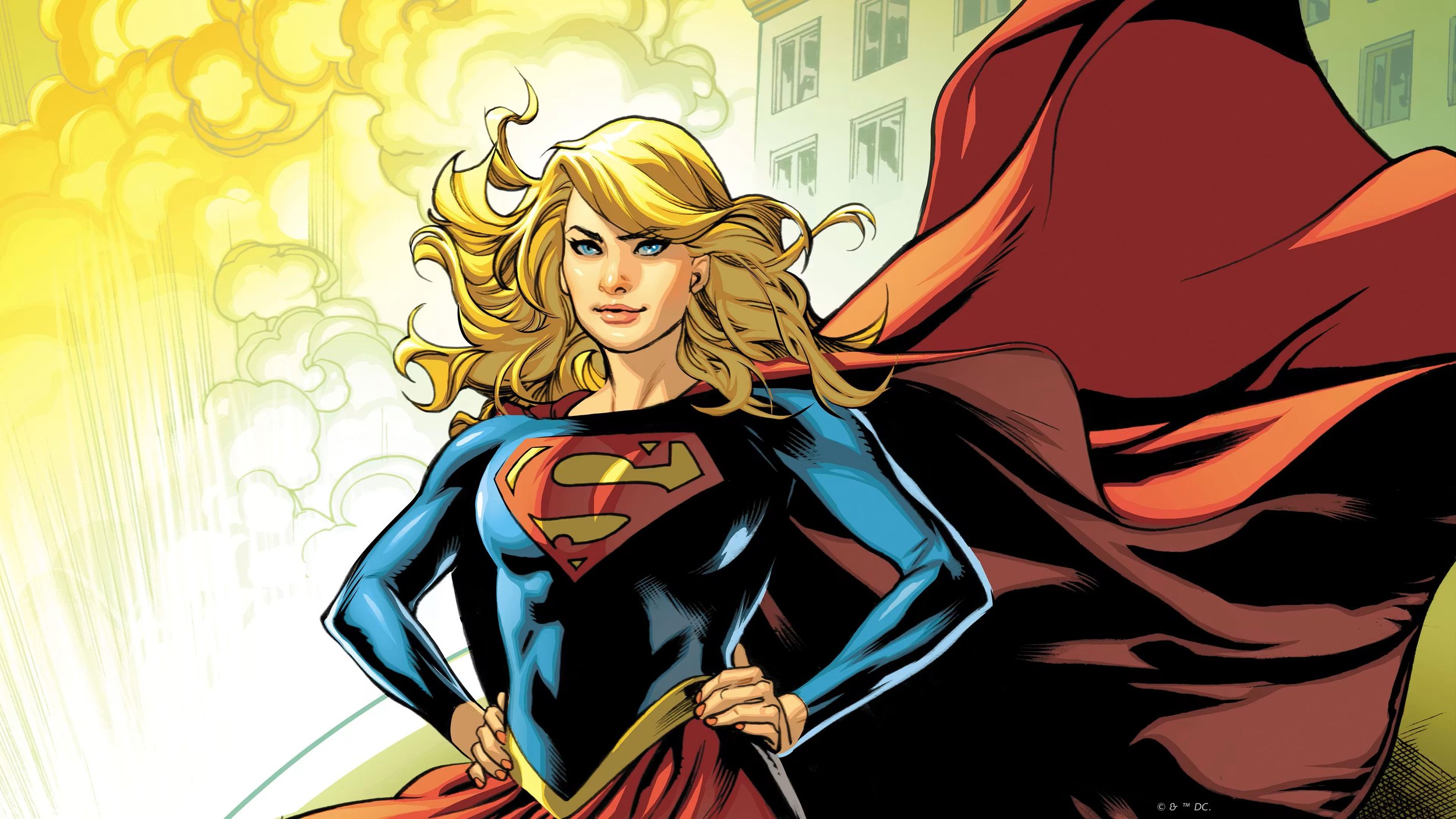
THERE ARE TWO FIRST SUPERGIRLS.
One of them is worth serious money and the other is not · Supergirl at Comic King
Supergirl — The Complete Comic King Guide
Supergirl has the strangest publishing history of any major DC character, and both of the strange parts cost people money if they do not know about them. There are two different comics from the late 1950s that can reasonably be called "the first Supergirl", published a year apart, and only one of them is the one collectors mean. And in 1985 DC killed her off deliberately, on purpose, as an editorial decision — and then did not publish her for nineteen years. That gap is why her back-issue run has a hole in the middle of it, and why she has never quite had the continuous presence her cousin has. Comic King carries Supergirl in Edmonton on both ends: the current series each week, and back issues from either side of the gap. If the issue you want isn't on the shelf, we can special-order or source it on request.
Quick Facts
Story: Superman's cousin, who survived Krypton too and arrived later — with all of his abilities and none of his certainty about what to do with them.
Length: Published since 1959, with a nineteen-year gap from 1985 to 2004 — see the era table.
Status: Ongoing — a new series written and drawn by Sophie Campbell has been running since 2025.
Publisher: DC Comics
Age Guide: Broadly all-ages — and one of DC's strongest characters for younger readers, particularly teenagers.
Formats: New issues · back issues · graphic novels · omnibus & Absolute editions.
At Comic King: New issues weekly, back issues from both eras, and we buy DC collections.
Two First Supergirls, and a Nineteen-Year Gap
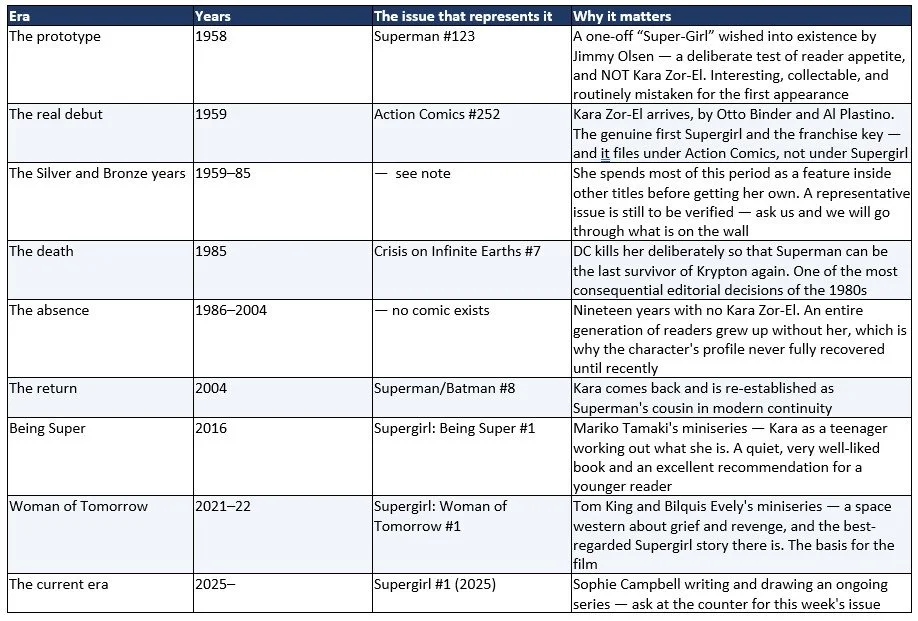
Here is the first thing, and it is where money changes hands wrongly. In August 1958, SUPERMAN #123 ran a story in which Jimmy Olsen wishes a "Super-Girl" into existence with a magic totem. She is not Kara Zor-El, she is not Superman's cousin, and she does not survive the issue — the whole thing was a deliberate test to see whether readers wanted a female counterpart. They did. Nine months later, in ACTION COMICS #252, cover-dated May 1959, Otto Binder and Al Plastino introduced the real one: Kara Zor-El, Superman's cousin, survivor of Krypton. That is the first Supergirl, and it is a genuine Silver Age key. Superman #123 is a collectable and interesting comic, but it is not the same thing and it is not worth the same, and sellers get those two confused in both directions. Here is the second thing. In 1985, DC decided that Superman needed to be the sole survivor of Krypton again, so in CRISIS ON INFINITE EARTHS #7 they killed her — properly, and meaning it. She stayed gone for NINETEEN YEARS, not returning until Superman/Batman #8 in 2004. Almost no major character in comics has an absence like that. It is why her back-issue run has a two-decade hole, why her keys behave differently from her cousin's, and why a lot of people who grew up in the 1990s have no memory of her at all.
The Run, Era by Era
Sixty-seven years with a gap in the middle, organized. Every era, the one issue that represents it, and why collectors care:
The Keys — Issues Everyone Hunts
Action Comics #252 is the book. It is Kara Zor-El's first appearance, a major Silver Age key, and it moves whenever Supergirl reaches a screen — but it files under ACTION COMICS, which means it sits with the Superman material rather than with hers. Anyone working through a collection looking for Supergirl comics will not find it there, and anyone selling a Superman run may not realise what is in it. We check every Action Comics run that comes through the door, and it is worth doing carefully because that title also contains Action Comics #1 and #23 and #242 — one masthead, four significant keys across three decades. Superman #123 from August 1958 is the prototype issue and it is genuinely collectable, but it is a different comic at a different price and we will always establish which one is meant before quoting. Crisis on Infinite Earths #7 is her death issue and it files under Crisis, not Supergirl — the same cross-title problem the Flash page has with Crisis #8. Superman/Batman #8 from 2004 is her return and an affordable, meaningful modern key. Woman of Tomorrow #1 from 2021 is modern and plentiful but genuinely sought after on the strength of the story. And the standing authentication rule applies to the Silver Age books: facsimiles and oversized reprints exist, and if it is oversized, it is a reprint, always. Key prices move constantly, so we buy and price against live sold comps — ask and we will pull them up on screen together.
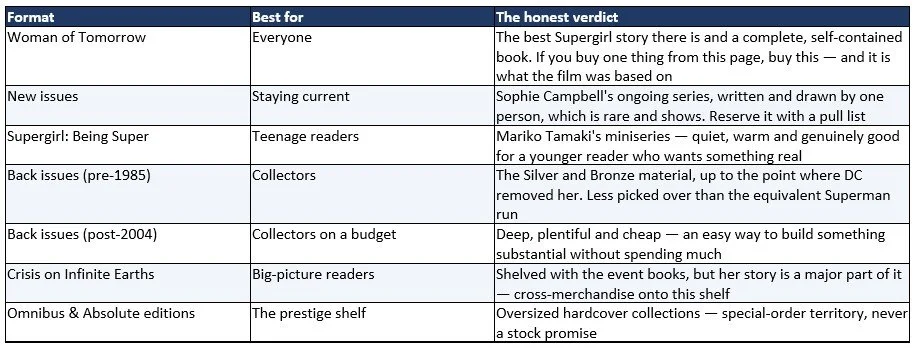
Every Format You Can Buy
Screen & Series Status
Updated August 2026: the Supergirl film arrived in cinemas at the end of June 2026, directed by Craig Gillespie and starring Milly Alcock, adapting Tom King and Bilquis Evely's Woman of Tomorrow. We will be straight with you about it, because you will hear otherwise elsewhere: reviews were mixed and it opened well below expectations commercially. What that means practically is that the demand bump from this film has largely already happened, and it was smaller than the industry expected — so this is not the moment to buy Supergirl keys on the assumption that a film is about to move them. What has NOT changed is that Woman of Tomorrow is an excellent comic, and adaptations create readers regardless of box office. The 2010 Scott Pilgrim film underperformed badly in cinemas and has been selling those books steadily ever since. We expect the same here, and we stock accordingly. On the page, Sophie Campbell's series continues.
Collector's Corner — Grading, Care & We Buy
Two habits matter here and both are about where things are filed rather than what they are worth. The first: Supergirl's first appearance is in ACTION COMICS, and her death is in CRISIS ON INFINITE EARTHS. Neither says Supergirl on the masthead. A collection sorted by character will file both somewhere nobody looking for her will check, and a seller can genuinely believe they own nothing of hers while holding her two most significant issues. We search Action Comics and Crisis runs in every DC collection we are offered, as a matter of routine. The second: we establish which 1958-or-1959 book is being discussed before any number is spoken. Superman #123 and Action Comics #252 are different comics with different values, and the confusion runs in both directions — we have seen people undervalue the real one and overvalue the prototype. Neither is a good outcome, and thirty seconds of checking prevents both. On condition, the usual Silver Age reality applies: 1950s and 1960s newsprint has usually aged, most survivors are mid-grade at best, and that is normal rather than a problem. We grade honestly, assess keys in front of you with live comps on screen, broker CGC submissions for slab-worthy books, and stock the bags, boards and boxes that keep a collection worth grading.
FAQ - Straight Answers
Which comic has the first Supergirl — Superman #123 or Action Comics #252?
Action Comics #252, cover-dated May 1959. That is Kara Zor-El, Superman's cousin and survivor of Krypton, created by Otto Binder and Al Plastino, and it is the issue collectors mean when they say the first Supergirl. Superman #123, from August 1958, is a different thing: a one-off story in which Jimmy Olsen wishes a "Super-Girl" into existence using a magic totem. She is not Kara, she is not related to Superman, and she does not last the issue — DC ran it as a test to see whether readers would want a female counterpart. They clearly did, and the real character followed nine months later. Superman #123 is a genuinely interesting and collectable comic in its own right. It is not the first Supergirl, and it is not valued as though it were. If you have either one, bring it in and we will identify it properly and show you live sold comps.
Did Supergirl really die, and why was she gone for so long?
Yes, and it was a deliberate editorial decision rather than a story that got reversed a year later. In Crisis on Infinite Earths #7, published in October 1985, Kara Zor-El sacrifices herself saving her cousin and the multiverse. DC wanted to rebuild Superman as the sole survivor of Krypton, and that meant she could not exist. She was not published again — not as Kara — until Superman/Batman #8 in 2004. That is nineteen years, which is close to unheard of for a character of her standing, and it has real consequences. Her back-issue run has a two-decade hole in the middle. Readers who grew up in the 1990s often have no memory of her at all. And it is a large part of why her modern profile took so long to recover, despite her being one of DC's oldest and most recognisable characters.
I saw the Supergirl film — which comic is it based on?
Supergirl: Woman of Tomorrow, a 2021 miniseries by Tom King and Bilquis Evely. It is genuinely one of the best superhero comics of the last decade — a space western about grief, revenge and what it costs to be the person who does the right thing, told largely from the point of view of an alien girl who hires Supergirl to help her. Evely's artwork is extraordinary. It is complete in one collected volume, requires no prior reading whatsoever, and it works perfectly well for someone who has never picked up a comic. It is also, in our honest opinion, considerably better than the film — which is not a criticism of the film so much as a reflection of how good the book is. We keep it stocked, and it is our first recommendation on this page by a distance.