
HE TOOK A SIDE NINE MONTHS BEFORE THE COUNTRY DID
Captain America — 1941 to the current run, and the keys hiding in other titles · Comic King
Captain America — The Complete Comic King Guide
In March 1941 — nine months before Pearl Harbor — Joe Simon and Jack Kirby put a brand-new character on a cover punching Adolf Hitler in the jaw. A superhero comic took a political side before the country did, and that single image made Captain America Comics #1 one of the most valuable and most recognized comics ever printed. What happened next is stranger than most people know: Cap's title collapsed with the whole superhero market in 1950, he vanished for roughly fifteen years, and when Marvel thawed him out in 1964 his comeback landed in a different comic entirely. That is the thing to understand about collecting this character — his biggest keys keep turning up under other names, and knowing where to look is most of the game. Comic King carries Captain America in Edmonton across all of it: this week's issues, an honest Silver and Bronze Age wall, the collections the films were built from, and proper handling for anything Golden Age that walks in. If the book you want isn't on the shelf, we can special-order or source it on request.
Quick Facts
Story: A 1941 super-soldier frozen at the end of his war and thawed into the modern age — the man out of time who became Marvel's conscience, and whose shield has passed to other hands more than once.
Length: Since March 1941 — with a fifteen-year gap (1950–64) in the middle — then continuously since 1964, across seven-plus numbered volumes.
Status: Ongoing — a new volume launched July 2025 with Steve Rogers as lead (Chip Zdarsky and Valerio Schiti), tied into Marvel's Doom storyline.
Publisher: Marvel Comics — the 1940s issues carry the TIMELY logo, which is your fastest Golden Age tell.
Age guide: One of the easiest superheroes to hand a child — Marvel's all-ages line covers him separately; the main line is standard teen fare.
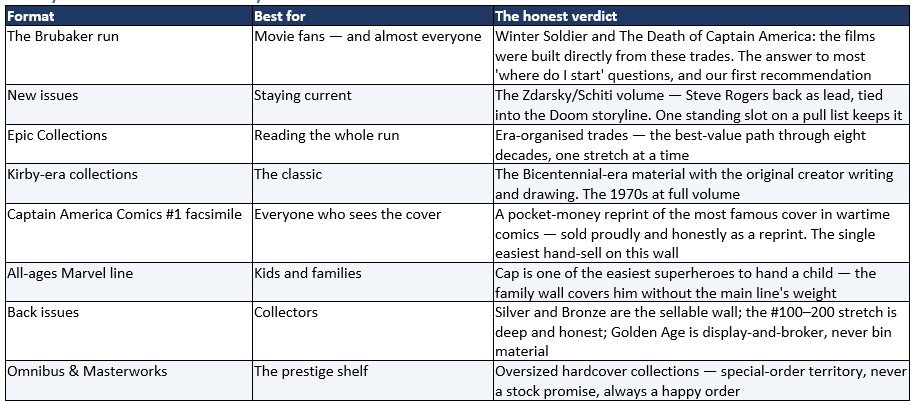
Formats: New issues · back issues · the Brubaker trades · Epic Collections · Kirby-era collections · omnibus editions · the Captain America Comics #1 facsimile.
At Comic King: New issues weekly, a real Silver-and-Bronze wall, Golden Age handled as broker material — and we always search the Avengers boxes, because his biggest Silver Age key hides there.
The Fifteen-Year Gap — and Why His Biggest Keys Aren't in His Own Comic
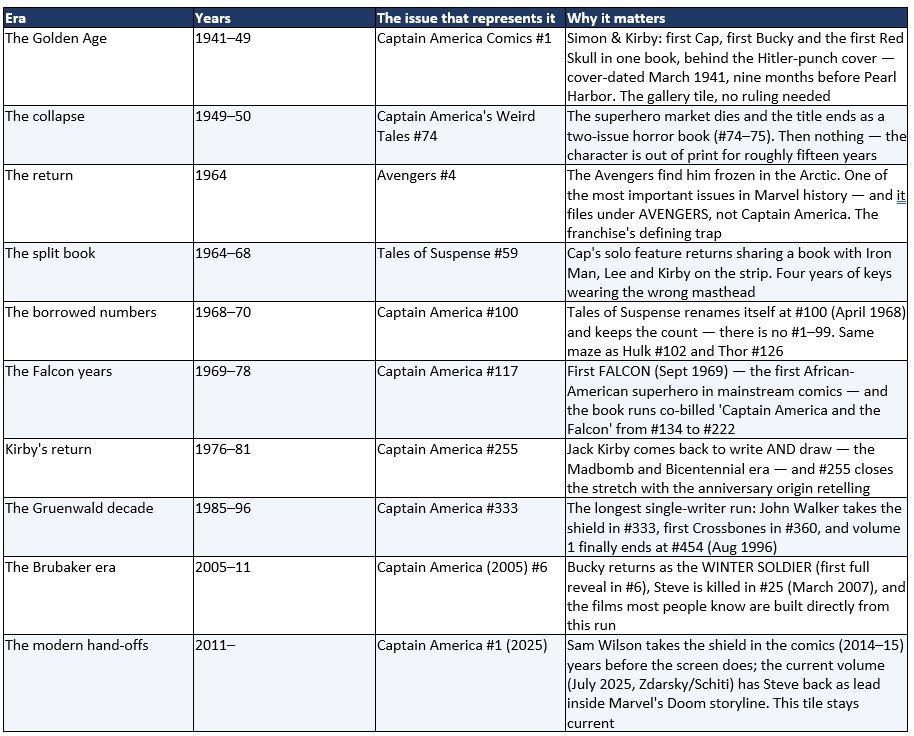
Here is what you actually need to know before buying or selling anything on this page. Captain America's history has a hole in the middle of it. The original Captain America Comics ran from 1941 to 1949, briefly became a horror book called CAPTAIN AMERICA'S WEIRD TALES for its final two issues (#74–75, 1949–50), and then stopped — the character simply did not exist in print for about fifteen years. When Marvel brought him back, his return did not happen in a Captain America comic: the Avengers find him frozen in the Arctic in AVENGERS #4 (March 1964), which means the single most important Silver Age Cap issue files under another team's title, and sellers sorting a collection by character miss it constantly. It gets better. His new solo feature then ran inside TALES OF SUSPENSE, a split book he shared with Iron Man, from #59 to #99 — so four years of Cap keys carry a masthead that never says Captain America. And when he finally got the book to himself in April 1968, Marvel simply renamed Tales of Suspense and kept counting: the first issue of Captain America is numbered #100. There is no Captain America #1 through #99 in that run at all. If that trick sounds familiar, it is exactly what happened to the Hulk (Tales to Astonish became Incredible Hulk at #102) and Thor (Journey into Mystery became Thor at #126) — same era, same publisher, same maze. One more wrinkle for the wall: the book was co-billed CAPTAIN AMERICA AND THE FALCON from #134 to #222 (1971–78), so even the masthead of his own comic changes mid-run. We sort all of this at the counter every week — the payoff for knowing it is finding a four-figure Avengers issue in a box someone priced as team filler.
The Run, Era by Era
Eighty-five years, organized. Every era of Captain America, the one issue that represents it, and why collectors care:
The Keys — Issues Everyone Hunts
Captain America Comics #1 is the book, and it is grail territory: first Captain America, first Bucky and the first Red Skull in a single 1941 issue, behind the most famous cover of the wartime era. It carries six figures in any presentable grade, low-grade copies are still serious money, and it is broker-and-authenticate material, never a counter quote — a detail worth knowing is that the Red Skull in #1 is the George Maxon version, a distinction slab labels and purists care about. The whole Golden Age run (#2–75) prices individually; never treat 1940s Cap as a lot. Then comes the trap: AVENGERS #4 (March 1964), his Silver Age return, a four-figure key that lives in another title's boxes — when a Cap collection comes through the door, we search the Avengers longboxes too, every time. TALES OF SUSPENSE #59 opens the split-book years and the same wrong-masthead problem. CAPTAIN AMERICA #117 (September 1969) is the modern era's cultural key — the first Falcon, the first African-American superhero in mainstream comics — and it is a proven mover every single time Sam Wilson appears on a screen. The modern tier is led by the Brubaker run: Captain America (2005) #6 with the first full Winter Soldier reveal is the best-performing modern key, #25 (the death of Steve Rogers, March 2007) was a genuine mainstream news event, and #333 (John Walker takes the shield) moves whenever that story reaches television. Under all of that sits the affordable engine — Bronze Kirby-era issues, Gruenwald keys, and the #100–200 stretch — the books that do the actual daily volume on the wall. One warning made of money: Captain America Comics #1 exists as an oversized 1970s reprint and as modern facsimile editions, and Avengers #4 has facsimiles too. Oversized always means reprint. We authenticate before any conversation about value, and we buy and price against live sold comps — ask and we will pull them up on screen together.
Every Format You Can Buy
Screen & Series Status
Updated August 2026: Captain America is a permanent fixture of Marvel's screen output, and the franchise's defining screen fact is that the shield has changed hands — Sam Wilson now carries it on film, while the current comic has Steve Rogers back as lead. Two Captains are live at once, which is a stocking instruction: stage the Falcon keys and the Steve-era trades together. The two most reliable demand patterns in the whole franchise are screen-driven and proven: every Sam Wilson appearance moves Captain America #117, and every Winter Soldier appearance moves the 2005 run, especially #6. An ensemble Avengers film is on the calendar ahead; as always, exact dates live in the Consolidated Ordering Calendar, not on this page. And unlike most franchises, when a customer asks 'which comic is the movie actually from?' this page has a real answer — the Brubaker trades, face-out, every screen window.
Collector's Corner — Grading, Care & We Buy
Four habits govern this franchise at our counter. The first is the AVENGERS #4 CHECK: when a Captain America collection arrives, we search the Avengers boxes too, because his most valuable Silver Age key is not in his own title and sellers sorting by character never find it — that habit alone has paid for itself many times over. The second is the TALES OF SUSPENSE check, the same discipline as the Hulk's Tales to Astonish era: file and search both names together or the 1964–68 keys vanish into a split-book run nobody thinks to open. The third is the Golden Age rule: 1940s newsprint is brittle, most surviving copies are low grade, and that is fine — low-grade Golden Age Cap still carries serious money. We authenticate first (the Timely logo is the fast tell, the indicia is the proof, and oversized always means 1970s reprint), grade honestly, and broker the real ones properly rather than shelf-pricing them. The fourth is the 90s reality: post-1996 material arrived in bulk and most of it is bin stock — we buy the listed keys and pass kindly on the rest. Beyond those: we assess keys against live sold comps on screen, broker CGC submissions for slab-worthy books, stock the bags, boards and boxes that keep a collection healthy — and if you are selling, bring the whole run in, Avengers issues included. Every collection has a Cap; the question is whether it also has Avengers #4 sitting three boxes over.
FAQ - Straight Answers
Is Captain America Comics #1 really worth six figures — and how do I know if mine is real?
Yes — and the second half of the question is the important half. Captain America Comics #1, cover-dated March 1941, is the first appearance of Captain America, Bucky and the Red Skull, behind one of the most famous covers ever printed, and genuine copies carry six figures in any presentable grade — the record sale is in the millions, and even well-worn copies are serious money. But the copy in most collections is not a 1941 original. The book exists as an oversized 1970s reprint and as modern facsimile editions — legitimate, clearly-labelled publications that are wonderful to own and worth pocket money, not houses. The tells: oversized format always means reprint, the indicia inside states what a facsimile is, and a 1941 original carries the Timely logo on brittle wartime newsprint. If you believe you have a real one, do not clean it, do not tape it, do not ship it anywhere — bring it in, we will authenticate it together, and if it is genuine we will talk about grading and brokering it properly. And if it is the facsimile, you still own the best-looking reprint in comics.
Why is there no Captain America #1 before #100 — and where is his Silver Age comeback?
Because his 1968 comic inherited another book's numbers, and his comeback happened in someone else's title. When the original 1940s series died (its last two issues retitled Captain America's Weird Tales), the character vanished for about fifteen years. Marvel revived him in AVENGERS #4, March 1964 — the Avengers find him frozen in the Arctic — so his single most important Silver Age issue is an Avengers comic, not a Captain America comic. His new solo stories then ran inside TALES OF SUSPENSE, sharing the book with Iron Man, from #59 to #99. In April 1968 Marvel gave him the book to himself by simply renaming it: Tales of Suspense #99 is followed by Captain America #100, numbering intact. So the run has no issues #1 through #99 — the first #1 actually titled Captain America didn't arrive until decades later, and there have been seven-plus relaunched volumes since. It is the same renaming trick Marvel pulled with the Hulk (Tales to Astonish #102) and Thor (Journey into Mystery #126) — one era, three franchises, identical maze. Bring in whatever you have and we will place it in the right run in about ten seconds.
Where should I start reading Captain America?
It depends on which Cap brought you here. If it was the films, start with the Brubaker run — Winter Soldier and The Death of Captain America — because the movies most people know were built directly from those pages; they read like the films feel, and they are the rare case where 'the comic the movie is from' is a real, specific answer. If you want to read him right now, the current volume by Chip Zdarsky and Valerio Schiti has Steve Rogers back as lead inside Marvel's Doom storyline — ask and we will pull this week's issue. If you want the classic, the Kirby-era collections give you the original creator returning to write and draw the character at full 1970s volume. If it is for a kid, Cap is one of the easiest superheroes in the store to hand a child — the all-ages Marvel wall covers him without the main line's weight. And if you are curious about the character's actual beginning, the Captain America Comics #1 facsimile puts the Hitler-punch issue in your hands for pocket money. Come in, tell us which of those sounds right, and we will put the book in your hands in about thirty seconds.