
HIS MOST IMPORTANT RUN IS IN SOMEBODY ELSE'S COMIC.
Green Arrow — 1941 to now, the books that actually matter, and where to start · Comic King
Green Arrow — The Complete Comic King Guide
Green Arrow started in 1941 as, frankly, Batman with a bow — a rich man with a costume, a teenage sidekick and a themed car. He should have been forgotten with the hundreds of other Golden Age imitations. Instead he became the angriest political voice in mainstream American comics, and the run that did it is one of the most important things DC ever published. The catch, for anyone collecting him, is that almost none of this happened in a comic with his name on it. His debut is in an anthology he shares with two other characters. His first cover is a team book. The run that made him matter is a Green Lantern title. The redesign that gave him the face you recognise is in Brave and the Bold. And right now, in 2026, he is a supporting character in Batman's comic. Eighty-five years, and he is still mostly somewhere else.
Quick Facts
Story: Oliver Queen — a wealthy man with no powers, a bow, and, since 1970, a great deal to say about politics. The character DC uses when it wants an argument on the page.
Length: Since November 1941 — but he did not headline a comic of his own until 1983, forty-two years later.
Status: Currently published, though not in a solo ongoing — see Screen & Series Status for where he actually is right now, because it moved recently.
Publisher: DC Comics
Age guide: ⚠ Split. Golden and Silver Age material is all-ages; the 1987 Grell era onward is adult in tone, and the current reimagining is horror. Two different characters share this name — ask us.
Formats: Graphic novels and collections · back issues · current series · omnibus and deluxe tier by special order.
At Comic King: The two runs that actually matter faced out together, the Bronze Age Green Lantern shelf checked for his material, and staff who will tell you which of his keys are underpriced.
Eighty-Five Years in Somebody Else's Comic
Most characters on this site have one or two keys filed under another title. Green Arrow has a whole career of it, and understanding that is the difference between finding his books and walking straight past them.
THE DEBUT IS A THREE-CHARACTER COMIC. More Fun Comics #73, on sale 19 September 1941, cover-dated November. Green Arrow debuts, SPEEDY debuts in the same issue, and so does AQUAMAN. Three lasting DC characters in one anthology, and not one of them is on the cover. It files under M. A Golden Age collection sorted by character hides it completely, which is why we search every More Fun run that comes through the door — that single comic pays three times over.
THE FIRST COVER IS A TEAM BOOK. Leading Comics #1, Winter 1941, is the debut of the Seven Soldiers of Victory — Green Arrow and Speedy alongside the Crimson Avenger, the Shining Knight, the Vigilante, and the Star-Spangled Kid and Stripesy. It is the first time Green Arrow appears on the front of any comic, and it is filed under L, for a title most people have never heard of. He gets his own starring cover a few months later, in More Fun Comics #77, when he and Speedy take over the cover feature — the issue before that, #76, is Doctor Fate's last cover, which is a useful marker if you are flipping through a run.
★ AND HERE IS THE COMPARISON WORTH KNOWING, because it makes the whole first-appearance-versus-first-cover problem click. Aquaman debuted in that same comic, More Fun #73, on the same day. Green Arrow was on a cover within about three months. Aquaman did not get a solo cover until 1961 — twenty years later. Same issue, same publisher, completely opposite careers.
THEN FOURTEEN YEARS INSIDE ADVENTURE COMICS, from #103 in 1946 to #269 in 1960, plus a long stretch in World's Finest. More anthologies, more filing under other titles.
THE REDESIGN IS IN BRAVE AND THE BOLD. In 1969, Neal Adams redrew him — the goatee, the hood, the whole silhouette every film and television version has used since. That happened in Brave and the Bold #85, a Batman team-up book, and it is one of the cheapest genuinely significant comics on this page.
THE RUN THAT MADE HIM MATTER IS A GREEN LANTERN COMIC. Green Lantern #76 through #89, from 1970 to 1972, by Denny O'Neil and Neal Adams. They put Green Arrow in a car with Green Lantern and drove across America arguing about racism and poverty, and the result changed what mainstream comics were allowed to be about. Then in issues #85 and #86 they gave Speedy a heroin addiction, and the Mayor of New York wrote to congratulate them. Anyone building a serious Green Arrow collection needs a Bronze Age Green Lantern run, and most people selling us a Green Lantern run have no idea what is in it.
HE DID NOT GET HIS OWN COMIC UNTIL 1983 — forty-two years after his debut, and even then only four issues.
AND IT IS STILL HAPPENING. His most recent ongoing series was cancelled, and since early 2026 he has been living in Gotham City as a supporting character in Detective Comics. The pattern is not a historical quirk. It is the shape of this character's entire publishing life, and it is the single most useful thing to know before you buy or sell him.
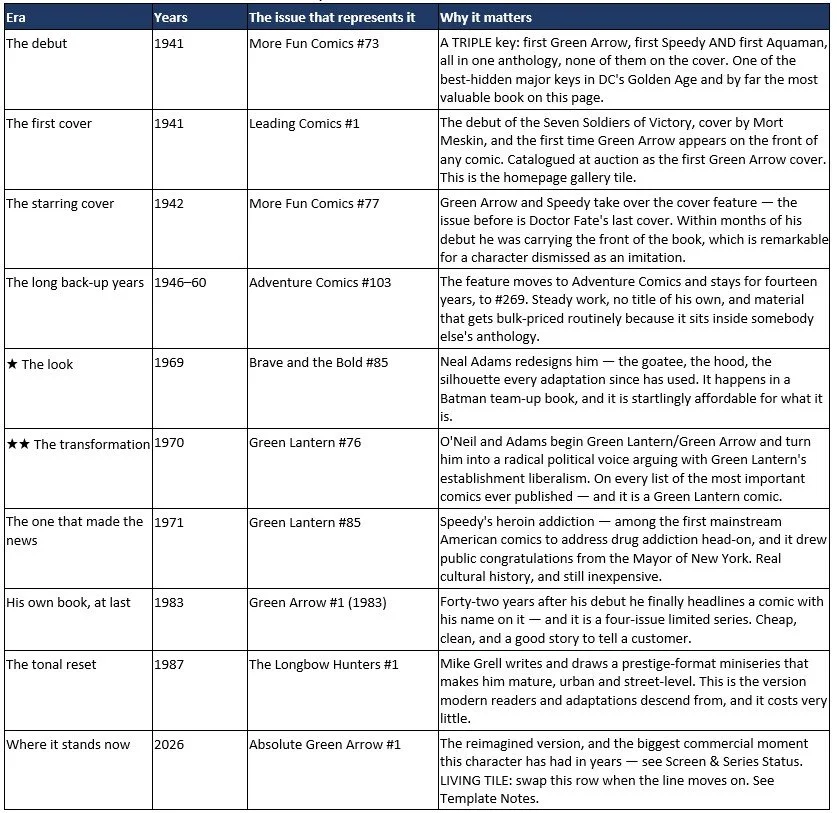
The Run, Era by Era
Eighty-five years, organised. Every era, the one issue that represents it, and why collectors care. Count how many of these are comics named after somebody else:
The Keys — Issues Everyone Hunts
MORE FUN COMICS #73 is the heavyweight, and it is brokered rather than sold off a shelf. First Green Arrow, first Speedy, first Aquaman, November 1941. Raw copies run into four figures and graded copies climb steeply from there — but the number that governs how we handle it is the frequency: it trades roughly twice a YEAR across the entire market. There is no such thing as a quick ballpark on a book that sells twice a year. It gets authenticated, graded and brokered, and anyone quoting you a confident figure across a counter is guessing.
★ BRAVE AND THE BOLD #85 IS THE BUY ON THIS PAGE, and we do not think that is a close call. August 1969, Neal Adams cover and interiors, and the first appearance of the Green Arrow costume — the goatee, the hood, the look that every screen version has copied since. It sits in the high twenties raw and it trades about once a week, which is the combination we are always hunting for: genuinely significant, genuinely affordable, genuinely liquid. It is also worth noticing that Adams designed the look eight months BEFORE the famous run started, so this book is the visual origin of the modern character and it is priced like a common Bronze Age team-up. Most people have no idea it exists.
GREEN LANTERN #76 IS THE HISTORICALLY IMPORTANT ONE, and it is not filed under Green Arrow. April 1970, the start of the O'Neil and Adams run. It sits comfortably in the mid-hundreds raw, trades about weekly, and has been drifting upward. If someone tells you they collect Green Arrow and they do not own this, they have a gap.
GREEN LANTERN #85 AND #86 ARE THE SLEEPERS AND WE SAY SO OPENLY. The Speedy addiction issues, from 1971. Number 85 costs well under half of what #76 does and it trades about twice a week, which makes it the most liquid book on this entire page. For a comic that is genuinely part of American cultural history — an anti-drug story a sitting mayor publicly praised — that is cheap. We think these are the most underpriced books we handle relative to their significance, and we would rather tell you that than quietly buy them.
THE LONGBOW HUNTERS #1 IS THE CHEAPEST WAY IN, and right now it is also the smartest. Grell's 1987 prestige miniseries costs about the price of a coffee raw and trades weekly. Read the Screen & Series Status section below before you skip past it — there is a specific and current reason this book matters more than its price suggests.
GREEN ARROW #1 FROM 1983 is a clean, cheap first-solo-series key that has been quietly rising, and it comes with the best trivia on the page: it took him forty-two years to get here. LEADING COMICS #1 is his first cover and a scarce Golden Age book — but be realistic about it, because it trades roughly once a year and costs four figures. It is a collector's purchase, not a flip.
REPRINT WARNING AND ONE PRICING NOTE. More Fun Comics #73 exists in oversized reprint and facsimile form; oversized is always a reprint, and a facsimile declares itself in the indicia. Check the indicia and the cover price, never a photo. And on the Golden Age books generally, published average prices are built from very few sales, so treat any guide number on More Fun #73 or Leading Comics #1 as a starting point for a conversation rather than a valuation.
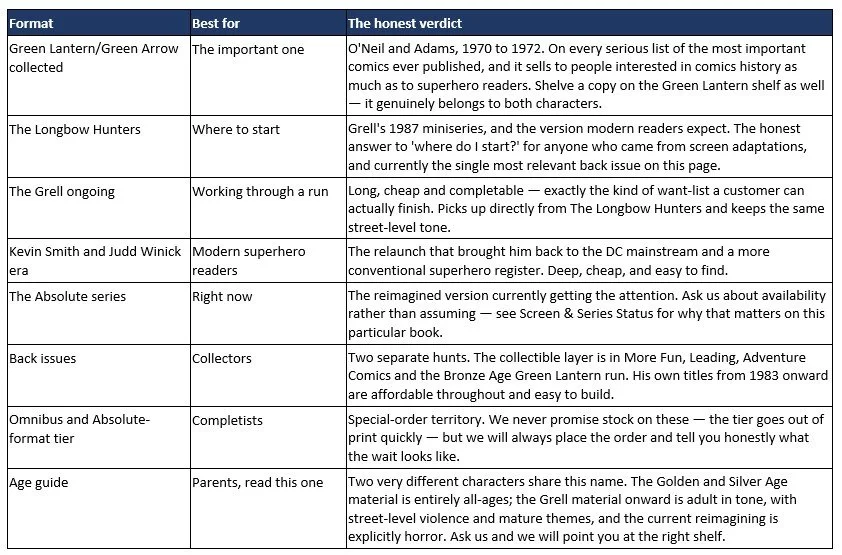
Every Format You Can Buy
Screen & Series Status
Updated August 2026: this is the most interesting moment this character has had in a decade, and it is a publishing story rather than a screen one.
ON THE PAGE, THREE THINGS HAVE CHANGED AT ONCE. His solo ongoing series was cancelled for low sales at the end of 2025. Since spring 2026 he has been living in Gotham City as a regular presence in Batman's own title, working alongside Black Canary — so he is being published, just not where anyone would look for him, which by now you will recognise as the theme of this entire page. And DC launched a reimagined version of the character in its premium line in May 2026, which SOLD OUT AT THE DISTRIBUTOR LEVEL A WEEK BEFORE IT REACHED SHOPS, went back for a second printing, and has since had its run extended. It is a horror story in which a killer hunts the billionaires responsible for Oliver Queen's death, with Dinah Lance investigating.
★ AND HERE IS THE PART WORTH ACTING ON, because it is a genuinely useful piece of shop knowledge: THAT KILLER IS NAMED AFTER THE 1987 MIKE GRELL MINISERIES. The hottest Green Arrow book in years is a direct nod to The Longbow Hunters — a comic you can still buy raw for roughly the price of a coffee. When a new book borrows a title from an old one, the old one is the cheapest possible way to understand what the new one is doing, and it is usually still sitting in the bins when the new issue is sold out. Ask us and we will put both in your hands.
ON SCREEN: a long-running television series through the 2010s introduced Green Arrow to an audience far larger than his comics ever reached, and it drew on the Grell material rather than the Golden Age — which is why almost everyone who walks in asking about him wants the street-level version. DC's film universe is currently being rebuilt and his place in it is not settled. That is a calm window, and calm windows are when back-issue walls get built cheaply.
THE EVERGREEN PLAYBOOK: on this character, the historically important books and the commercially responsive books are not the same books, and both are underpriced relative to their significance. Ahead of ANY Green Arrow screen announcement, the Grell material and the Neal Adams redesign move first, because those are the versions adaptations actually use. Have them identified and in the case before the announcement, not after.
Collector's Corner — Grading, Care & We Buy
Three search habits and one pricing principle govern this character at our counter.
WE SEARCH MORE FUN, AND IT PAYS THREE TIMES. Issue #73 is the first Green Arrow, the first Speedy and the first Aquaman. One comic, three character firsts, filed under M, none on the cover. We check every More Fun run that comes through the door, and we also check the early 1942 issues for the cover appearances. If you are selling to us you do not need to know any of this — finding it is our job.
WE SEARCH BRONZE AGE GREEN LANTERN RUNS FOR HIM, ALWAYS. His most historically important material is Green Lantern #76 to #89, and the Speedy addiction issues are #85 and #86. Someone selling a Green Arrow collection will not have them; someone selling a Green Lantern run very often does not know what is in it. This is the same shape as searching an anthology title for a character who is not on the masthead, and it is the single most valuable habit on this page.
WE SEARCH ADVENTURE COMICS AND BRAVE AND THE BOLD. Fourteen years of his run sits inside Adventure Comics between 1946 and 1960, and the costume redesign that defines the modern character is in Brave and the Bold #85. Both titles get treated as generic old comics by people sorting by character.
AND THE PRICING PRINCIPLE, which on this character is mostly about telling people what they have. Green Arrow's significant books are consistently cheaper than their importance warrants — the Speedy addiction issues especially, and the Neal Adams redesign. That means two things at our counter. When you are buying, we will point you at the underpriced ones rather than the expensive ones, because that is better advice. And when you are selling, we will tell you that the unremarkable-looking Brave and the Bold in your box is the one we actually want, rather than letting it go through at bin price. Comps before every quote above the bin tier: More Fun #73 and Leading Comics #1 get authenticated and brokered; Green Lantern #76, #85 and #86 get pulled and comped; Brave and the Bold #85 gets pulled; 1983 onward is keys-pulled and the rest is honestly priced.
Grading is a service, not a sales pitch. Storing them: bag and board, boards behind the comic, upright in a proper box, off concrete floors and away from exterior walls — Edmonton basements swing hard on humidity between February and July, and that swing is what does the damage, not age. Selling: bring them in, or send a list first if it is a large collection, at https://www.comickingedmonton.com/sell-your-comics.
FAQ — Straight Answers
What is Green Arrow's first appearance, and why is it so expensive?
More Fun Comics #73, on sale 19 September 1941 and cover-dated November, created by Mort Weisinger and designed by George Papp. It is expensive because it is not just his first appearance — Speedy debuts in the same issue, and so does Aquaman. Three lasting DC characters in one Golden Age anthology, and none of them is on the cover, which is also why it hides so effectively from anyone sorting a collection by character. It is a serious Golden Age book that trades only a couple of times a year, so it is authenticated, graded and brokered rather than priced across a counter. If you think you have one, bring it in and we will handle it properly and slowly.
Where do I start with Green Arrow?
The Longbow Hunters, Mike Grell's 1987 miniseries, if you came from the television series — that is the version the show was built on, it is street-level and mature, and it costs almost nothing. Then the Grell ongoing that follows it. If you want the historically important one instead, that is Green Lantern/Green Arrow, by Denny O'Neil and Neal Adams from 1970 to 1972 — and note the title, because it is a Green Lantern comic, which is where a great deal of this character's best work lives. It is on every list of the most important comics ever published and it holds up. Both are collected and both are on the shelf or can be special-ordered.
Which Green Arrow back issues are actually underpriced?
We will name them, because we would rather be the shop that tells you. The Speedy drug-addiction issues, Green Lantern #85 and #86 from 1971, are the clearest case — among the first mainstream American comics to deal with addiction directly, praised publicly by the Mayor of New York at the time, and they still cost a fraction of what comparable Bronze Age keys do while trading more often than anything else on this page. The other is Brave and the Bold #85 from 1969, which is where Neal Adams designed the goatee-and-hood look that every film and television version has used since. It is a Batman team-up book, so nobody files it under Green Arrow, and it sells for a fraction of what the more famous issues do. If you want one recommendation from this page, it is that one.