
How To Tell A First Printing
Almost every week somebody brings us a comic they believe is a first printing, and quite often it is not. That is not because they have done anything wrong. It is because the advice most people have been given is either harder than it needs to be, or has quietly stopped working.
There is a faster test, and it is on the front cover where anybody can see it. LOOK AT THE PRINTED PRICE. Publishers reprint famous comics constantly, and almost every reprint carries a different cover price from the original — usually because it was printed years later, at a different price point, for a different purpose. The artwork gets reproduced faithfully. The price almost never does.
This page explains the method, then walks through four books people get wrong all the time. Bring yours in and we will do it with you in front of you, whether or not you are selling — there is no charge for an opinion and we would rather you knew.
The Method, in Order
Four steps, and most comics are settled at step one. Work down the list only as far as you need to.
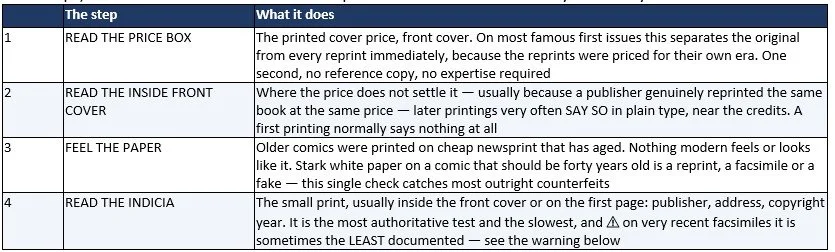
★ AND ONE THING THAT USED TO WORK AND NO LONGER DOES: checking the advertisements. For years the standard trick on older reprints was that the ads were swapped out or removed, so original ads meant an original comic. TWO SEPARATE PUBLISHERS RELEASED FACSIMILES IN 2026 THAT DELIBERATELY REPRODUCE THE ORIGINAL ADVERTISEMENTS, because collectors asked for them. On those books the interior proves nothing at all. If a guide tells you to check the ads, it was written before this year.
Four Books People Get Wrong
These are the four we handle most often, and each one teaches a different version of the same lesson. All four have their own page on this site with the full detail.
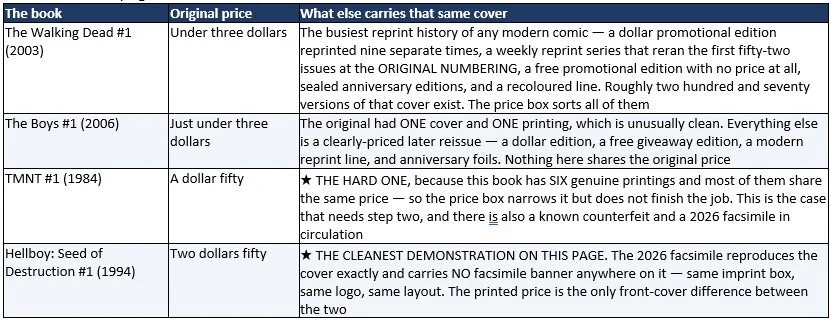
★ THE TMNT CASE IS WORTH DWELLING ON because it is the one where step one is not enough. Six printings, most at the same price, so you go to step two — and the second and third printings helpfully say which they are, in plain type, on the inside front cover. A first printing says nothing. That is the whole difference between a book worth a great deal and a book worth an ordinary amount, and it is printed in a place most people never look.
The Newest Problem: Facsimiles With No Banner
A facsimile edition is a modern reprint made to look like the original on purpose — same cover art, same trade dress, sometimes the same page dimensions and the same interior advertisements. They are legitimate products, they are not fakes, and they are a lovely way to own a famous comic without paying for the famous comic. They are also, for the first time, genuinely hard to distinguish at a glance.
★ THE THING THAT CHANGED IN 2026: at least two major facsimiles arrived carrying NO banner, no corner flash and no altered logo — nothing on the front cover announcing what they are. One of them was also restored to the original oversized dimensions, and one deliberately reprints the original inside-back-cover advertisement, which was the tell that authentication guides had relied on for forty years. In a bag, on a shelf, from across a table, they look like the real thing.
This is not a reason to be nervous. The printed price still separates them instantly, and the paper gives them away the moment you handle both. But it does mean that ANY BUYING GUIDE WRITTEN BEFORE THIS YEAR IS NOW INCOMPLETE, and that a seller telling you a book 'has all the original ads' is no longer telling you anything.
⚠ And Some of What You Will Read Online Is Simply Made Up
We want to be careful about how we say this, because most people repeating these things are passing on what they were told in good faith. But in researching the four books above we found TWO confident, widely repeated, completely unsupported claims — and both of them would have cost somebody money.
The first was an article explaining, in detail, how to tell apart four different printings of a famous first issue — logo colours, paper stock, the lot. That comic has ONE printing. The other three do not exist and never did. The page appears to have been generated rather than researched, and it is confident, specific and completely wrong.
The second was a print-run figure attached to a scarce convention comic, quoted everywhere including in places we would normally trust. It fails simple arithmetic: the grading companies have certified several hundred copies of that book between them, and a comic with the print run being claimed would have close to half its entire run sitting in plastic cases. We do not know the real number. Nobody seems to. Saying so is more useful than repeating a figure.
★ SO HERE ARE THE TWO TESTS WE NOW APPLY TO ANY CLAIM, and you can apply them yourself in about a minute. FIRST: IF A PRINTING IS REAL, SOMEBODY IS SELLING IT. Look it up in a dealer's catalogue or a price guide and see whether the printing exists as a thing you can actually buy, with its own listing and its own price. An article describing a printing is not evidence; a dealer stocking it is. SECOND: CHECK A PRINT-RUN CLAIM AGAINST THE NUMBER OF GRADED COPIES. If a large fraction of a supposed print run has been professionally graded, the print-run figure is wrong. Real books do not get certified at those rates.
Detail and confidence are not evidence. A page that tells you exactly which shade of red to look for can still be describing a comic that was never printed.
Bring It In
None of this requires you to become an expert. It requires somebody to show you once, with two copies side by side, and then you have it for life. We keep reference copies behind the counter for exactly this reason — including a facsimile, because the cheapest way to learn the difference is to hold both.
So bring the comic in. We will look at it with you, we will tell you what it is, and we will tell you the same thing whether it makes the book more valuable or less. That is not generosity, it is just the only version of this job that works — and it is why people come back with the next one.
FAQ — Straight Answers
What is the single fastest way to check a first printing?
The price printed on the front cover. Most famous first issues have been reprinted at a different price point, so the original price is usually unique to the original. It takes a second, it needs no reference copy, and it settles the majority of cases before you open the comic.
Does a comic with no printing number on it mean it is a first printing?
Usually, but only if you also know that the publisher DID label its later printings — and on the most valuable examples that line can be chemically removed to fake a first. So treat a missing printing line as supporting evidence rather than proof, and confirm with the price, the paper and the indicia.
Are facsimile editions fakes?
No. They are official reprints published deliberately to look like the original, usually to mark an anniversary, and they are sold openly at a normal cover price. They are a genuinely good way to own a famous comic you could not otherwise afford. The only problem is that some recent ones carry nothing on the cover to say what they are, so a copy can end up misdescribed by somebody who is not trying to mislead anyone.
Should I get my comic graded to find out?
Not for identification, no. Grading is expensive, it takes months, and it answers a different question — condition, not printing. Come in and we will identify it for free. Once you know what it is, we can have an honest conversation about whether grading is worth it, and for most comics the answer is that it is not.