
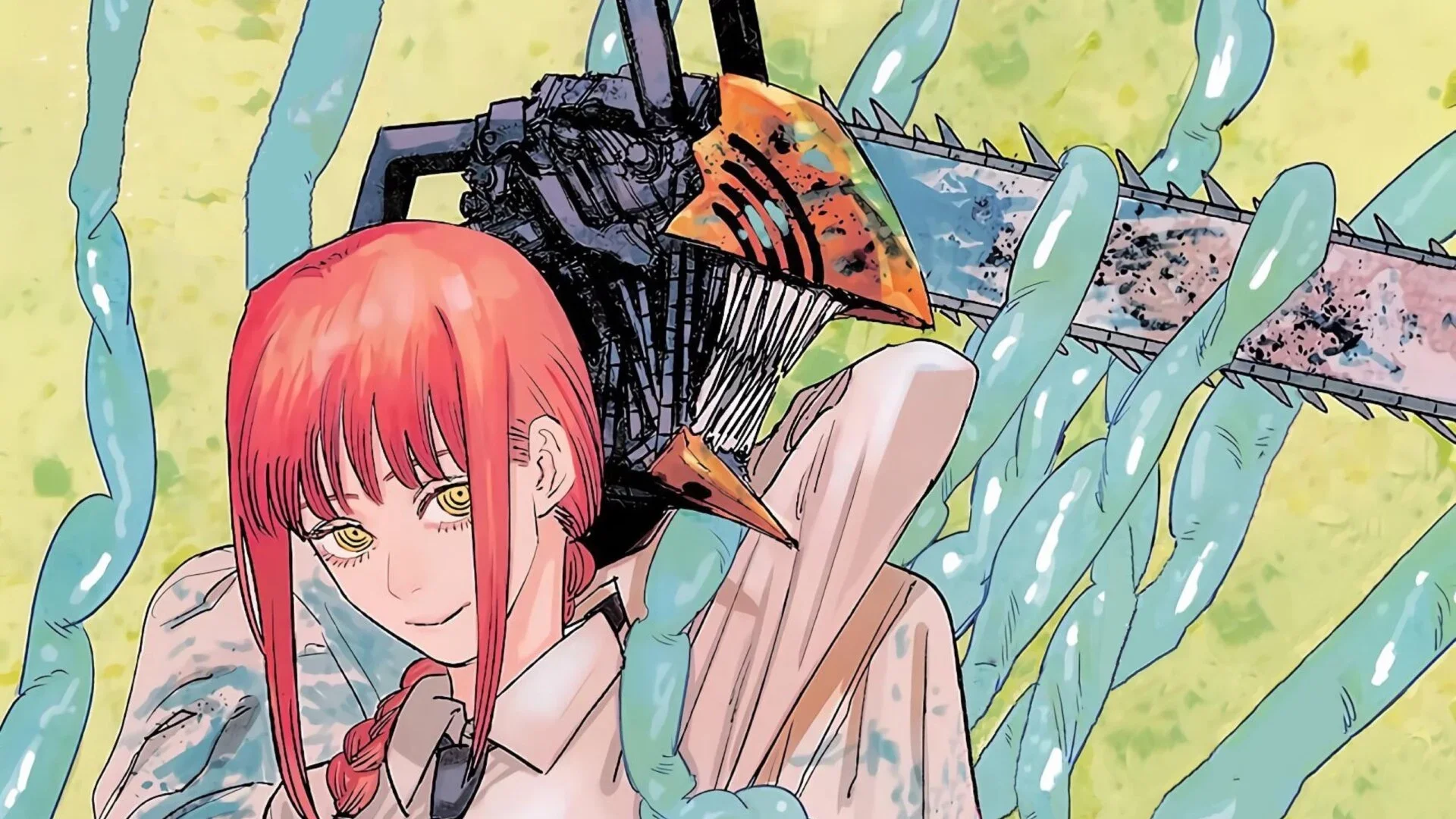
CHAINSAW MAN
Part 1, Part 2, the box set & the Fujimoto shelf · Comic King, Edmonton
Chainsaw Man - The Complete Comic King Guide
Chainsaw Man is the manga that rewired what a Shonen Jump series could be — Tatsuki Fujimoto's blood-soaked, big-hearted story of Denji, a broke teenager who merges with his chainsaw devil and discovers that the scariest thing in his world is wanting an ordinary life. It is the fastest-growing title on our wall, and this page is the whole picture: how the two Parts fit together, where to start after the anime, which formats exist, and what else belongs beside it. Comic King carries the run — and if a volume is not on the shelf, we can special-order manga on request.
Quick Facts
Creator: Tatsuki Fujimoto — the most distinctive voice in modern manga.
Publisher (English): VIZ Media (Shonen Jump).
Structure: PART 1: the Public Safety saga, volumes 1–11 — complete. PART 2: the Academy saga, volume 12 onward — ongoing.
Where to start: Volume 1. Full stop. (Watched the anime? See below — you have more read than you think).
Box set: The Part 1 box set collects volumes 1–11 complete — the gift answer.
Age guidance: Older teen and up — graphic violence with real emotional weight; not a kids' title.
The Two Parts, Explained
Part 1 (volumes 1–11) is a complete story — beginning, middle, and one of the most talked-about endings in modern manga. Denji joins Public Safety's devil hunters, meets Makima, Aki and Power, and the series systematically breaks every rule about what happens to a Jump protagonist. If you only ever read eleven volumes of manga, these eleven work as a finished masterpiece.
Part 2 (volume 12 onward) changes the lens: a new viewpoint character, the Academy saga, and Denji seen from the outside. It is the same world, running today, with new volumes arriving on a steady rhythm — ask at the counter for the newest one, because the answer changes through the year. You do not need Part 2 to feel finished; you will want it anyway.
The Run, Arc by Arc
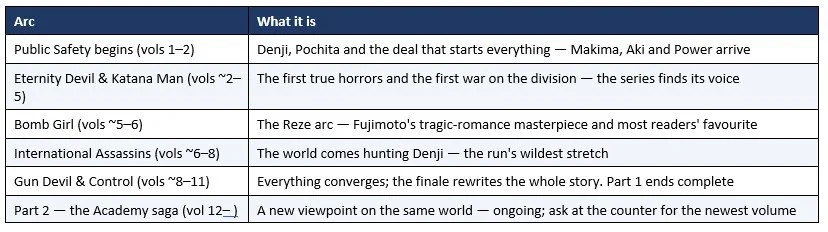
Ranges are approximate — arcs bleed into each other by design. The reading order is simply volume order, 1 onward.
Watched the Anime? Here's Where You Pick Up
The screen adaptations cover early Part 1: the series adapts roughly the first four-and-a-bit volumes, and the film continues directly from there with the Bomb Girl arc across volumes five and six. So the practical answer: if you have seen everything on screen, start reading around volume 5 or 6 and you will hit new story almost immediately — or start at volume 1 anyway, because Fujimoto on the page is a different experience than any adaptation. Unsure exactly where you left off? Tell us the last scene you remember and we will place you on the right volume at the counter.
Formats & Editions
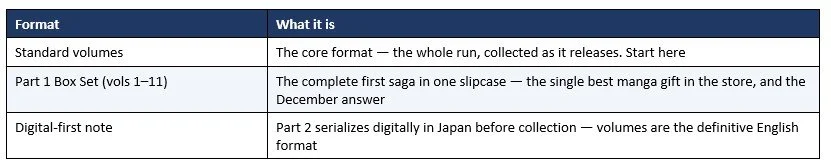
The honest trade-offs: Deluxe volumes are heavier on the wallet and the shelf, and the series' newest material reaches paperback first. But nobody who owns a Deluxe regrets it — the art is the argument. Both formats are special-orderable when the shelf is between copies.
The Fujimoto Shelf — What Sits Beside It
Here is what makes this franchise different at Comic King: the author is the brand. Nobody reads Chainsaw Man and stops there, so we shelve the Fujimoto adjacents together. Look Back — the one-volume masterpiece about art, friendship and grief that made grown adults cry in public; the single easiest handsell in the store. Goodbye, Eri — the follow-up one-shot, a film-obsessed story that reads like a magic trick. Fire Punch — the earlier, harsher series for readers who want to see where the voice came from. And the Before Chainsaw Man short-story collections for completists. If Chainsaw Man is the gateway, this shelf is the destination — and every one of these is special-orderable if the shelf is between copies.
After Chainsaw Man — the Natural Next Reads
The two roads out: Jujutsu Kaisen for the reader who wants the same generation's other dark-shonen pillar — see our Jujutsu Kaisen page — and Berserk for the reader ready to go where Fujimoto's influences live; see our Berserk page. Both sit steps away on the wall.
The Collector Layer — the Honest Version
Manga is not comics: value lives in reading copies and complete runs, not speculation. Early printings of volume 1 carry a modest premium and the box set holds its value as a gift item, but nobody should buy Chainsaw Man as an investment — buy it because it is one of the best things on the wall. When a series is this popular, individual volumes DO sell out publisher-wide from time to time; that is when the want-list-and-special-order habit earns its keep.
Chainsaw Man on Screen — the Standing Pattern
Every screen event — a new season, a new film — sends a wave of readers to exactly two places: volume 1, and the volume where the adaptation stopped. That pattern repeats every cycle, and it is why we keep the early volumes deep and the continuation point flagged. Whenever new Chainsaw Man is announced for screens, the right move is simple: leave your want list or grab your starting volume before the wave, not after it.
FAQ - Straight Answers
What is Part 1 and Part 2 of Chainsaw Man?
Part 1 — the Public Safety saga — is volumes 1 through 11, and it is a complete story with a real ending. Part 2 — the Academy saga — begins at volume 12, follows a new viewpoint character in the same world, and is still ongoing. New readers start at volume 1; Part 1's eleven volumes stand alone as a finished work.
Is Chainsaw Man okay for kids?
No — it is best for older teens and up. The series carries graphic violence, gore and mature themes alongside its humour and heart. For younger readers looking for a devil-hunting adventure, ask us at the counter — the manga wall has age-appropriate alternatives for every reader, and matching them is what we are here for.
I watched the anime — which volume do I start reading at?
The screen adaptations cover early Part 1: the series runs through roughly the first four-and-a-bit volumes, and the film continues with the Bomb Girl arc across volumes five and six. Starting at volume 5 or 6 puts you at new story almost immediately. Tell us the last scene you remember and we will place you on the exact volume.